

US warns of ‘large-scale massacre’ in Sudan city/node/2501661/middle-east
US warns of ‘large-scale massacre’ in Sudan city
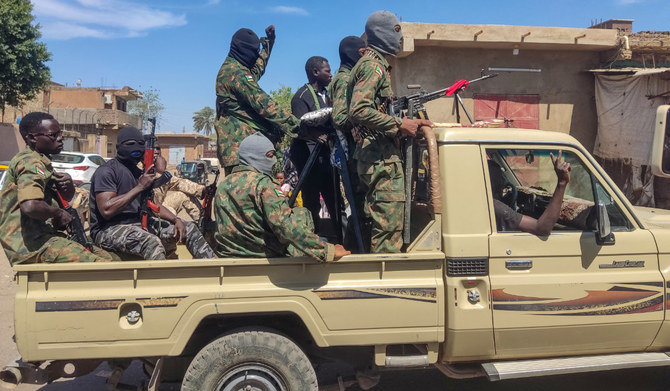
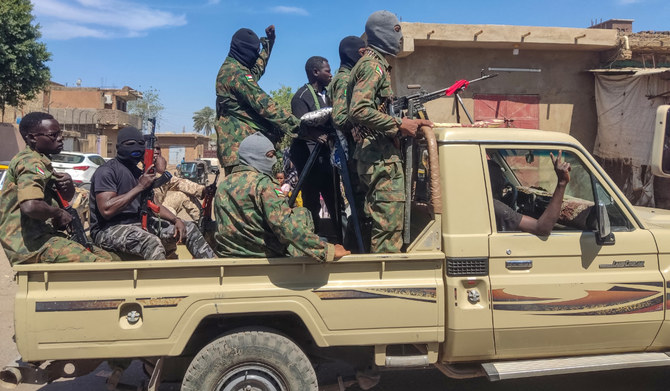
Supporters of the Sudanese armed popular resistance, which backs Sudan's army, ride on trucks in Gedaref in eastern Sudan on March 3, 2024, amid the ongoing conflict in the country between the army and paramilitaries. (AFP)
Millions have been displaced in the country since fighting began last year between the SAF forces of General Abdel Fattah Al-Burhan and RSF paramilitaries under General Mohamed Hamdan Dagalo
Updated 30 April 2024
AFP
UNITED NATIONS, United States: The US ambassador to the United Nations on Monday warned of an impending “large-scale massacre” in the Sudanese city of El-Fasher, a humanitarian hub in the Darfur region.
The city had until recently been relatively unaffected by fighting between the Sudanese Armed Forces (SAF) and the Rapid Support Forces (RSF), but bombardment and clashes have been reported both there and in surrounding villages since mid-April.
El-Fasher “is on the precipice of a large-scale massacre. This is not conjecture. This is the grim reality facing millions of people,” Linda Thomas-Greenfield told journalists following a UN Security Council meeting on Sudan.
“There are already credible reports that the RSF and its allied militias have razed multiple villages west of El-Fasher, and as we speak, the RSF is planning an imminent attack on El-Fasher,” which “would be a disaster on top of a disaster,” Thomas-Greenfield said.
Millions have been displaced in the country since fighting began last year between the SAF forces of General Abdel Fattah Al-Burhan and RSF paramilitaries under General Mohamed Hamdan Dagalo.
El-Fasher functions as the main humanitarian hub in the vast western region of Darfur, home to around a quarter of Sudan’s 48 million people.
VIENNA/WASHINGTON: Commercial satellite imagery has captured what appears to be the first known strikes on an Iranian nuclear site since the start of the US-Israeli air operation, an independent policy institute said on Monday.
The Institute for Science and International Security said imagery produced by Colorado-based Vantor showed two strikes on access points to the underground uranium enrichment plant at Natanz, which was hit by the US last June.
David Albright, a former UN nuclear inspector and founder of the institute, said the strikes appeared to have occurred sometime between Sunday afternoon and Monday morning local time, based on the satellite imagery his group reviewed.
He was unable to identify whether the US or Israel hit the Natanz complex, one of the main facilities of Iran's nuclear program.
He credited Ben Tzion Macales, an Israeli geo-analyst, as being the first to find satellite imagery of the Natanz strikes.
The and Israel launched their air war against Iran early Saturday, triggering Iranian retaliatory strikes around the region.
Albright's findings appeared to corroborate an earlier statement by Reza Najafi, Iran's envoy to the International Atomic Energy Agency, that Natanz was hit on Sunday. Najafi was disputing a comment by IAEA chief Raphael Grossi, who said there was no sign that any nuclear site had been hit.
Albright said it was likely that Grossi had relied on imagery produced before the pictures obtained by his institute.
The IAEA did not immediately respond to a request for comment. The White House and Central Command also did not immediately respond.
(Reuters)
Iran's nuclear programme is among the reasons Israel and the US have given for the attacks, alleging Iran was getting too close to being able to eventually make a nuclear bomb. Iran has repeatedly denied seeking a nuclear arsenal.
Albright's report said Vantor's imagery showed that three buildings at Natanz had been destroyed. Two were personnel entrances to two underground halls housing thousands of centrifuges, machines that enrich uranium for use in power plants or weapons depending on the duration.
Even though the halls were rendered inoperable by the US attack in June, the strikes could indicate that the halls still contained "recoverable centrifuges" or other related equipment, the report said.
The third building destroyed covered the only vehicle access ramp to the underground halls, it said.
Grossi said in a statement to a meeting of the IAEA's 35-nation board of governors that the agency had no indication that "any of thenuclear installations ... have been damaged or hit."
Moments after Grossi's remarks, Najafi told reporters outside that Natanz had been attacked.
"Again they attacked Iran's peaceful, safeguarded nuclear facilities yesterday," Najafi said. Asked by Reuters which facilities were hit, he replied: "Natanz" and left.
IAEA has limited contact with Iran
While the IAEA's crisis-response centre has been unable to reach Iran's nuclear regulatory authorities, there has been some contact with Iranian officials, Grossi told a press conference.
"We are, of course, in conversation with Iran, but at the moment, it's very limited. Until last Thursday, it was very intense," he said, adding that while the IAEA has no staff in Iran at the moment, it is watching satellite images closely.
Tehran has not let the IAEA return to its bombed facilities since they were attacked in June.
Calls for dialogue to resume
Natanz housed facilities including two uranium-enrichment plants attacked in June - an above-ground one the IAEA says was destroyed and the underground facility containing the two centrifuge halls that were at least badly damaged at the time.
Asked about Najafi's remarks, Grossi stood firm at his later press conference, saying, "I will not get into a polemic on that. We stand by what I said before."
Grossi was in Geneva for the last two rounds of Oman-mediated talks between Iran and the United States, discussing nuclear specifics with both sides.
"An understanding eluded the parties this time. I am sure we are, quite understandably, feeling a strong sense of frustration," Grossi told the board.