

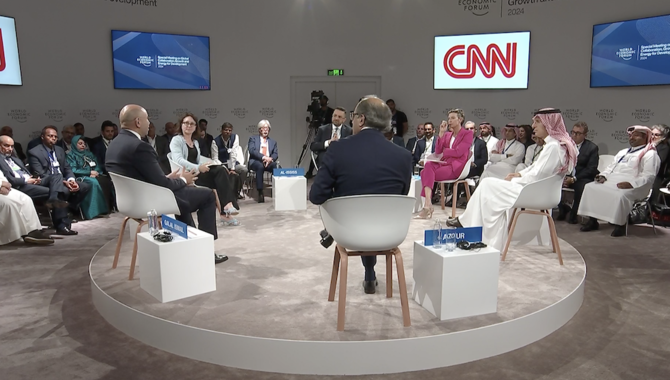

RIYADH: The key to getting the Middle East region back on track toward development and prosperity is ending the Gaza conflict, the Saudi minister of state for foreign affairs said on Sunday.
Adel Al-Jubeir, who was speaking at the World Economic Forum Special Meeting being held in Riyadh, said the Israel-Hamas conflict raging in the enclave only served to “undercut” any attempts to integrate the region and “unleash its potential.”
He added that, considering its young population, abundant natural resources and strategic geographical location, the Middle East had all the ingredients to be a successful region.
The goal of policymakers in Saudi Arabia and beyond was to ensure these elements benefitted everyone and better linked the Middle East region with the rest of the world, Al-Jubeir said.
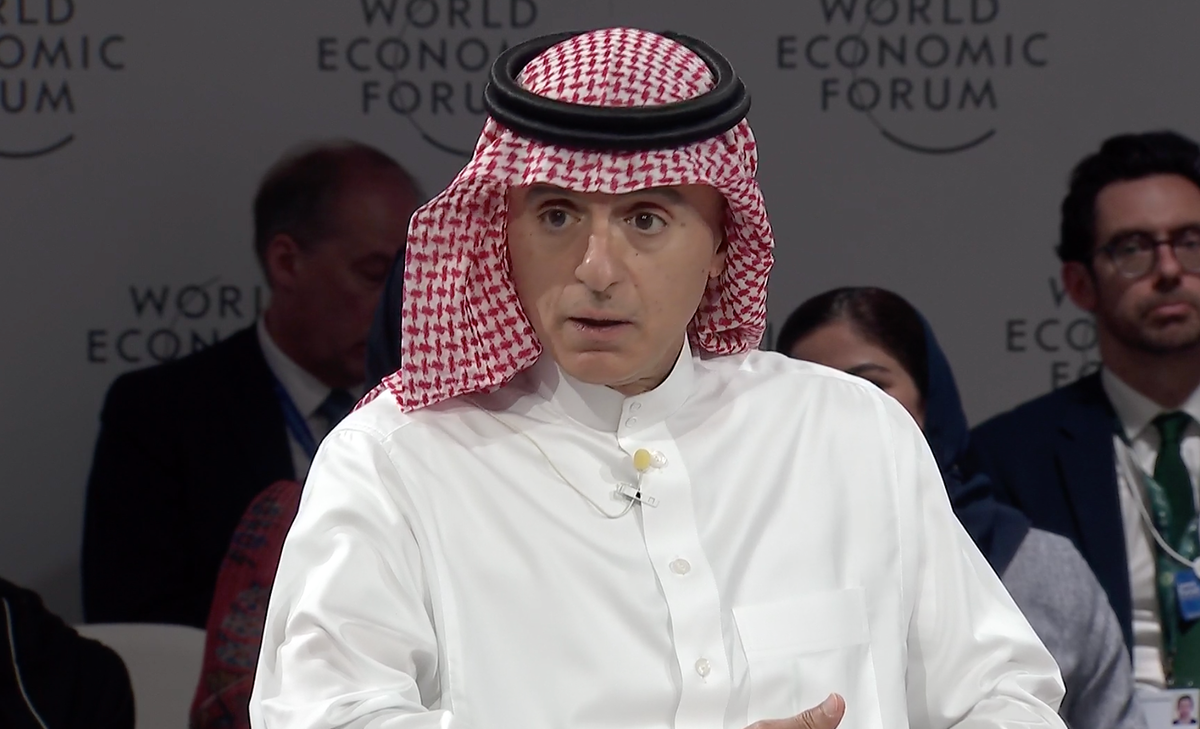
Adel Al-Jubeir was speaking at the World Economic Forum Special Meeting being held in Riyadh. (Screenshot/WEF)
However, he said that this vision was “complicated by tensions” affecting the Middle East, and it was important to put an end to these in order to “focus on the things that matter” to developing its prosperity.
“(With the situation in Gaza), our number one priority is to stop the fighting,” he said. “Our second priority is to ensure enough humanitarian assistance goes into the Gaza Strip so that we avoid starvation, disease, and we take care of the people there,” he added.
“In the long term, we need to find a way to end this conflict (for good), and the only way we end it is by having a two-state solution, so we need to chart a clear, time-bound irreversible path to a Palestinian state.
“Saudi Arabia has said in terms of normalization (with Israel), this would be a part of that. The Arab world has had a position with regard to the Arab Peace Initiative, the US and the rest of the world supports this, so we need to make sure we stop the fighting, increase assistance and come up with a pathway to that Palestinian state,” he added.
When pressed by the panel moderator, CNN’s Becky Anderson, on whether a two-state solution would be possible with Benjamin Netanyahu and his right-wing government in charge in Israel, Al-Jubeir said it was in “everyone’s interest” to end the conflict.
“I’m not a mind reader or a psychiatrist; it’s not what I was educated in or my profession,” he said. “But what I can tell you is the interests of everybody in the region requires putting an end to this conflict, the potential that can be unleashed is tremendous, with good will, seriousness and foresight we should be able to get the ball over the goal line,” he added.
Mohamad Al-Ississ, Jordanian finance minister, also said the region had lurched from crisis to crisis over several decades, and told the WEF panel: “The one certain thing anybody can be certain of is that uncertainty is here to stay.”
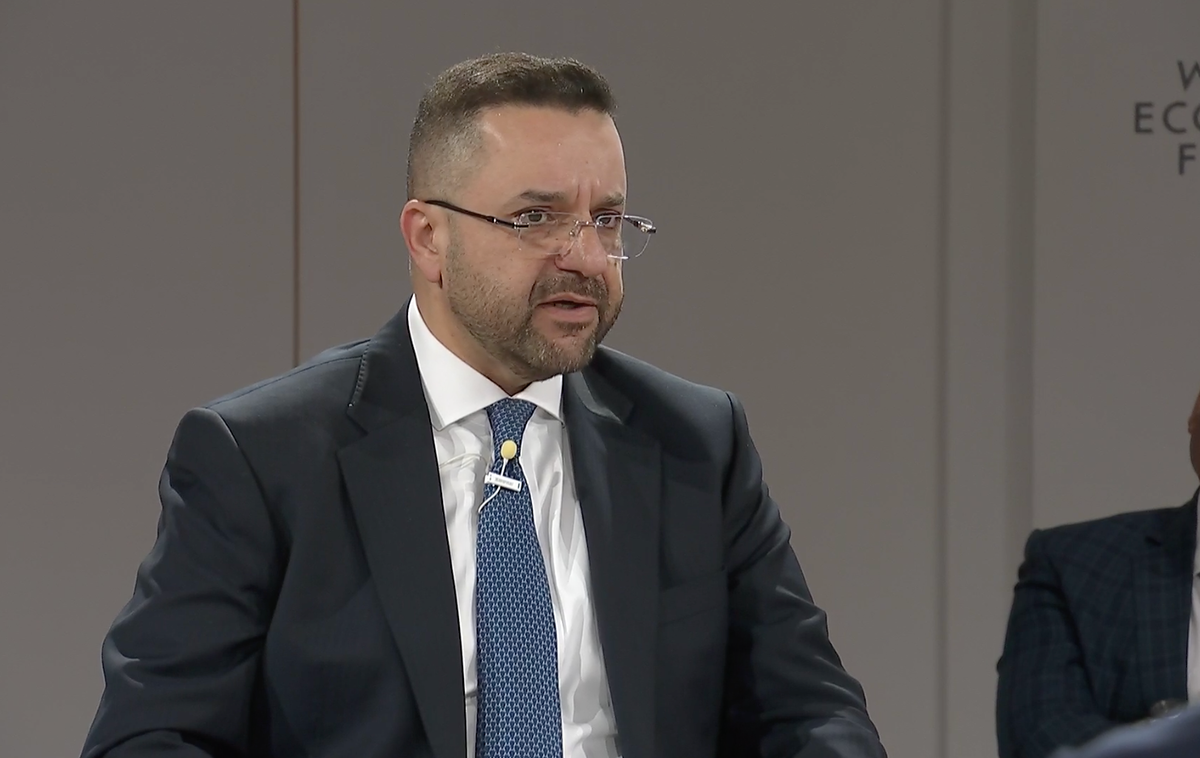
Mohamad Al-Ississ, Jordanian finance minister. (Screenshot/WEF)
He said the role of policymakers in the Middle East should be investing and developing sectors that allowed the region’s economies to absorb and ride out the shock and impact that crises can have.
“The top priority is (determining) how to invest in enhancing your buffers, so that you can increase your resilience for when ‘black swan’ events, which have become the norm, unfold,” he said.
Ahmed Galal Ismail, CEO of UAE’s Majid Al-Futtaim Holding, agreed. He said that while peace and stability were “obviously indispensable to economic growth,” if the region just waited for it to happen, it could be “waiting for a long time.”
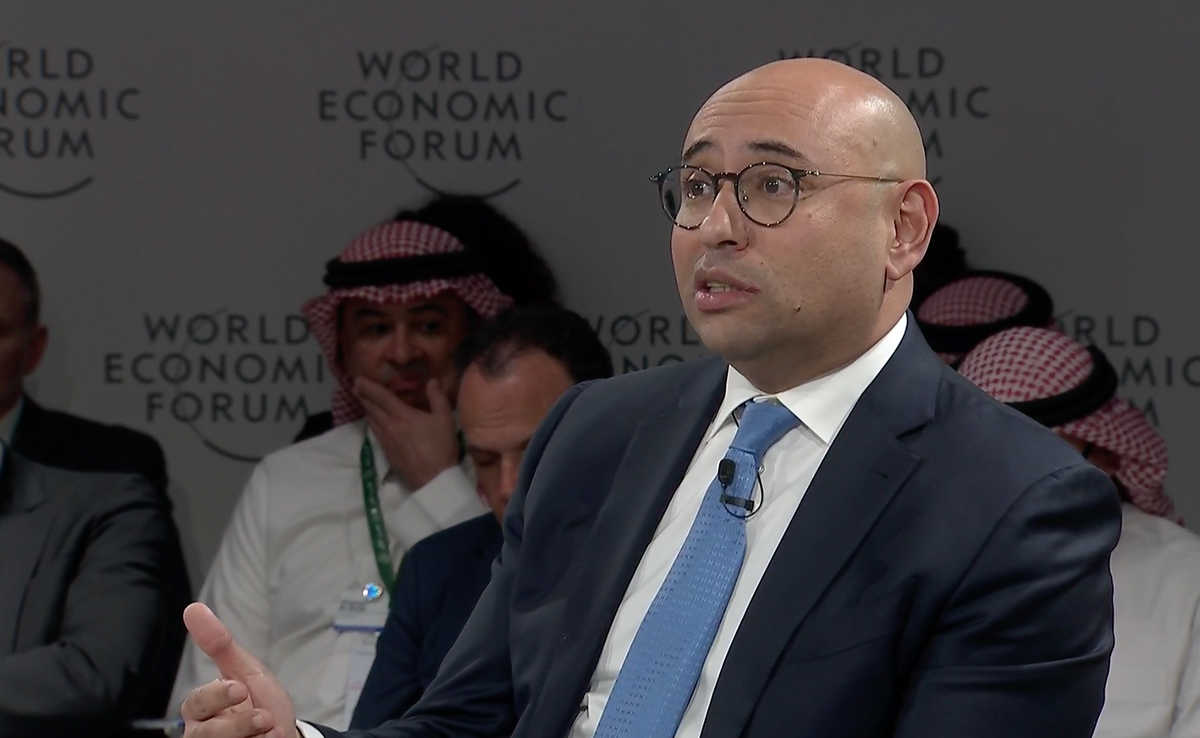
Ahmed Galal Ismail, CEO of UAE’s Majid Al-Futtaim Holding. (Screenshot/WEF)
He cited an example of intra-Arab trading being at its highest-ever level, but added it was “anaemic” compared with other global blocs.
“We need to act. From a private sector perspective, we see opportunities independent from geopolitics and from the cruelty we see in parts of the region, so it is very important the actors in the sector are pragmatic, take the lead, and start what is needed to drive that economic integration.”


