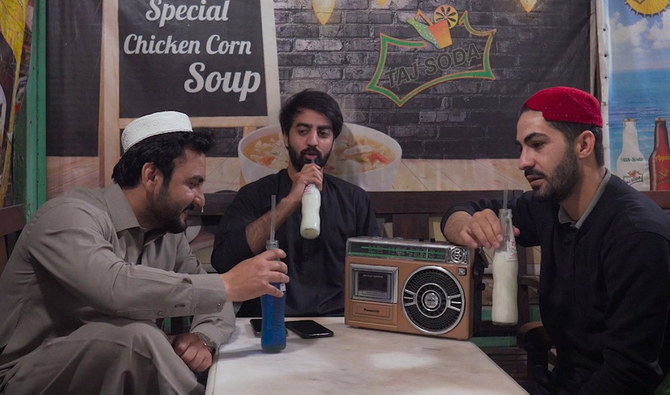
PESHAWAR: One is greeted by the sounds of glass bottles clinking and their brass lids pop-opening as they enter a nearly 90-year-old soft drink outlet, named ‘Taj Soda,’ in the historic Qissa Khwani bazaar in the northwestern Pakistani city of Peshawar.
The visitors are led through a three-feet-wide passage into a hall room, which boasts benches and tables for customers to sit and enjoy their favorite drinks, with its walls adorned with pictures that depict the city’s history through the ages.
Taj Soda, established by Taj Muhammad more than a decade before the partition of the Indian subcontinent, claims to be the “oldest” carbonated drink outlet in Pakistan, which few say provides an alternative to Peshawar’s famed ‘qahwa,’ or green tea, in summers.
“My grandfather’s name was Taj Muhammad, who established this business in 1936. After him, my father Mukhtar Hussain, may he rest in peace, he ran the business for his whole life for 76 years,” Waqas Hussain, Muhammad’s 33-year-old grandson who currently runs the establishment, told Arab News on Friday.
“Our work goes on in six months of summer.”
The outlet, which offers a range of flavors like raspberry, blueberry, pomegranate, apple, rose, banana, mango and mint, is mostly frequented by customers from April till September, though it offers the cherished soft drinks round the year, according to the owner.
A simple drink, made with carbonated water, sugar, sodium citrate and benzoate, is sold for Rs50, while those with the addition of milk cost Rs80.
“We start [selling] soup in winter and we do serve cold drinks, soda water, but it is not like this [as high in demand as in summers],” Hussain said.
Usman Khan, a 21-year-old resident of Peshawar who took a group of friends on a tour of the city, said he brought them to Taj Soda to introduce them to the historic establishment, which was said to be older than even 7 Up, an American brand of lemon lime-flavored, non-caffeinated soft drink.
“They all are my friends, they are from different places. One is from Balochistan and the other is from Kohistan [in Khyber Pakhtunkhwa]. I have brought all of them here,” Khan told Arab News.
“The reason is that it is an old building and was made in 1936. I heard that Taj Soda was established [even] before 7 Up, but this is our bad luck that ... Taj Soda is restricted only to this place. No one knows about it outside [the city].”
But for Hussain, Taj Soda means more than just profit. It is about keeping the legacy of his father and grandfather alive.
“We try not to spoil the name of [our] elders and make the best product, and people trust us,” he told Arab News, with a sense of pride.
“Wherever we go, people know us. We feel happy about it.”


![]()

In Pakistan’s Peshawar, famed ‘Taj Soda’ has been cooling summers for nearly 90 years
Short Url
https://arab.news/9f9j7
In Pakistan’s Peshawar, famed ‘Taj Soda’ has been cooling summers for nearly 90 years
- Taj Soda in Peshawar’s historic Qissa Khwani bazaar offers raspberry, blueberry, mint and several other seasonal flavors
- For some, the establishment, set up in 1936, provides an alternative to the city’s famed ‘qahwa,’ or green tea, in summers
Latest updates


© 2026 SAUDI RESEARCH & PUBLISHING COMPANY, All Rights Reserved And subject to Terms of Use Agreement.