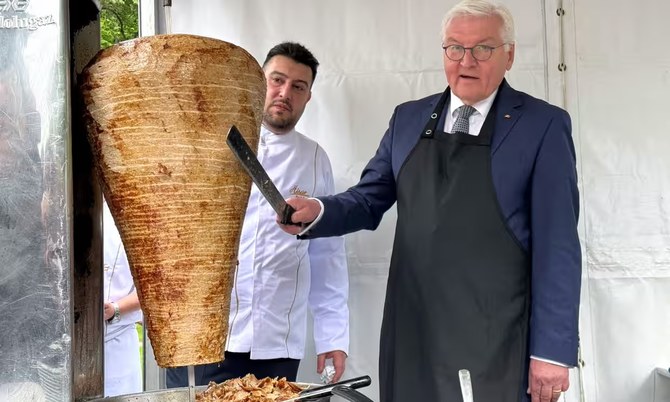

LONDON: German President Frank-Walter Steinmeier’s visit to Turkiye this week has stirred controversy after he brought along a 60-kg kebab skewer as part of his diplomatic mission.
Starting his three-day tour in Istanbul instead of Ankara, Steinmeier served kebabs at a reception, viewing it as a symbol of cultural exchange between the two nations.
“It is these special and intense relationships that bridge distances, and also some differences, today,” he said.
However, rather than emphasizing the close personal ties between Germans and Turks, the gesture drew criticism from many in the diaspora who viewed it as reducing their community’s contributions to a stereotypical image.
Germany, home to 2.7 million people of Turkish descent, welcomed hundreds of thousands of workers in the 1960s as part of its “guest worker” program, a bilateral agreement with Ankara to address labor shortages.
Turkish-Germans took to social media to condemn what they saw as a clumsy attempt to represent their community, accusing Steinmeier of failing to take them seriously or treat them as equals.
“Turkish-Germans discovered the 1st COVID vaccine in the world; some were movie directors who won awards on behalf of Germany, numerous writers, musicians, intellectuals from Turkey call Germany home,” wrote Evren Celik Wiltse, a professor of political science, on X.
“Of all of these, the (German) president chose the kebab maker to accompany him to (Turkiye)”, she added.
Turkish-Germans discovered the 1st COVID vaccine in the world; some were movie directors who won awards on behalf of Germany, numerous writers, musicians, intellectuals from Turkey call Germany home.
Of all these, the president chose the kebab maker to accompany him to https://t.co/ZVMHyi48P0— Evren Celik Wiltse (@EvrenWiltse) April 22, 2024
Berkay Mandıracı, a senior analyst of Turkish-German heritage at the non-governmental organization Crisis Group, acknowledged that the gesture was well-intentioned but felt it was “anachronistic and reductionist.”
A well-intended gesture, I'm sure, but somehow not belonging to this age. As someone born and raised (until I was 12) in Germany, this feels anachronistic and reductionist.
But let's not read too much into it and hope the rest of the visit will deepen Turkish-German ties https://t.co/ZjUvCLH7ES
— Berkay Mandıracı (@BerkayMANDIRACI) April 23, 2024
The faux pas, which risked overshadowing the celebration of 100 years of diplomatic ties between the two nations, received the approval of Arif Keles, a third-generation kebab shop owner invited on the delegation trip by Steinmeier.
Keles, who served kebabs during the reception, described the opportunity as a “great honor.”
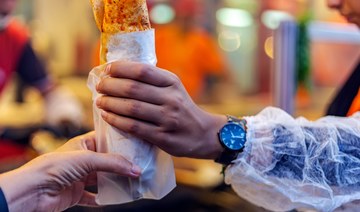
The dish of thinly sliced meat cooked on a vertical rotisserie was introduced to Germany by Turkish migrants.
Packed with chopped vegetables and doused with mayonnaise, the doner kebab has gained iconic status.
Local sales of the kebab total an estimated €7 billion ($7.5 billion), an immigrant success story the German presidency wanted to celebrate as an example of “how much Turkiye and Germany have grown together.”
Relations between Berlin and Ankara have been strained by various disputes, including disagreements over the Gaza conflict.
Steinmeier, visiting Turkiye for the first time since assuming office in 2017, has had a challenging relationship with Turkish President Recep Tayyip Erdogan, criticizing him for his approach to concerns about democratic norms in Turkiye.
Turkish-Germans have long spoken up about economic and social exclusion. Last year, Germany agreed to significantly ease citizenship rules to allow more dual nationals, a move welcomed by many Turkish individuals who have lived in Germany for decades.
With AFP