Pakistan’s planning minister discusses enhanced educational ties with UK delegation

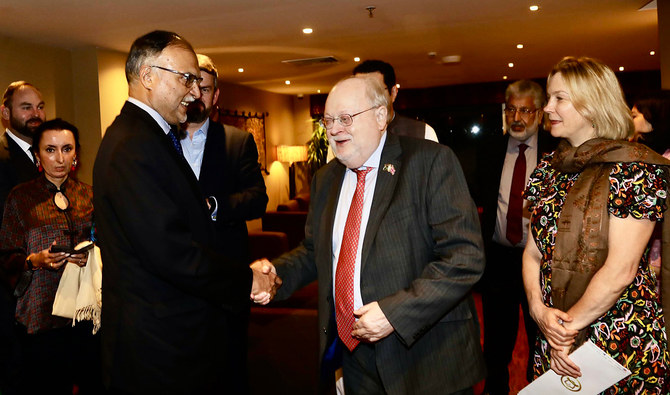
Pakistan’s planning minister Ahsan Iqbal (left) meets United Kingdom’s delegation in Islamabad on April 25, 2024. (Photo courtesy: X/PlanComPakistan)
Short Url
Updated 25 April 2024
Follow

Pakistan’s planning minister discusses enhanced educational ties with UK delegation

  • Ahsan Iqbal proposes faculty training, research collaboration and UK campus expansions in Pakistan
  • He says UK universities should develop specialized knowledge clusters through Pakistani scholars’ expertise

ISLAMABAD: Pakistan’s planning minister Ahsan Iqbal met a delegation from the United Kingdom, said an official statement on Thursday, to discuss the possibility of fostering closer ties and enhancing collaboration between the educational institutions in both countries.
British universities are a popular destination for Pakistani students due to the quality of education and the strong historical and cultural ties between the two countries.
Many students from Pakistan go to these educational institutions on scholarships offered by various organizations, such as the British Council, UK government and universities themselves, while others fund their studies independently.
The Pakistani planning minister presented various recommendations during his meeting with the delegation led by Steve Smith, the UK government’s International Education Champion, along with officials of the British High Commission.
He proposed faculty training programs to bolster academic expertise across borders, encouraging UK universities to establish campuses in Pakistan to promote educational accessibility and harnessing the expertise of Pakistani scholars in British universities to develop specialized knowledge clusters on the country.
“Pakistan envisions a future where universities in Pakistan are categorized into the Champions League (having first-tier universities) and the National League (having second-tier universities), driving excellence and accessibility in higher education,” Iqbal said during the meeting.
He highlighted the imperative for joint research initiatives, pointing at the importance of establishing joint research groups and fostering collaborations between PhD scholars from both countries.
The visiting delegation official reaffirmed the British government’s commitment to building international partnerships in education, citing the presence of over 20,000 Pakistani students in his country and 8,000 students who are pursuing degree programs in Pakistan with UK’s financial support.
The two sides also discussed procedural issues while pointing to the need for streamlined regulations, with a particular emphasis on minimizing hurdles for universities and strengthening the link between research institutions and economic growth.
They agreed to hold further dialogue and take concrete action toward implementing the planning minister’s recommendations to further solidify the foundation for enduring academic cooperation between the two countries.


Pakistan party calls Sindh resolution against new provinces ‘unconstitutional’

Updated 5 sec ago
Follow

Pakistan party calls Sindh resolution against new provinces ‘unconstitutional’

  • The development follows calls to separate Karachi from Sindh amid governance concerns intensified by a deadly mall fire last month
  • Muttahida Qaumi Movement-Pakistan calls for a referendum in urban areas of Sindh for the establishment of a new administrative unit

ISLAMABAD: The Muttahida Qaumi Movement-Pakistan (MQM-P) political party on Sunday criticized the Sindh provincial government for adopting a resolution in the provincial assembly against the creation of new provinces, describing it as “illegal, unconstitutional.”

The resolution was adopted on Saturday after fresh demands by the MQM-P and other voices to grant Karachi a provincial or federal status following governance challenges highlighted by a deadly mall fire earlier this year that killed 80 people.

Karachi, Pakistan’s largest city that is home to more than 20 million, is the country’s main commercial hub and contributes a significant share to the national economy.

Speaking at a press conference, MQM-P’s Khalid Maqbool Siddiqui said the Constitution of Pakistan provided procedure for establishing new provinces, but a province had “carried itself as if it were a separate country,” referring to Saturday’s resolution.

“Anything in contrast with the constitution cannot be adopted. This is illegal, unconstitutional, undemocratic,” he said, calling for a referendum in urban areas of Sindh for the establishment of a new administrative unit in the region.

Sindh Chief Minister Syed Murad Ali Shah had tabled the resolution in the assembly on Saturday, condemning what he described as “divisive statements” about breaking up Sindh or detaching Karachi.

“The province that played a foundational role in the creation of Pakistan cannot allow the fragmentation of its own historic homeland,” Shah told lawmakers, citing Article 239 of Pakistan’s 1973 Constitution, which requires the consent of not less than two-thirds of a provincial assembly to alter provincial boundaries.

“If any such move is attempted, it is this Assembly — by a two-thirds majority — that will decide,” he said.

The resolution reaffirmed that Karachi would “forever remain” an integral part of Sindh and directed the provincial government to forward the motion to the president, prime minister and parliamentary leadership for record.

Calls to alter Karachi’s status have periodically surfaced amid longstanding complaints over governance, infrastructure and administrative control in the megacity, though no formal proposal to redraw provincial boundaries has been introduced at the federal level.

Taha Ahmed Khan, a senior MQM-P member, acknowledged that his party had “presented its demand openly on television channels with clear and logical arguments” to separate Karachi from Sindh.

“It is a purely constitutional debate,” he told Arab News on Saturday. “We are aware that the Pakistan Peoples Party, which rules the province, holds a two-thirds majority and that a new province cannot be created at this stage. But that does not mean new provinces can never be formed.”