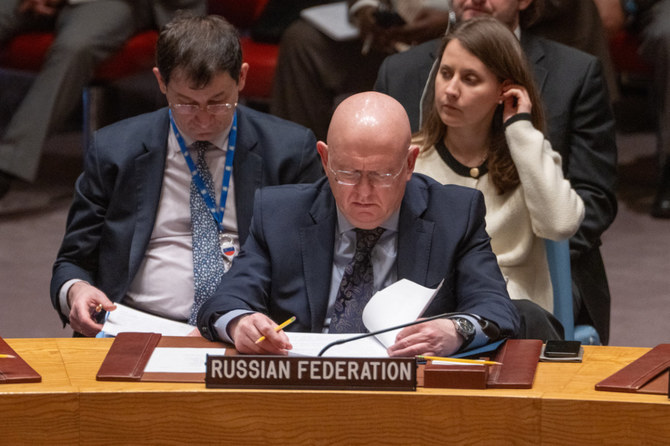

UNITED NATIONS: Russia on Wednesday vetoed a UN resolution sponsored by the United States and Japan calling on all nations to prevent a dangerous nuclear arms race in outer space, calling it “a dirty spectacle” that cherry picks weapons of mass destruction from all other weapons that should also be banned.
The vote in the 15-member Security Council was 13 in favor, Russia opposed and China abstaining.
The resolution would have called on all countries not to develop or deploy nuclear arms or other weapons of mass destruction in space, as banned under a 1967 international treaty that included the US and Russia, and to agree to the need to verify compliance.
US Ambassador Linda Thomas-Greenfield said after the vote that Russian President Vladimir Putin has said Moscow has no intention of deploying nuclear weapons in space.
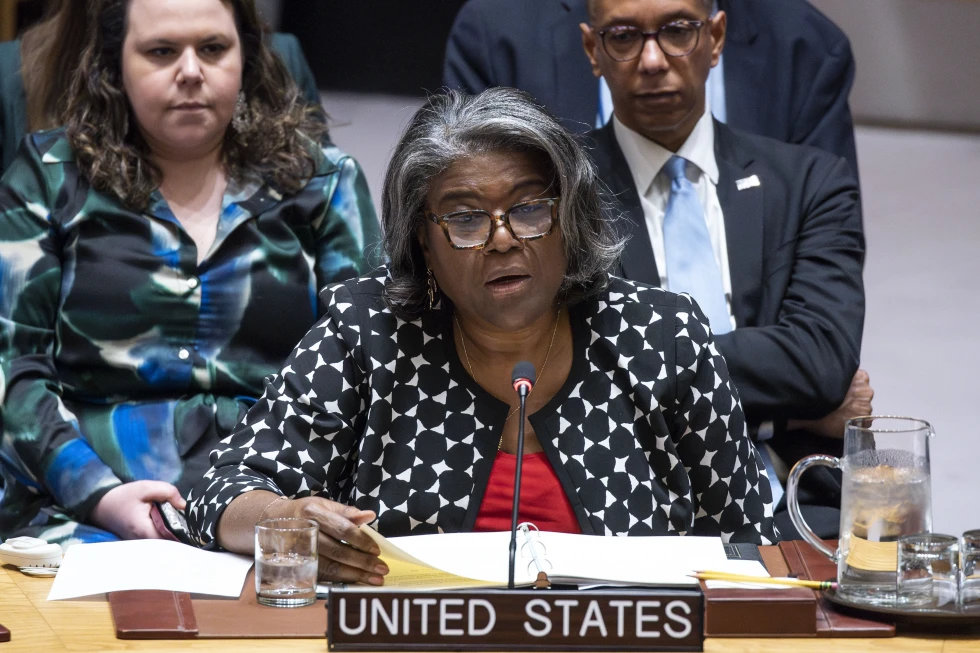
US Ambassador to the United Nations Linda Thomas-Greenfield addresses members of the UN Security Council during a meeting on non-proliferation of nuclear weapons on April 24, 2024. (AP)
“Today’s veto begs the question: Why? Why, if you are following the rules, would you not support a resolution that reaffirms them? What could you possibly be hiding,” she asked. “It’s baffling. And it’s a shame.”
Putin was responding to White House confirmation in February that Russia has obtained a “troubling” anti-satellite weapon capability, although such a weapon is not operational yet.
US National Security Advisor Jake Sullivan on Wednesday echoed Thomas-Greenfield, reiterating that “the United States assesses that Russia is developing a new satellite carrying a nuclear device.” If Putin has no intention of deploying nuclear weapons in space, Sullivan said, “Russia would not have vetoed this resolution.”
Russia’s UN Ambassador Vassily Nebenzia dismissed the resolution as “absolutely absurd and politicized,” and said it didn’t go far enough in banning all types of weapons in space.
Russia and China proposed an amendment to the US-Japan draft that would call on all countries, especially those with major space capabilities, “to prevent for all time the placement of weapons in outer space, and the threat of use of force in outer spaces.”
The vote was 7 countries in favor, 7 against, and one abstention and the amendment was defeated because it failed to get the minimum 9 “yes” votes required for adoption.
The US opposed the amendment, and after the vote Nebenzia addressed the US ambassador saying: “We want a ban on the placement of weapons of any kind in outer space, not just WMDs (weapons of mass destruction). But you don’t want that. And let me ask you that very same question. Why?”
He said much of the US and Japan’s actions become clear “if we recall that the US and their allies announced some time ago plans to place weapons … in outer space.”
Nebenzia accused the US of blocking a Russian-Chinese proposal since 2008 for a treaty against putting weapons in outer space.
Thomas-Greenfield accused Russia of undermining global treaties to prevent the spread of nuclear weapons, irresponsibly invoking “dangerous nuclear rhetoric,” walking away from several of its arms control obligations, and refusing to engage “in substantive discussions around arms control or risk reduction.”
She called Wednesday’s vote “a real missed opportunity to rebuild much-needed trust in existing arms control obligations.”
Thomas-Greenfield’s announcement of the resolution on March 18 followed White House confirmation in February that Russia has obtained a “troubling” anti-satellite weapon capability, although such a weapon is not operational yet.
Putin declared later that Moscow has no intention of deploying nuclear weapons in space, claiming that the country has only developed space capabilities similar to those of the US.
Thomas-Greenfield said before the vote that the world is just beginning to understand “the catastrophic ramifications of a nuclear explosion in space.”
It could destroy “thousands of satellites operated by countries and companies around the world — and wipe out the vital communications, scientific, meteorological, agricultural, commercial, and national security services we all depend on,” she said.
The defeated draft resolution said “the prevention of an arms race in outer space would avert a grave danger for international peace and security.” It would have urged all countries carrying out activities in exploring and using outer space to comply with international law and the UN Charter.
The draft would have affirmed that countries that ratified the 1967 Outer Space Treaty must comply with their obligations not to put in orbit around the Earth “any objects” with weapons of mass destruction, or install them “on celestial bodies, or station such weapons in outer space.”
The treaty, ratified by some 114 countries, including the US and Russia, prohibits the deployment of “nuclear weapons or any other kinds of weapons of mass destruction” in orbit or the stationing of “weapons in outer space in any other manner.”
The draft resolution emphasized “the necessity of further measures, including political commitments and legally binding instruments, with appropriate and effective provisions for verification, to prevent an arms race in outer space in all its aspects.”
It reiterated that the UN Conference on Disarmament, based in Geneva, has the primary responsibility to negotiate agreements on preventing an arms race in outer space.
The 65-nation body has achieved few results and has largely devolved into a venue for countries to voice criticism of others’ weapons programs or defend their own. The draft resolution would have urged the conference “to adopt and implement a balanced and comprehensive program of work.”
At the March council meeting where the US-Japan initiative was launched, UN Secretary-General António Guterres warned that “geopolitical tensions and mistrust have escalated the risk of nuclear warfare to its highest point in decades.”
He said the movie “Oppenheimer” about Robert Oppenheimer, who directed the US project during World War II that developed the atomic bomb, “brought the harsh reality of nuclear doomsday to vivid life for millions around the world.”
“Humanity cannot survive a sequel to Oppenheimer,” the UN chief said.