

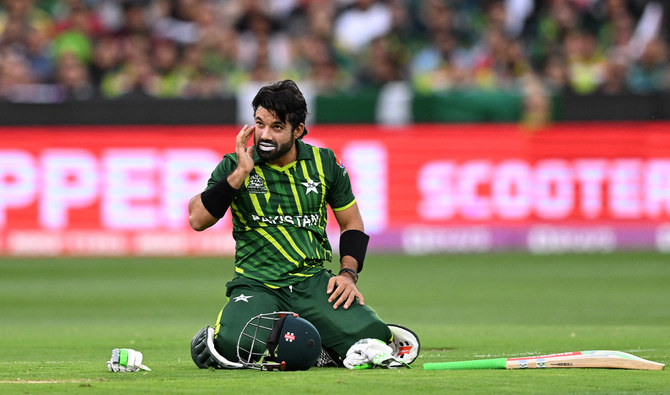
As T20 World Cup looms, injuries become headache for Pakistan yet again

Pakistan's Muhammad Rizwan reacts after being hit by a delivery during the ICC men's Twenty20 World Cup 2022 final cricket match England and Pakistan at The Melbourne Cricket Ground in Melbourne, Australia, on November 13, 2022. (AFP/File)
Short Url
Updated 22 April 2024
Follow

As T20 World Cup looms, injuries become headache for Pakistan yet again

  • Star batter Muhammad Rizwan was pulled out of Sunday’s match against New Zealand after he felt discomfort in his hamstring
  • Pakistani wicketkeeper batter Azam Khan has been ruled out of the New Zealand series after he suffered a tear in his right calf muscle 

ISLAMABAD: The Pakistan Cricket Board (PCB) said on Sunday that star batter Muhammad Rizwan had been pulled out of the third T20I fixture against New Zealand in Rawalpindi after he felt discomfort in his hamstring, raising fears that the 2009 champions may once again be plagued by injuries before the mega T20 tournament kicks off in June. 

Rizwan, who was instrumental in Pakistan’s win in the second T20I over New Zealand on Saturday, was pulled from the match after scoring only 22 runs from 21 balls on Sunday. The PCB later released a statement saying the batter felt discomfort in his right hamstring, and that he would not take part in the rest of the match. 

If injured, Rizwan would add to a mounting list of Pakistani players who have suffered injuries in recent times. Wicketkeeper batter Azam Khan was ruled out of the New Zealand series last week after radiology reports confirmed a grade one tear in his right calf muscle. 

“Azam will now depart from the Pakistan men’s cricket team and report to the National Cricket Academy, where he will commence his rehabilitation process under the supervision of the PCB medical panel,” the PCB said in a statement on Sunday. 

Express Pakistani pacer Ihsanullah has also been out of action since he made his ODI debut for Pakistan in April 2023. Ihsanullah was initially sidelined with an elbow injury which, according to media reports, turned into a significantly more serious as it was misdiagnosed by the PCB’s medical team. 

PCB Chairman Mohsin Naqvi said on Sunday that the cricket body had decided to constitute an independent board “to analyze if Ihsanullah’s medical case was handled properly by PCB medical support team.”

The South Asian team suffered a massive blow last year when right-arm pacer Naseem Shah, a regular member of the Pakistan cricket team in all three formats of the game, suffered a serious shoulder injury and was ruled out of the 50-over World Cup in India months before it was scheduled to take place. Pakistan ended up not qualifying for the semifinal stages of the tournament on account of their poor bowling and batting performances. 


Pakistan stocks recover as oil supply fears ease after Islamabad seeks Red Sea route— analyst

Updated 05 March 2026
Follow

Pakistan stocks recover as oil supply fears ease after Islamabad seeks Red Sea route— analyst

  • Pakistan has sought Saudi help to secure oil supplies via Red Sea port after Iran’s closure of Strait if Hormuz
  • Analyst says higher crude oil prices, expectations of IMF releasing next loan tranche also triggered bullish activity

ISLAMABAD: Pakistani stocks marked a sharp recovery when trading closed on Thursday, as institutional activity increased following Islamabad’s move to seek crude oil supplies through the Red Sea port eased oil supply fears, a financial analyst said. 

Pakistani stocks have recorded a sharp decline this week, with the benchmark KSE-100 index recording its largest-ever single-day decline on Monday when it plunged 16,089 points. Escalating conflict in the Middle East triggered panic selling at the Pakistani bourse, forcing a temporary trading halt on Monday. 

The KSE-100 index, however, gained 3.49 percent or 5,433.46 points to close at 161,210.67 when trading ended on Thursday, up from the previous close of 155,777.21 points, according to Pakistan Stock Exchange’s (PSX) data.

Pakistan’s Petroleum Minister Ali Pervaiz Malik met Saudi Ambassador Nawaf bin Said Al-Malki on Wednesday to discuss Iran’s closure of the key Strait of Hormuz, which has threatened Pakistan’s energy supply. Roughly 20 percent of the global oil and gas supply passes through the route. Saudi Arabia indicated it could facilitate shipments through the Red Sea port of Yanbu, offering an alternative route if Gulf shipping lanes remain disrupted, the petroleum ministry said on Wednesday. 

“Stocks staged a sharp recovery at PSX amid institutional activity on easing fuel supply fears after KSA [Kingdom of Saudi Arabia] commits oil supplies through the Red Sea port,” Ahsan Mehanti, chief executive officer at Arif Habib Commodities, told Arab News.

He said higher global crude oil prices and expectations of the International Monetary Fund releasing its next tranche of the $7 billion loan for Pakistan also helped bullish activity at the PSX.

An IMF mission was in Pakistan to hold talks on the third review of a $7 billion Extended Fund Facility multi-year program, and for the second review of the $1.4 billion Resilience and Sustainability Facility this week.

However, the delegation left for Türkiye amid tensions in the Gulf. Pakistani officials have said talks are likely to continue virtually in the coming days. 

Pakistani brokerage Topline Securities said in its daily market review report that strong institutional buying “turned the tide” on Thursday after the market’s recent overreaction to regional issues.

The report added that Hub Power Company (HUBC), Oil & Gas Development Company (OGDC), Fauji Fertilizer Company (FFC), Engro Corporation (ENGROH), and Meezan Bank Limited (MEBL) collectively contributed 2,197 points to the KSE benchmark’s gain.

Topline Securities said 723 million shares were traded on Thursday, with K-Electric Limited (KEL) stealing the spotlight as more than 1.17 billion shares changed hands.

Pakistani investors are closely monitoring developments in the Gulf, particularly around energy routes and further retaliatory actions, as the conflict’s trajectory remains uncertain.