

PM Sharif says results of Pakistan by-elections reflect people’s confidence in ruling party

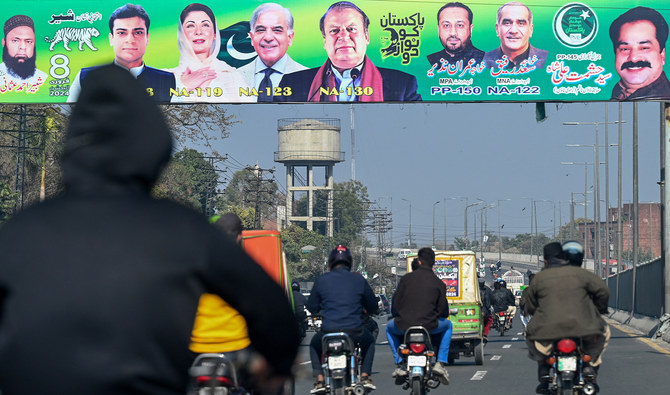
Commuters ride past posters of Nawaz Sharif (C) Pakistan's former Prime Minister and leader of the Pakistan Muslim League (PML) party, a day after national elections in Lahore on February 9, 2024. (AFP/File)
Short Url
Updated 22 April 2024
Follow

PM Sharif says results of Pakistan by-elections reflect people’s confidence in ruling party

  • Local media reports, quoting unofficial results, showed ruling PML-N leading in nearly two dozen constituencies 
  • Former PM Khan’s Pakistan Tehreek-e-Insaf party rejects results of by-polls, accuses authorities of rigging 

ISLAMABAD: Prime Minister Shehbaz Sharif on Monday congratulated Pakistan’s newly elected legislators, saying that the results of Sunday’s by-polls reflected ​people’s confidence in the ruling Pakistan Muslim League-Nawaz (PML-N) party. 

Pakistan conducted by-polls across 21 national and provincial constituencies on Sunday. In Punjab, polls were held on 12 provincial and two National Assembly seats while in Pakistan’s northwestern Khyber Pakhtunkhwa (KP) province, by-polls were held on four seats. Elections were also held on two seats in Pakistan’s southwestern Balochistan province while one National Assembly seat in Sindh was also up for grabs.

Quoting unofficial and preliminary results, Pakistani news website Geo.tv said Sharif’s party succeeded in winning electoral contests in four out of 12 provincial seats in Punjab while it also won a provincial assembly seat in Balochistan and one National Assembly seat in Pakistan’s eastern city of Lahore. 

“The victory of the newly elected members of the Pakistan Muslim League (PML-N) in the by-elections is a manifestation of the people’s confidence,” the PML-N quoted Sharif as saying on X. “We assure the public that we will spare no effort in serving them.”

The Pakistani premier said the PML-N candidates’ success is a public recognition of the government’s efforts to restore the economy, reduce inflation and improve foreign relations.

“With further economic improvement and increase in relief for the masses, the public’s opinion will change further in the coming days,” he said.

Meanwhile, jailed former prime minister Imran Khan’s Pakistan Tehreek-e-Insaf (PTI) party rejected the results of the by-polls, alleging that they were heavily rigged in favor of the ruling party. 

“Congratulations to you and your party for such a victory in which the election was stolen in broad daylight by trampling on the people’s opinion,” the PTI wrote to Punjab Chief Minister and PML-N Vice President Maryam Nawaz Sharif on X. 

In another post on the social media platform, the PTI accused authorities of helping PML-N candidates win via force. It saluted voters for “forcing the system to its knees.”

The polls were held amid suspension of cellular services in Balochistan and specific districts of Punjab. On Saturday, the Pakistan Telecommunication Authority (PTA), which regulates Internet in the country, said the decision to keep cellular services suspended was taken on the interior ministry’s directions.

“This decision has been taken to safeguard the integrity and security of the electoral process,” the regulator said in a statement.

The federal government authorized the deployment of civil armed forces and Pakistan Army to assist the ECP in peaceful conduct of by-polls.


Pakistan, China to sign multiple MoUs at major agriculture investment conference today

Updated 18 January 2026
Follow

Pakistan, China to sign multiple MoUs at major agriculture investment conference today

  • Hundreds of Chinese and Pakistani firms to attend Islamabad event
  • Conference seen as part of expanding CPEC ties into agriculture, trade

KARACHI: Islamabad and Beijing are set to sign multiple memorandums of understanding (MoUs) to boost agricultural investment and cooperation at a major conference taking place in the capital today, Monday, with hundreds of Chinese and Pakistani companies expected to participate.

The conference is being billed by Pakistan’s Ministry of National Food Security and Research as a platform for deepening bilateral agricultural ties and supporting broader economic engagement between the two countries.

“Multiple memorandums of understanding will be signed at the Pakistan–China Agricultural Conference,” the Ministry of National Food Security said in a statement. “115 Chinese and 165 Pakistani companies will participate.”

The conference reflects a growing emphasis on expanding Pakistan-China economic cooperation beyond the transport and energy foundations of the flagship China-Pakistan Economic Corridor (CPEC) into agriculture, industry and technology.

Under its first phase launched in 2015, CPEC, a core component of China’s Belt and Road Initiative, focused primarily on transportation infrastructure, energy generation and connectivity projects linking western China to the Arabian Sea via Pakistan. That phase included motorways, power plants and the development of the Gwadar Port in the country's southwest, aimed at helping Pakistan address chronic power shortages and enhance transport connectivity.

In recent years, both governments have formally moved toward a “CPEC 2.0” phase aimed at diversifying the corridor’s impact into areas such as special economic zones, innovation, digital cooperation and agriculture. Second-phase discussions have highlighted Pakistan’s goal of modernizing its agricultural sector, attracting Chinese technology and investment, and boosting export potential, with high-level talks taking place between planning officials and investors in Beijing.

Agri-sector cooperation has also seen practical collaboration, with joint initiatives examining technology transfer, export protocols and value-chain development, including partnerships in livestock, mechanization and horticulture.

Organizers say the Islamabad conference will bring together government policymakers, private sector investors, industry associations and multinational agribusiness firms from both nations. Discussions will center on investment opportunities, technology adoption, export expansion and building linkages with global buyers within the framework of Pakistan-China economic cooperation.