

Israel’s brutal tactics blamed for Palestinians’ financial crisis

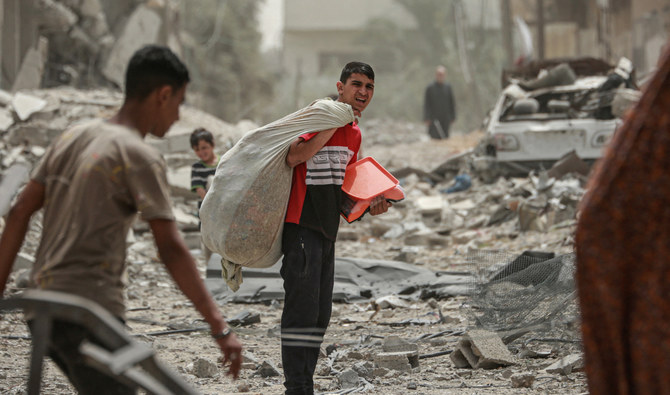
A Palestinian carries a bag as he walks amidst the debris in the city of Nuseirat in the central Gaza Strip on April 18, 2024. (AFP/File)
Short Url
Updated 21 April 2024
Follow

Israel’s brutal tactics blamed for Palestinians’ financial crisis

JERUSALEM: The Gaza war is speeding up Israel’s “annexation” of the Palestinian economy, say analysts, who argue it has been hobbled for decades by agreements that followed the Oslo peace accords.

While the Israel-Hamas war raging since Oct. 7 has devastated swaths of Gaza, it has also hit the public finances and wider economy of the Israeli-occupied West Bank.

Israel is tightening the noose on the Palestinian Authority, which rules parts of the West Bank, by withholding tax revenues it collects on its behalf, said economist Adel Samara.

Palestinian livelihoods have also been hurt by bans on laborers crossing into Israel and by a sharp downturn in tourism in the violence-plagued territory, including a quiet Christmas season in Bethlehem.

Samara said that “technically speaking, there is no Palestinian economy under Israeli occupation — Israel has effectively annexed our economy.”

The Palestinian economy is largely governed by the 1994 Paris Protocol, which granted sole control over the territories’ borders to Israel and, with it, the right to collect import duties and value-added tax for the Palestinian Authority.

Israel has repeatedly leveraged this power to deprive the authority of much-needed revenues.

But the Gaza war has further tightened Israel’s grip, Samara said, with the bulk of customs duties withheld since Hamas sparked the war with the Oct. 7 attack on Israel.

“Without these funds, the Palestinian Authority struggles to pay the salaries of its civil servants and its running costs,” said Taher Al-Labadi, a researcher at the French Institute for the Near East.


Much of Iran’s near-bomb-grade uranium likely to be in Isfahan, IAEA’s Grossi says

Updated 7 sec ago
Follow

Much of Iran’s near-bomb-grade uranium likely to be in Isfahan, IAEA’s Grossi says

  • Isfahan tunnels appear to have survived military strikes
  • Some highly ‌enriched uranium was known to be stored there
PARIS: Almost half of Iran’s uranium enriched to up to 60 percent purity, a short step from weapons-grade, was stored in a tunnel complex at Isfahan and is probably still there, UN nuclear watchdog chief Rafael Grossi said on Monday.
The tunnel complex is the only target that appears not to have been badly damaged in attacks last June by Israel and the US on Iran’s nuclear ‌facilities.
Diplomats have long ‌said Isfahan has been used to store ‌60 percent uranium, ⁠which the International ⁠Atomic Energy Agency confirmed in a report to member states last month, without saying how much was there.
Iran still has highly enriched uranium stocks
The IAEA estimates that when Israel launched its first attacks in June, Iran had 440.9 kg of 60 percent uranium. If enriched further, that would provide the explosive needed for 10 nuclear weapons, according to an IAEA yardstick.
“What we believe ⁠is that Isfahan had until our last inspection a bit ‌more than 200 kg, maybe a ‌little bit more than that, of 60 percent uranium,” IAEA chief Rafael Grossi told ‌reporters in Paris.
He said the stock was “mainly” at Isfahan, and some held elsewhere ‌may have been destroyed.
“The widespread assumption is that the material is still there. So we haven’t seen — and not only us, I think in general all those observing the facility through satellite imagery and other means to see what’s going ‌on there — movement indicating that the material could have been transferred,” Grossi said.
Iran has not informed the ⁠IAEA of the ⁠status or whereabouts of its highly enriched uranium since the June attacks, nor has it let IAEA inspectors return to its bombed facilities.
Iran’s nuclear program is one reason Israel and the US have given for their current attacks on Iran, arguing that it was getting too close to being able to produce a bomb, despite Trump saying in June that US strikes had obliterated the program. The IAEA has said it has no credible indication of a coordinated nuclear weapons program.
All three Iranian uranium-enrichment plants known to have been operating — two at Natanz and one at Fordow — were destroyed or badly damaged in June.
“There is an amount (of 60 percent uranium) in Natanz also, which we believe is still there,” Grossi said.