

Gunmen kill 7 customs officials in western Pakistan in two attacks

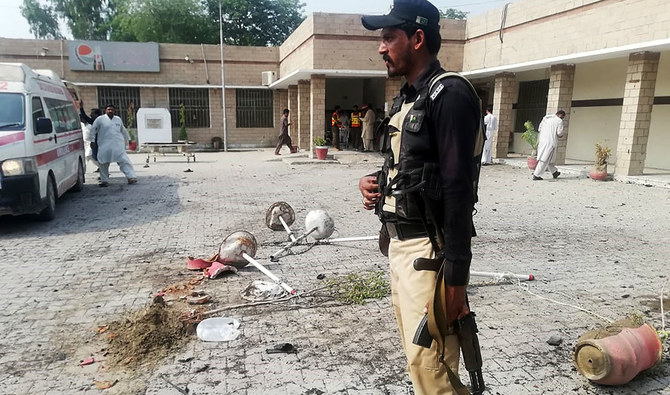
A Pakistani policeman stands guard at site of a suicide bomb attack a hospital entrance in Kotlan Saidan village on the outskirts of the northwestern city of Dera Ismail Khan on July 21, 2019. (AFP/file)
Short Url
Updated 21 April 2024
Follow

Gunmen kill 7 customs officials in western Pakistan in two attacks

  • No group has yet claimed responsibility for the two attacks since Thursday
  • A recent surge in attacks in Pakistan has soured its relations with Afghanistan 

DERA ISMAIL KHAN: Unknown gunmen killed two customs officers in western Pakistan, officials said on Sunday, following the killing of five other customs officials in the area in recent days.

No group has claimed responsibility for the two attacks since Thursday, which police said they were investigating.

Security in regions of Pakistan bordering Afghanistan has deteriorated in recent years. Attacks, some claimed by the Pakistani Taliban (TTP) militant group, have risen, mostly targeting police and security officials.

“Customs officials were present for checks... when unknown persons opened fire,” said the district deputy superintendent of police, Muhammad Adnan, adding that two people were injured and the area on a busy highway had been cordoned off.

“Three days ago, five officials, including an officer, of the customs department, were killed in a shooting in the same area and the attackers escaped,” he said.

The rise in attacks has escalated tensions between Pakistan and Afghanistan’s ruling Taliban administration.

Pakistan, saying militants have been using Afghan territory to launch attacks, has called on the Taliban to take action and carried out an airstrike last month on Afghan territory.

The Taliban have denied allowing the use of Afghan soil for militancy and said Pakistan’s security issues are a domestic issue for Islamabad.


Pakistan hails Bangladesh’s ‘historic democratic transition’ as ties gather momentum

Updated 6 sec ago
Follow

Pakistan hails Bangladesh’s ‘historic democratic transition’ as ties gather momentum

  • Ahsan Iqbal visits Dhaka for the swearing-in of PM-elect Tarique Rahman after recent elections
  • Islamabad calls for building connectivity, expanding trade and shaping a stable region together

ISLAMABAD: Pakistan’s Planning Minister Ahsan Iqbal on Tuesday congratulated Bangladesh on a “historic democratic transition,” as he pointed to positive momentum in Pakistan-Bangladesh relations during a visit to Dhaka for the oath-taking of Prime Minister-elect Tarique Rahman.

Bangladesh’s parliament was sworn in earlier in the day, marking the first elected legislature since a deadly 2024 uprising that toppled the government of Sheikh Hasina. Rahman, 60, is chief of the Bangladesh Nationalist Party (BNP) and won a landslide victory in the February 12 elections.

He is set to formally take office later on Tuesday after lawmakers pledged loyalty before their country’s chief election commissioner.

The Pakistani minister said in a social media post on X he met Bangladesh’s Chief Adviser, Muhammad Yunus, and congratulated him “on the successful conduct of elections and the historic democratic transition.”

“Our discussions focused on opening a new, forward-looking chapter in Pakistan-Bangladesh relations,” he said. “I expressed appreciation for the positive momentum in bilateral ties, including growing trade engagement, revival of direct air connectivity, and renewed people-to-people contacts.”

Pakistan’s Minister for Planning, Development and Special Initiatives, Ahsan Iqbal (left), paid a courtesy call on Chief Adviser Professor Muhammad Yunus (right) at the State Guest House Jamuna in Dhaka, Bangladesh, on February 17, 2026. (AhsanIqbal/X)

“We agreed that the current regional and geopolitical environment demands greater economic cooperation, connectivity, and collaboration between our two countries,” he added.

Iqbal also extended an invitation to Yunus to visit Pakistan to institutionalize cooperation in youth empowerment, innovation and sustainable development.

“Pakistan and Bangladesh share deep cultural, historical, and social affinities,” he said. “It is time to transform these affinities into structured economic partnerships, academic exchanges, and regional cooperation. Our future lies in building connectivity, expanding trade, empowering youth, and shaping a stable and prosperous South Asia together.”

Bangladesh’s Prime Minister-elect Rahman has pledged to restore economic stability and revive growth after months of turmoil that rattled investor confidence in the world’s second-largest garment exporter. In his victory speech, he described the outcome as a win for democracy but warned of challenges, including a fragile economy and weakened institutions.

Pakistan and Bangladesh have improved bilateral ties amid a recent thaw in relations. The two countries were part of the same state until Bangladesh’s secession following a bloody civil war in 1971, an event that long cast a shadow over ties.

Relations have warmed since August 2024, after the ouster of Hasina, who was widely viewed as close to India. While Islamabad and Dhaka have moved closer, ties between Bangladesh and New Delhi remain strained over India’s decision to grant asylum to Hasina.