

Pakistan to hold by-elections on 21 national, provincial assembly seats on Sunday 

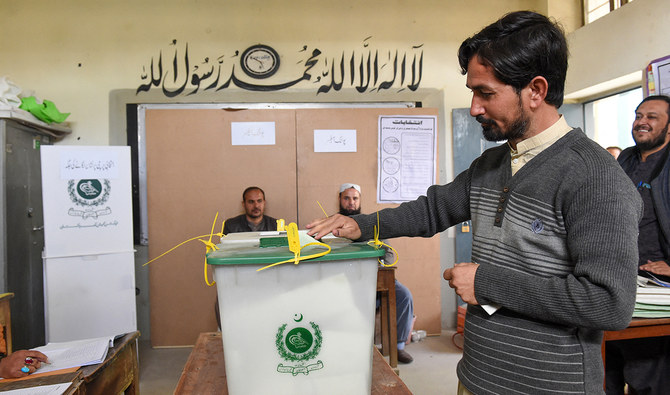
A man casts his ballot to vote during Pakistan's national elections, at a polling station in Quetta on February 8, 2024. (AFP/File)
Short Url
Updated 20 April 2024
Follow

Pakistan to hold by-elections on 21 national, provincial assembly seats on Sunday 

  • Polling will be held on seats vacated by candidates or where polling was postponed due to various reasons 
  • Polling will take place on seats vacated by PM Shehbaz Sharif, Chief Ministers Maryam Nawaz and Ali Amin Gandapur

ISLAMABAD: Pakistan will conduct by-elections on 21 national and provincial seats on Sunday, state-run media reported on Saturday, marking the country’s first major electoral exercise since the contentious general elections of Feb. 8. 

The by-elections would be held on the national and provincial assembly seats that were vacated by candidates following the Feb. 8 elections. 

Polling on Sunday is scheduled to be held on five National Assembly seats, 12 Punjab Assembly seats, two Khyber Pakhtunkhwa (KP) Assembly seats and two Balochistan Assembly seats. 

“Polling will start at 8:00 in the morning and it will continue till 5:00 p.m. without any break,” Radio Pakistan said. 

Polling for NA-8 Bajaur and PK-22 Bajaur were postponed on Feb. 8 after the murder of a candidate, Rehan Zeb Khan. Polling will also be held in NA-44 Dera Ismail Khan, where the National Assembly seat was vacated by Ali Amin Gandapur, who retained his provisional assembly seat to become KP’s chief minister. 

Similarly, Punjab Chief Minister Maryam Nawaz Sharif vacated her NA-119 seat in Pakistan’s eastern city of Lahore, choosing instead to keep the PP-159 constituency that she also won. 

Prime Minister Shehbaz Sharif won elections on two provincial and National Assembly seats. He left the NA-132 Kasur and Lahore’s PP-158 and PP-164 seats vacant, preferring to retain the NA-123 Lahore constituency. 

Pakistan Peoples Party (PPP) Chairman Bilawal Bhutto-Zardari won two National Assembly seats. He retained the NA-194 Larkana constituency, leaving the NA-196 seat in Qamber Shahdadkot vacant.

Pakistan’s Feb. 8 elections were marred by delayed results, a countrywide shutdown of mobile phone services and rigging allegations. Jailed former prime minister Imran Khan’s Pakistan Tehreek-e-Insaf (PTI) accused Pakistan’s election regulator of manipulating the results of the elections, claiming in reality it had won over 180 National Assembly seats. 

The Election Commission of Pakistan (ECP) rejected the PTI’s allegations, saying polling results were delayed due to the shutdown of mobile phone services countrywide. Pakistan’s caretaker administration had said the mobile services were suspended due to security reasons, rejecting rigging allegations by Khan’s party.

Independent candidates backed by Khan secured the highest number of seats in the National Assembly. However, the Pakistan Muslim League-Nawaz (PML-N) emerged as the largest party in the National Assembly, as a court decision prevented Khan-backed candidates from contesting polls with the PTI’s symbol. 


Pakistan, global crypto exchange discuss modernizing digital payments, creating job prospects 

Updated 05 December 2025
Follow

Pakistan, global crypto exchange discuss modernizing digital payments, creating job prospects 

  • Pakistani officials, Binance team discuss coordination between Islamabad, local banks and global exchanges
  • Pakistan has attempted to tap into growing crypto market to curb illicit transactions, improve oversight

ISLAMABAD: Pakistan’s finance officials and the team of a global cryptocurrency exchange on Friday held discussions aimed at modernizing the country’s digital payments system and building local talent pipelines to meet rising demand for blockchain and Web3 skills, the finance ministry said.

The development took place during a high-level meeting between Finance Minister Muhammad Aurangzeb, Pakistan Virtual Assets Regulatory Authority (PVARA) Chairman Bilal bin Saqib, domestic bank presidents and a Binance team led by Global CEO Richard Teng. The meeting was held to advance work on Pakistan’s National Digital Asset Framework, a regulatory setup to govern Pakistan’s digital assets.

Pakistan has been moving to regulate its fast-growing crypto and digital assets market by bringing virtual asset service providers (VASPs) under a formal licensing regime. Officials say the push is aimed at curbing illicit transactions, improving oversight, and encouraging innovation in blockchain-based financial services.

“Participants reviewed opportunities to modernize Pakistan’s digital payments landscape, noting that blockchain-based systems could significantly reduce costs from the country’s $38 billion annual remittance flows,” the finance ministry said in a statement. 

“Discussions also emphasized building local talent pipelines to meet rising global demand for blockchain and Web3 skills, creating high-value employment prospects for Pakistani youth.”

Blockchain is a type of digital database that is shared, transparent and tamper-resistant. Instead of being stored on one computer, the data is kept on a distributed network of computers, making it very hard to alter or hack.

Web3 refers to the next generation of the Internet built using blockchain, focusing on giving users more control over their data, identity and digital assets rather than big tech companies controlling it.

Participants of the meeting also discussed sovereign debt tokenization, which is the process of converting a country’s debt such as government bonds, into digital tokens on a blockchain, the ministry said. 

Aurangzeb called for close coordination between the government, domestic banks and global exchanges to modernize Pakistan’s payment landscape.

Participants of the meeting also discussed considering a “time-bound amnesty” to encourage users to move assets onto regulated platforms, stressing the need for stronger verifications and a risk-mitigation system.

Pakistan has attempted in recent months to tap into the country’s growing crypto market, crack down on money laundering and terror financing, and promote responsible innovation — a move analysts say could bring an estimated $25 billion in virtual assets into the tax net.

In September, Islamabad invited international crypto exchanges and other VASPs to apply for licenses to operate in the country, a step aimed at formalizing and regulating its fast-growing digital market.