Fighting raged at Myanmar’s eastern frontier with Thailand on Saturday, witnesses, media and Thailand’s government said, forcing about 200 civilians to flee as rebels pressed to flush out junta troops holed up for days at a bridge border crossing.
Resistance fighters and ethnic minority rebels seized the key trading town of Myawaddy on the Myanmar side of the frontier on April 11, dealing a big blow to a well-equipped military that is struggling to govern and is now facing a critical test of its battlefield credibility.
Three witnesses on the Thai and Myanmar sides of the border said they heard explosions and heavy machine gun fire near a strategic bridge from late on Friday that continued into early Saturday.
Several Thai media outlets said about 200 people had crossed the border to seek temporary refuge in Thailand.
Thai broadcaster NBT in a post on social media platform X said resistance forces used 40-milimeter machine guns and dropped 20 bombs from drones to target an estimated 200 junta soldiers who had retreated from a coordinated rebel assault on Myawaddy and army posts since April 5.
Reuters could not immediately verify the reports and a Myanmar junta spokesperson could not immediately be reached for comment.
Thai Prime Minister Srettha Thavisin said he was closely monitoring the unrest and his country was ready to provide humanitarian assistance if necessary.
“I do not desire to see any such clashes have any impact on the territorial integrity of Thailand and we are ready to protect our borders and the safety of our people,” he said on X. He made no mention of refugees.
BIG SETBACK
Myanmar’s military is facing its biggest challenge since first taking control of the former British colony in 1962, caught up in multiple, low-intensity conflicts and grappling to stabilize an economy that has crumbled since a 2021 coup against Nobel laureate Aung San Suu Kyi’s government.
The country is locked in a civil war between the military on one side and, on the other, a loose alliance of established ethnic minority armies and a resistance movement born out of the junta’s bloody crackdown on anti-coup protests.
The capture of Myawaddy and surrounding army outposts is a significant setback for a junta that has been squeezed by Western sanctions, with the town a key tax revenue source and conduit for more than $1 billion of annual border trade.
The Khaosod newspaper in a post on X showed a video of Myanmar civilians, many of them women and children, being marshalled by Thai soldiers at an entry point to Thailand.
Thailand had on Friday said no refugees had entered the country and it was discussing with aid agencies about increasing humanitarian relief to civilians on the Myanmar side.

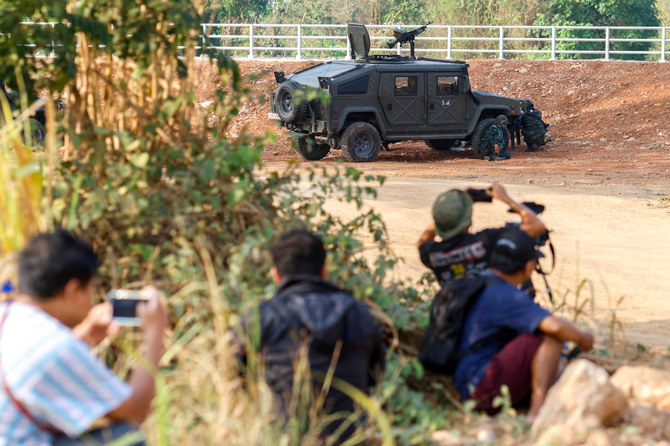
Fighting flares at Myanmar-Thai border as rebels target stranded junta troops
https://arab.news/gs7f6
Fighting flares at Myanmar-Thai border as rebels target stranded junta troops
- Resistance fighters and ethnic minority rebels seized the key trading town of Myawaddy on the Myanmar side of the frontier on April 11
Lufthansa adds more flights to Asia, Africa as Middle East war reshapes air travel
- Airlines across Europe have been redirecting capacity after suspending services in the Middle East
- Lufthansa said the move also helps meet demand on long-haul routes that Middle Eastern carriers cannot currently serve
LONDON: Lufthansa said on Friday it was shifting capacity from 10 canceled Middle Eastern destinations to routes such as Singapore and Bangkok as it contends with disruption from the US-Israeli war on Iran.
Airlines across Europe, including budget carrier Wizz Air , have been redirecting capacity after suspending services in the Middle East.
Lufthansa said the move also helps meet demand on long-haul routes that Middle Eastern carriers cannot currently serve.
Airline stocks have slumped this week as US and Israeli airstrikes on Iran — and retaliatory strikes by Iran across the Middle East — have disrupted long-haul flights and sent oil prices soaring.
“The war in the Middle East proves once again how exposed air traffic is and how vulnerable it remains,” Lufthansa CEO Carsten Spohr said in a statement. He added the outlook was uncertain, particularly for jet fuel costs.
The schedule changes came as the German group reported better-than-expected 2025 results, saying stricter financial management and fleet renewal had helped contain costs and lift profits. Its shares rose as much as 4 percent, before reversing to trade down 1.2 percent at 1246 GMT.
The company said demand on routes to and from Asia and Africa had risen strongly since the conflict began on Saturday, and it would stick with its focus on expanding long-haul services. Spohr said new flights to Asia would launch in days.
Lufthansa did say how many services it had canceled because of the conflict.
While carriers face costs for rescheduling and rerouting, the biggest impact for those outside the Middle East is expected from surging fuel prices. Brent crude futures have jumped more than 20 percent this week.
Spohr said Lufthansa was well hedged in the short term. The group hedges fuel up to 24 months ahead and was 85 percent hedged as of December 31, according to its annual report.
RESILIENCE
European carriers, including Lufthansa, benefited from slightly lower fuel bills in 2025. Lufthansa’s fuel bill fell 7 percent, helping support earnings as passenger demand stayed firm.
“Last year we were able to significantly increase the Group’s operating profit and achieved the highest revenue in our history. Our results demonstrate the resilience and stability of the Group,” Spohr said.
Lufthansa reported an adjusted operating profit of 2 billion euros ($2.3 billion), compared with 1.9 billion euros forecast in a company-compiled analyst poll and up from 1.6 billion euros in 2024. The group also posted an operating margin of 4.9 percent, up from 4.4 percent a year earlier.
Lufthansa aims to lift operating margins to 8 percent-10 percent between 2028 and 2030 from 4.4 percent in 2024, but strikes by workers, including the most recent on February 12, have made it harder to boost profitability.
Bernstein analyst Alex Irving said ongoing weakness in the passenger airline segment persisted, but that strong performances in Cargo and Lufthansa Technik helped lift profits.
The carrier said the outlook for 2026 was unclear due to geopolitical uncertainty. It projected capacity growth of 4 percent, alongside increased revenue and profit margin.