

Pakistan rejects US move to sanction firms for aiding its ballistic missile program 

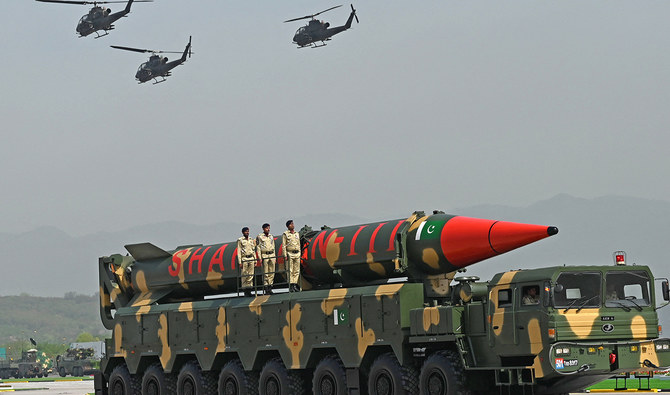
Pakistani military helicopters fly past a vehicle carrying a long-range ballistic Shaheen III missile during the military parade to mark Pakistan's National Day in Islamabad on March 25, 2021. (AFP/File)
Short Url
Updated 20 April 2024
Follow

Pakistan rejects US move to sanction firms for aiding its ballistic missile program 

  • US sanctions four international companies for supplying missile-applicable items to Pakistan’s ballistic missile program
  • Pakistan’s foreign office questions double standards of allowing advanced military technologies to some countries

ISLAMABAD: Pakistan’s foreign office spokesperson on Saturday rejected Washington’s move to impose sanctions on four international firms for providing missile-applicable items to its ballistic missile program, saying Islamabad is against the “political use” of export controls. 

In a press release issued late Friday, the US State Department announced sanctions against three Chinese companies and one Belarus-based firm on charges they supplied items to Pakistan’s ballistic missile program.

The companies listed by the US for sanctions are the China-based Xi’an Longde Technology Development Company Limited, Tianjin Creative Source International Trade Co. Ltd, Granpect Company Limited and Belarus-based Minsk Wheel Tractor Plant.

Pakistan’s foreign office spokesperson responded by saying that commercial entities have been sanctioned in the past on allegations of having links to Pakistan’s ballistic missile program “without sharing any evidence whatsoever.”

“Pakistan rejects political use of export controls,” the foreign office spokesperson said in a statement. It added that the same jurisdictions that claim to exercise non-proliferation controls have waived off licensing requirements for advanced military technologies for some countries.

“This is leading to arms build up; accentuating regional asymmetries, and undermining the objectives of non-proliferation and of regional and global peace and security,” it said. 

The statement said Islamabad had repeatedly pointed out that such items have legitimate civil commercial uses, urging Washington to avoid “arbitrary application of export controls.”

“There is need for discussions between concerned parties for an objective mechanism to ensure access to technology in pursuit of socio-economic development,” the spokesperson said.

“Pakistan has always been ready to discuss end-use and end-user verification mechanisms so that legitimate commercial users are not hurt by discriminatory application of export controls.”

The sanctions mean all property and interests in property of the companies in the US or in possession or control of American citizens are blocked and must be reported to the US Treasury Department’s Office of Foreign Assets Control (OFAC), the State Department has said.

They also mean that all transactions by American citizens, or those within (or transiting) the US that involve any property or interests in property of the companies, are prohibited unless authorized by a general or specific license issued by OFAC.


Rating firm S&P says it won’t rush Iran war downgrades, sees risks for countries like Pakistan

Updated 12 March 2026
Follow

Rating firm S&P says it won’t rush Iran war downgrades, sees risks for countries like Pakistan

  • Agency says it is monitoring indebted energy importers as higher oil prices strain finances
  • Gulf economies seen better placed to weather shock, though Bahrain flagged as vulnerable

LONDON: S&P Global ‌said it would not make any knee-jerk sovereign rating cuts following the outbreak of war in the ​Middle East, but warned on Thursday that soaring oil and gas prices were putting a number of already cash-strapped countries at risk.

The firm’s top analysts said in a webinar that the conflict, which has involved US and Israeli strikes ‌against Iran and Iranian ‌strikes against Israel, ​US ‌bases ⁠and Gulf ​states, ⁠was now moving from a low- to moderate-risk scenario.

Most Gulf countries had enough fiscal buffers, however, to weather the crisis for a while, with more lowly rated Bahrain the only clear exception.

Qatar’s banking sector could ⁠also struggle if there were significant ‌deposit outflows in ‌reaction to the conflict, although there ​was no evidence ‌of such strains at the moment, they ‌said.

“We don’t want to jump the gun and just say things are bad,” S&P’s head global sovereign analyst, Roberto Sifon-Arevalo, said.

The longer the crisis ‌was prolonged, though, “the more difficult it is going to be,” he ⁠added.

Sifon-Arevalo ⁠said Asia was the second-most exposed region, due to many of its countries being significant Gulf oil and gas importers.

India, Thailand and Indonesia have relatively lower reserves of oil, while the region also had already heavily indebted countries such as Pakistan, Bangladesh and Sri Lanka whose finances would be further hurt by rising energy prices.

“We ​are closely monitoring ​these (countries) to see how the credit stories evolve,” Sifon-Arevalo said.