

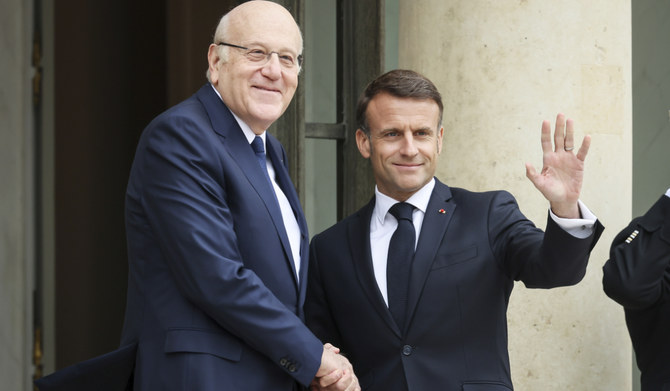

BEIRUT: Israel continued its raids on Hezbollah positions on Friday amid reports of dawn explosions in Iran, as Lebanon’s caretaker Prime Minister Najib Mikati held talks with French President Emmanuel Macron at the Elysee Palace.
Lebanese Army Commander Gen. Joseph Aoun and the Chief of Staff of the French Armed Forces Gen. Thierry Burkhard also attended the extended meeting.
According to reports, Aoun presented a study to the French military commander, as well as the head of the Italian armed forces, about the needs of the Lebanese Army, its current situation, challenges, and logistical and material requirements.
FASTFACT
Hezbollah forces based in Lebanon have clashed with the Israeli army in recent weeks, marking their most serious hostilities since a war between them in 2006.
The discussion focused on “how to assist in enhancing the situation of the Lebanese army in the south, provided that a committee is formed to study these needs and how to secure the necessary support and funding.”
The international community insists on Lebanon’s compliance with UN Security Council Resolution 1701, while Lebanon, in return, demands assistance for its military to enable it to deploy more of its forces in the south to implement the resolution.
Aoun described his separate meetings with his French and Italian counterparts as “positive.”
Israeli warplanes carried out an attack on a house in the town of Aita Al-Shaab with two air-to-ground missiles.
The raid resulted in the killing of Mohammed Hassan Abdel Mohsen Fadlallah, 54, who worked at the Islamic Education Foundation (Al-Mahdi Schools), an educational institution affiliated with Hezbollah.
Israeli Army spokesman Avichay Adraee said on X that “reconnaissance soldiers from Battalion 869 spotted saboteurs inside a military building belonging to the Hezbollah terrorist organization in the Aita Al-Shaab area. An airstrike targeted the building and the saboteurs who were stationed there.”
Hezbollah announced a few hours later the targeting of a gathering of Israeli soldiers in the vicinity of the Al-Raheb site with artillery shells.
Israeli forces fired machine guns at one of the Wazzani areas while Israeli artillery shelled the outskirts of the town of Rmeish.
The total number of Hezbollah deaths has now reached 280 since the beginning of the war.
Russia Today news agency — citing Israel’s Yneti website — claimed it had the names of a number of high-ranking Hezbollah members who were killed in Israeli airstrikes in Lebanon since the start of the clashes on the southern front on Oct. 8.
The report stated that the Israeli Army often carries out attacks against vehicles, “demonstrating its deep knowledge of Hezbollah's organizational structure and role distribution in the field.”
According to the report, 14 senior Hezbollah figures have been killed in the attacks.
They include Ismail Youssef Baz, the commander of the coastal sector of Hezbollah; Mohammed Hussein Mustafa Shahhouri, the commander of the rocket and missile unit in the western sector of the Radwan Force; Ali Ahmed Hussein, the commander of the Hajir region of the Radwan Force; Ali Abdul Hassan Naeem, deputy commander of the rocket and missile unit in Hezbollah; and Ali Mohammed Al-Debs, a central commander in the Radwan Force.
The report also published the following names: Hassan Mahmoud Saleh, commander of the attack in the Jabal Douf area; Mohammed Alawiyah, commander of Hezbollah’s Maroun Al-Ras area; Hassan Hussein Salama, a commander in Hezbollah’s Nasser unit; Wissam Al-Taweel, a commander in the Radwan Force; Ali Hussein Burji, commander of the southern Lebanon region of Hezbollah’s air unit; Hussein Yazbek, local commander of Hezbollah in Naqoura; Abbas Mohammed Raad, a leader in the Radwan Force and son of the head of the Hezbollah parliamentary bloc; Khalil Jawad Shehimi, a leader in the Radwan Force; and Ali Mohammed Hadraj, commander the Palestine branch of the Quds Force in the Tyre area.
Hezbollah usually mourns its dead without acknowledging their political or military roles within the organization.


