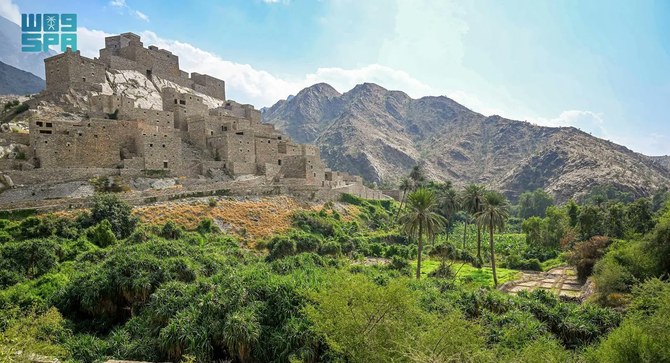
Al-Baha’s monuments: A pivotal testament to civilizational advancement

Nestled in Al-Baha region in southwestern Saudi Arabia lies a treasure trove of ancient architecture in the quaint villages that dot its landscape. (SPA)
Short Url
Updated 19 April 2024
Follow

Al-Baha’s monuments: A pivotal testament to civilizational advancement

  • Characterized by intricate designs, the residential buildings, castles, and forts embody a harmonious fusion of environmental adaptability and cultural resonance

RIYADH: Nestled in Al-Baha region in southwestern Saudi Arabia lies a treasure trove of ancient architecture in the quaint villages that dot its landscape.

Characterized by intricate designs, the residential buildings, castles, and forts embody a harmonious fusion of environmental adaptability and cultural resonance.

Crafted with precision, these structures seamlessly integrate with the rugged terrain and fluctuating climate, while also paying homage to the long-standing customs and traditions of ancient Arab society.

Seventy-three-year-old Mohammed bin Salem Al-Ghamdi told Saudi Press Agency: “For decades, I have dedicated myself to the craft of stone house construction.”

Currently, he and his companions are diligently crafting a stone room, employing stones as their primary building material. Together, as a cohesive team of builders, craftsmen, and eager participants, they collaborate harmoniously to bring their vision to life. He described it as both a hobby and inheritance passed down through generations.
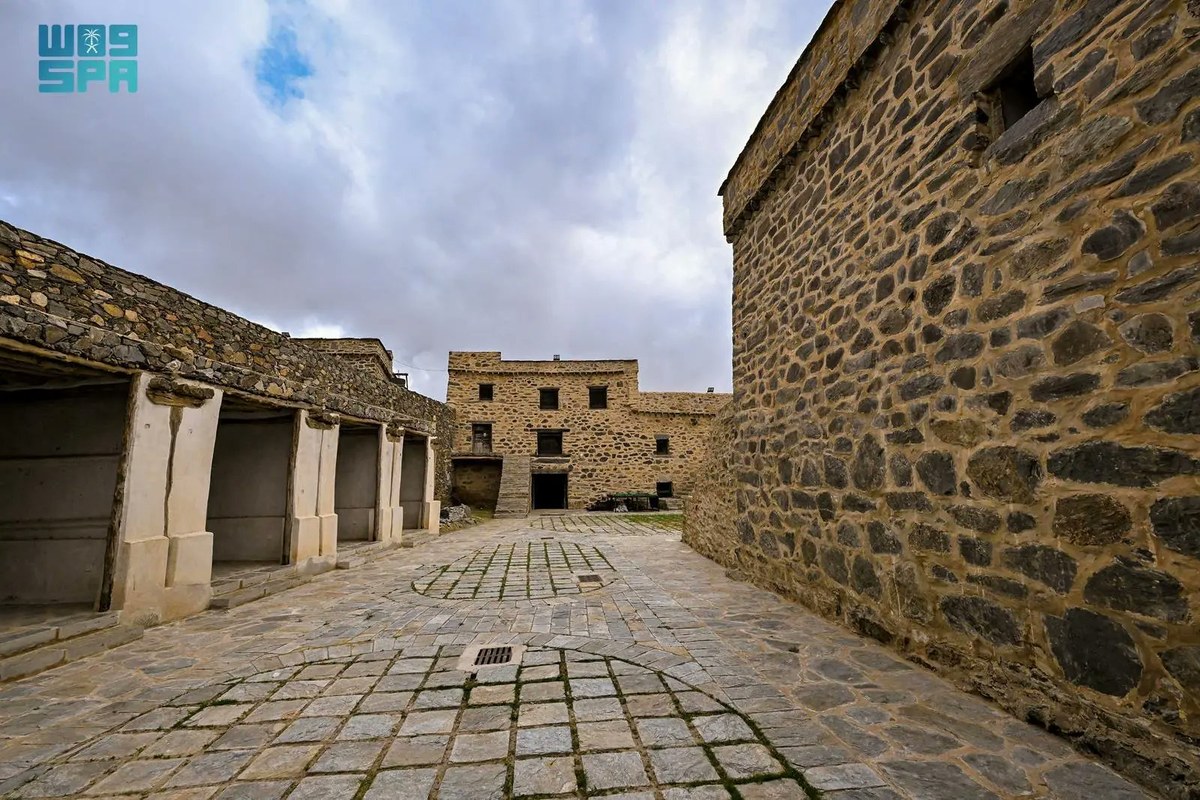
“In every construction endeavor, we rely on what’s known as the cornerstone, strategically positioned at the room’s corners. Additionally, a lengthy stone, referred to as the ‘link,’ is essential for connecting each stone within the structure. We also use sturdy stones known as ‘Al-Mateen’ or ‘Al-Daher’ to fortify the room’s foundation.

“Moreover, we meticulously place ‘Al-Lazza’ stones, tiny yet significant, within the larger stones, ensuring a seamless fit without any gaps or openings in the room’s structure,” he added.

“Once the corners are meticulously stacked and leveled, I proceed to roof the room with wood. This involves utilizing a series of wooden beams cut to specific lengths to interconnect all corners of the room. Next, I scatter small plants across the wooden framework to fully cover the ceiling, upon which clay is applied to secure the structure. This method ensures durability against erosion and rainfall, further reinforced by specific paving techniques.”

Al-Ghamdi emphasized the importance of post-construction plastering with clay, which not only gives the interior an earthy tone but also regulates the temperature — ensuring warmth in winter and coolness in summer.

He mentioned the practical use of juniper trees for doors and windows, facilitating easy replacement and serving a dual purpose in construction.

Dr. Abdulaziz bin Ahmed Hanash, professor of urban design at Al-Baha University, highlighted the profound significance of human construction in Al-Baha region, portraying it as a living chronicle of urban civilization’s evolution over time.

He underscored the traditional architecture and urban legacy of Al-Baha as foundational elements, inherently distinguishing the region. With its wealth of historical landmarks spanning the Sarat and Tihamah regions, the area has gained the attention of state authorities, who aim to nurture its potential as both a summer and winter tourism hotspot through strategic development initiatives.


Saudi Arabia witnessing comprehensive cultural development, says expert

Updated 14 February 2026
Follow

Saudi Arabia witnessing comprehensive cultural development, says expert

  • Clotilde Entrecanales of Acciona hails pace of change in Kingdom

JEDDAH: Museums, exhibitions and art centers play a crucial role in the development of free and educated societies such as the one now burgeoning in Saudi Arabia, an expert has told Arab News.

Clotilde Entrecanales, the Spanish art historian and cultural executive who heads Acciona Living & Culture, a leading creator of technology-driven interactive museums, exhibits and events, said the Kingdom is making efforts to expand the role of culture development to show the world the greatest possible cultural offer.

She added that the Kingdom has quickly infused new energy into the region, and is rapidly establishing itself as a global cultural hub through massive investment in world-class museums, public art and international events, aligning with its 2030 vision.

She said: “With around 70 percent of the population under 30, cultural consumption looks very different than in Europe or the US. These spaces can’t feel like quiet, isolated institutions … they need to be fast, dynamic, brave and deeply connected to the city, blending into everyday urban life rather than sitting apart from it.”

Asked about the role of these sites in the evolving global cultural landscape, particularly in emerging cultural hubs like Saudi Arabia, Entrecanales said: “Our vision is to be a purpose-led partner for cultural and entertainment institutions, helping them be more relevant, connected, inclusive and sustainable.”

She added: “In emerging cultural hubs like Saudi Arabia, that approach feels especially relevant. The cultural transformation underway is moving fast — with major heritage and cultural destinations being developed and opened to the world.”

Speaking about her impression of the Kingdom’s approach to blending heritage with modernity face, Entrecanales said: “Others who attempt to achieve this balance often end up turning heritage into a theme, a layer of storytelling or a cultural program. What feels different about Saudi’s approach is how much pressure there is to treat heritage as the foundation, not just the surface.

“When you’re building at this speed and scale, there’s always a risk that history becomes a backdrop instead of a backbone. The projects that work best are the ones that slow down just enough to let the past set the rhythm for the present.”

Regarding opportunities and challenges, she said: “The opportunity is nothing less than positioning Saudi Arabia as a global cultural center. The challenge, as always, lies in balancing the speed and scale of that ambition with long-term sustainability and a sense of authenticity that remains credible and rooted.”

She added: “You can really feel this in places like the Islamic Arts Biennale, which shows hundreds of historical artefacts of the Islamic world, while re-framing them through contemporary scenography and designs by some of the best design studios in the world; or in AlUla, a world-class heritage site that hosts a major contemporary platform like Desert X, allowing ancient context and present-day artistic practice to coexist in a way that feels genuine.”

Under her guidance, ACCIONA Cultura aspires to create museums and cultural experiences that function as landmarks while fostering sustainable, inclusive and immersive interactions.

She elaborated on how the company is integrating technology, culture, and sustainability to preserve and promote the region’s cultural heritage: “We always start with human connection and storytelling: what’s the story, what should people leave with? Tech comes later.”

Recently, ACCIONA Cultura has been involved in significant projects in Saudi Arabia and is looking forward for more.

She said: “Right now, for example, we’re designing and curating a museum gallery where the entire space is shaped by the practice of a Saudi artist. Another example is the Net Zero exhibition at the King Abdulaziz Center for World Culture (Ithra), where we brought together Saudi and international artists to explore sustainability and our relationship with the planet, including voices like Dina Haddadin, Mohammed Al-Faraj, and Zahrah Al-Ghamdi.”

She added: “One of the projects I’m most proud of isn’t a museum, but our NEXT IN Summit, which we’ve hosted in two editions in our ACCIONA Campus in Madrid, highlighting the Kingdom’s unprecedented cultural momentum as it builds future-facing institutions with a startup mindset.”

About further collaboration with Saudi Arabia, she said: “Let’s just say … something’s definitely simmering in the kitchen.”

Commenting on being recognized among the Blooloop 50 Museum Influencers for 2025, she said: “It means a lot. More than anything, it feels like a nod to the years of teamwork and dedication behind Acciona Cultura, rather than to me personally.”