

French police arrest man who threatened to blow himself up at Iran’s Paris consulate

1 / 3
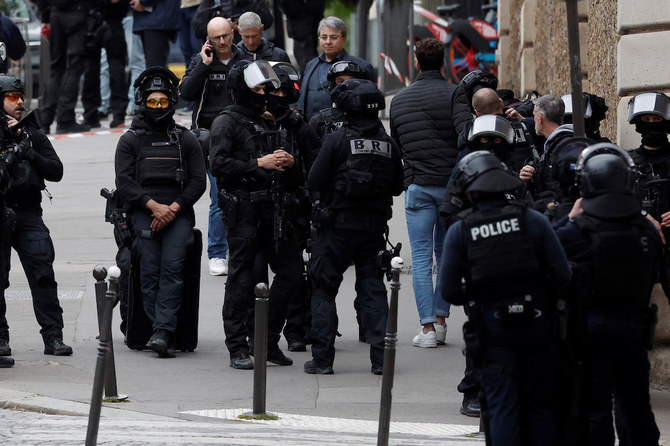
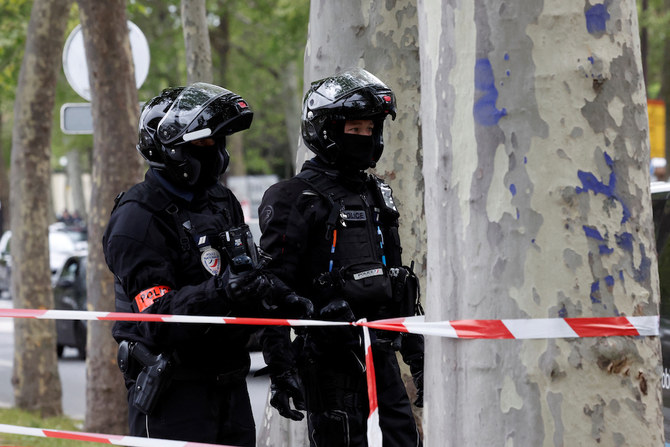
French police cordoned off the Iranian consulate in Paris on Friday following reports that a man was threatening to blow himself up there. (Reuters)
2 / 3
French police cordoned off the Iranian consulate in Paris on Friday following reports that a man was threatening to blow himself up there. (Reuters)
3 / 3
French police cordoned off the Iranian consulate in Paris on Friday following reports that a man was threatening to blow himself up there. (Reuters)
Short Url
Updated 19 April 2024
Follow

French police arrest man who threatened to blow himself up at Iran’s Paris consulate

  • Police verifying man’s identity and trying to determine whether he had weapons

PARIS: A man who had threatened to blow himself up at Iran’s consulate in Paris was arrested by police, a police source said.

French police earlier cordoned off the Iranian consulate, Reuters reporters saw, and did not immediately confirm finding any weapons.

A police source told Reuters the man was seen at about 11 am (0900 GMT) entering the consulate, carrying what appeared to be a grenade and explosive vest.

A Paris police official told The Associated Press that officers were verifying the man’s identity and trying to determine whether he had weapons.

Police earlier said they were at the scene and asked the public to avoid the area but provided no further details.

Service was interrupted on a nearby metro line for security reasons, the RATP metro company said.

A police cordon remained in place on Friday afternoon, but traffic was resuming in the area.

A person at the Iranian embassy who responded to a call from Reuters declined to provide any information on the situation.

It was unclear whether the incident had any link to the escalating tensions between Iran and Israel.

Earlier on Friday, explosions echoed over the Iranian city of Isfahan in what sources described as an Israeli attack, but Tehran played down the incident and indicated it had no plans for retaliation — a response that appeared gauged toward averting region-wide war.

The incident also comes as Paris is gearing up to host the summer Olympics.

* With Reuters and AP


From round fruits to lucky charms: How Filipinos invite prosperous New Year

Updated 59 min 59 sec ago
Follow

From round fruits to lucky charms: How Filipinos invite prosperous New Year

  • Lights are lit, doors and windows open to allow good spirits in
  • Sticky rice dishes are served to keep family sticking together

MANILA: With the dining table set with symbolic foods, a bit of noise and rituals to invite good luck, Filipinos are ready to welcome the New Year, carefully observing every tradition and superstition to bring prosperity.

Media noche or the midnight dinner on New Year’s Eve is central to the celebration. Besides traditional meats, there will be sticky rice dishes to keep the family sticking together, and pancit or long rice noodles to represent long life.

There should also be 13 round fruits prepared specifically for the occasion, with 12 representing each month of the year, and the 13th adding extra luck. Because they are round like coins, they are believed to invite abundance, wealth and prosperity.

“We cook bilo-bilo (sticky rice balls) with coconut milk and palitaw (sweet rice cakes). It’s something we simply grew up with,” said Cel Reyes from Mabini in Batangas province, south of Manila.

“It’s sticky, so it symbolizes togetherness, and it is also round. Anything that’s round is prepared also as a symbol of prosperity.”

In Malabon, a coastal city in the northern part of Metro Manila, Priam Nepomuceno’s 86-year-old mother-in-law sets unhulled rice on the table.

“Because of the gold color, it’s believed to bring luck and abundance,” he said. “Grapes are also hung on the door. They’re not meant to be eaten and are kept hanging for the whole year as a symbol of prosperity.”

Some people also jump when the clock strikes 12, believing it will help them grow taller.

In many households, all lights are lit before midnight, with doors and windows open to allow good spirits to enter, while noise from firecrackers and party horns keeps the bad ones at bay.

“By nature, Filipinos are superstitious. We believe in good luck, deities. We give in to faith and luck, and it’s tied to deep spirituality,” said Juanita Galang-Trinidad, an 80-year-old editor from Bulacan province north of Manila.

“We also put 12 coins in varying amounts in our pockets and wear polka dot clothing. Rice, cereal, and salt containers should be full.”

New Year’s celebrations, like Christmas, bring families together, but with extra traditions for good luck. Beyond the midnight feast and keeping round objects on the table and at hand, Filipinos try to pay off debts to avoid financial trouble in the coming year.

On New Year’s Eve, they also avoid serving chicken, as chickens are believed to scratch backward when they eat, symbolically scratching away good fortune.

“We hold on to our traditions despite these growing changes, modernity, in our environment,” Trinidad said.

“We still hold on to our traditions and customs because they identify us as a people, as Filipinos.”