



DAMASCUS, Syria: Iran’s foreign minister Monday accused the United States of giving Israel the “green light” for a strike on its consulate building in Syria that killed seven Iranian military officials including two generals.
Hossein Amirabdollahian reiterated Tehran’s vows that it will respond to the attack, widely blamed on Israel, that appeared to signify an escalation of Israel’s targeting of military officials from Iran, which supports militant groups fighting Israel in Gaza, and along its border with Lebanon.
Hezbollah leader Hassan Nasrallah in an address Monday reiterated the Iran-backed group’s support for a Tehran military response to the attack that killed Gen. Mohammad Reza Zahedi, a senior military official in the Iranian Revolutionary Guard’s Quds Force, and worsened fears of the war spiraling into the rest of the Middle East.
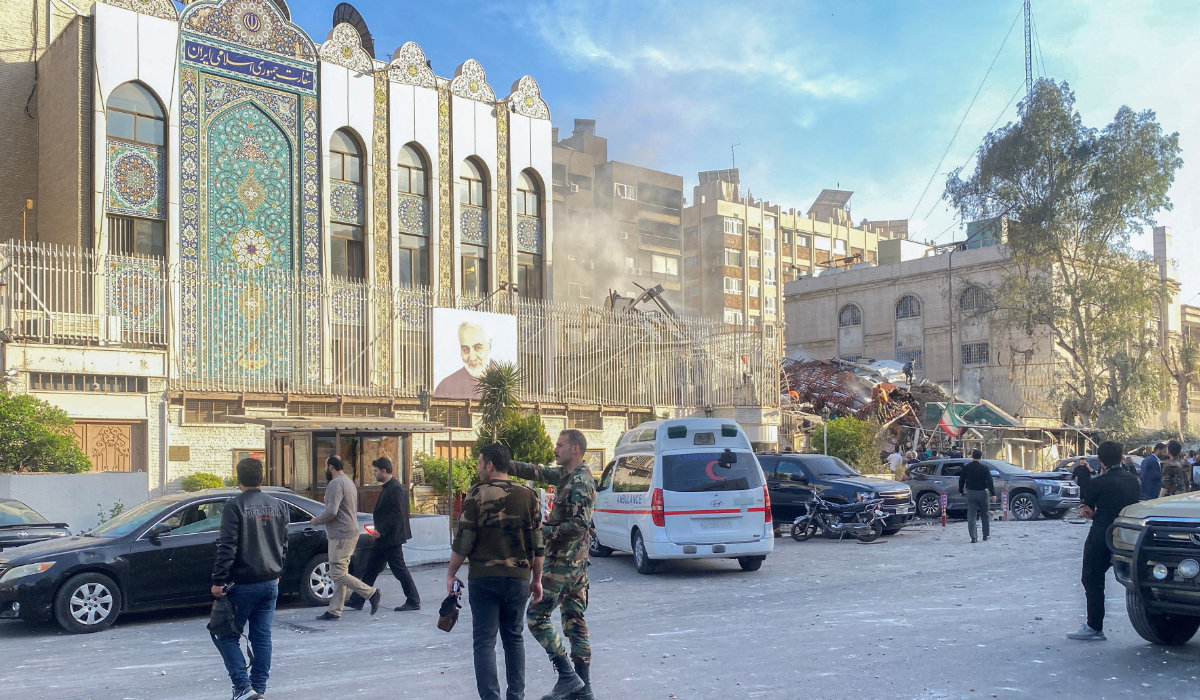
Smoke rises after what the Iranian media said was an Israeli strike on a building close to the Iranian embassy in Damascus, Syria April 1, 2024. (REUTERS)
Since the war in Gaza began six months ago, clashes have increased between Israel and Lebanon’s Hezbollah. Hamas, which rules Gaza and attacked Israel on Oct. 7, is also backed by Iran, as well as an umbrella group of Iraqi militias targeting US military bases and positions in Syria and Iraq.
Though Israel has regularly conducted strikes targeting Iranian military officials and allies, Zahedi’s death was the most significant blow for Tehran since a US drone targeted and killed Quds Force chief Gen. Qassim Soleimani in 2020 in Baghdad.
“I’d like to say with a very loud voice from here in Damascus that America has a responsibility in what happened and must be held responsible,” Amirabdollahian told reporters in Damascus during a visit where he met his Syrian counterpart, Faisal Mekdad, who condemned both the strike and Israel’s offensive in Gaza. Amirabdollahian also met President Bashar Assad, with whom he discussed Gaza and the wider situation in the region, a statement from Assad’s office said.
The Iranian foreign minister, who earlier that day inaugurated the opening of a new consular section in a nearby building, justified his claims by saying that Washington and “two European countries” did not condemn the attack on the diplomatic building.
He said that failure to condemn the attack “indicates that Washington had given the green light to Israel to commit this crime.”
The Biden administration has insisted that it had no advance knowledge of the airstrike. Washington is Israel’s vital military ally.
Israel, which rarely acknowledges strikes against Iranian targets, said it had no comment on the strike in the Syrian capital. However, Pentagon spokeswoman Sabrina Singh said last week that the US has assessed Israel was responsible.
Initially after the strikes, Iranian state media said Zahedi led the Quds Force in Lebanon and Syria until 2016.
Then, in a public address Monday, Hezbollah leader Hassan Nasrallah said Zahedi was a key figure for the Lebanese group, and had three four-year stints in the tiny Mediterranean country.
Nasrallah, like Syria, and other key allies of Tehran, have said they remain committed to backing Iran.
“It’s a natural right for Iran. It’s natural for the Islamic Republic to conduct this response (to the consulate attack),” Nasrallah said.
Nasrallah said Zahedi’s first involvement was until 2002, overseeing Israel’s withdrawal from southern Lebanon, and helping Hezbollah scale up. Zahedi’s second term covered some of the fiercest fighting in Syria’s uprising turned civil war, where Tehran and Russia played a key role in backing Assad against opposition forces. Zahedi’s final stint began in 2020 and ended when he was killed.
Hezbollah militants and Israeli troops have clashed along the tense Lebanon-Israel border since Oct. 8, the day after the Hamas attack on southern Israel.
The Hezbollah leader said that the moment the clashes began, Zahedi reportedly wanted to join Hezbollah militants on the front line but wasn’t permitted to do so.
Earlier Monday, Israeli airstrikes over southern Lebanon killed Ali Ahmad Hussein, an elite commander of Hezbollah’s secretive Radwan Force. Hezbollah announced Hussein’s death, but did not give any details on the circumstances or his role with the group in line with how it makes public the deaths of its members.
The killing of Hussein, one of the most senior militants slain thus far, came ahead of the Iranian foreign minister’s visit to Syria.
Israel considers Hezbollah its most serious immediate threat, estimating it has some 150,000 rockets and missiles, including precision-guided missiles that can hit anywhere in Israel. The group, which has thousands of battle-hardened fighters who participated in Syria’s 12-year conflict, also has different types of military drones.
In January, Israeli jets struck and killed another elite Hezbollah commander from the Radwan Force, Wissam Al-Tawil, who fought with the group for decades and took part in some of its biggest battles.
Hezbollah says it will stop firing rockets once a ceasefire is reached in the Gaza Strip that would end the Israel-Hamas war. Israeli officials have been demanding that the Radwan Force withdraw from the border area in order for tens of thousands of displaced Israelis to return home.
Washington and Paris have been scrambling to find a diplomatic resolution to halt the fighting along the Lebanon-Israel border, hoping to prevent a new all-out war between Hezbollah and Israel since a month-long war in the summer of 2006.
The risk of war spreading to Lebanon has worsened existing political tensions within the country between Hezbollah and their most vocal opponent, the nationalist Christian Lebanese Forces party.
Matters worsened Monday when the Lebanese military announced the death of a Lebanese Forces local official who had been kidnapped a day earlier in northern Lebanon. The Lebanese Army said they detained three Syrians accused in the kidnapping and killing of Pascale Suleiman as they tried to steal his car.
The Lebanese Forces party cast doubt on the army’s findings, saying they believed it was a political assassination.
Nasrallah in his speech slammed members of the Christian party and allies who had accused Hezbollah of being involved in the kidnapping. calling it “baseless” and dangerous rhetoric.


