

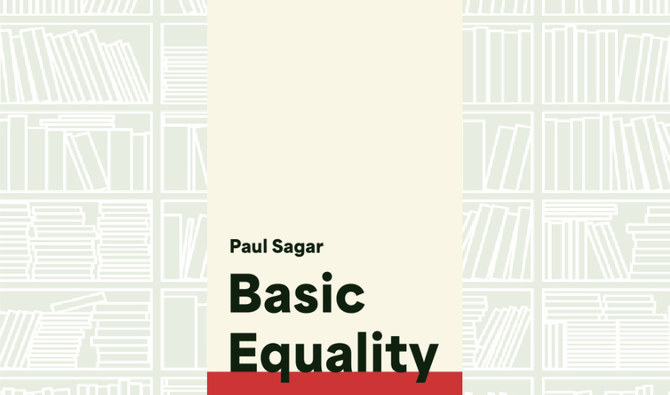
What We Are Reading Today: Basic Equality

Short Url
Updated 17 April 2024
Follow

What We Are Reading Today: Basic Equality

Author: Paul Sagar

What makes human beings one another’s equals? That we are “basic equals” has become a bedrock assumption in Western moral and political philosophy. 

And yet establishing why we ought to believe this claim has proved fiendishly difficult, floundering in the face of the many inequalities that characterise the human condition. 

In this provocative work, Paul Sagar offers a novel approach to explaining and justifying basic equality. Rather than attempting to find an independent foundation for basic equality, he argues, we should instead come to see our commitment to this idea as the result of the practice of treating others as equals. 

Moreover, he continues, it is not enough to grapple with the problem through philosophy alone — by just thinking very hard, in our armchairs; we must draw insights from history and psychology as well.


What We Are Reading Today: The Political Economy of Security by Stephen G. Brooks

Updated 04 March 2026
Follow

What We Are Reading Today: The Political Economy of Security by Stephen G. Brooks

In this book, Stephen Brooks provides a systematic empirical and theoretical examination of how economic factors influence security affairs. Empirically, he analyzes how economic variables of all kinds affect interstate war, terrorism, and civil war; in total, 16 pathways are examined.

Brooks shows that the relationship between economic factors and conflict is complex and multifaceted; discrete economic factors—such as international trade, economic development, and globalized manufacturing, to name a few—are sometimes helpful for promoting peace and stability, but at other times are detrimental.

Brooks also develops a stronger theoretical foundation for guiding future research on the economics-security interaction. 

Drawing on Adam Smith, he provides a more complete range of answers to the three key conceptual questions analysts must consider: how economic goals relate to security goals; what economic factors to focus on; and how economic actors influence security policies.

Combining an innovative theoretical understanding with empirical rigor, Brooks’s account will reshape our understanding of the political economy of security.