

Hezbollah’s attack on Israeli military command center injures 14

1 / 2
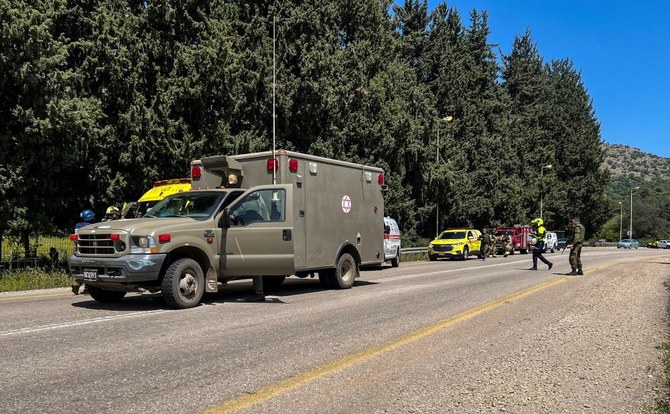
Emergency services respond to an incident, amid ongoing cross-border hostilities between Hezbollah and Israeli forces, near Arab Al-Aramshe, northern Israel, Apr. 17, 2024. (Reuters)
2 / 2
A Lebanese man collects books from a house that was destroyed by an Israeli airstrike, in Mansouri village, south Lebanon, Wednesday, Apr. 17, 2024. (AP Photo)
Short Url
Updated 17 April 2024
Follow

Hezbollah’s attack on Israeli military command center injures 14

  • Iran-backed group takes confrontations to new level, directly targets soldiers
  • Hezbollah said operation was a ‘response to the killing of several resistance fighters in Ain Baal and Shehabiya in southern Lebanon’

BEIRUT: The Iran-backed Hezbollah launched on Wednesday “a combined attack with guided missiles and explosive drones on a military reconnaissance command center in Arab Al-Aramshe,” as it targeted the Israeli army south of the border with Lebanon.

The group claimed responsibility for the operation, saying that “it is in response to the killing of several resistance fighters in Ain Baal and Shehabiya in southern Lebanon.”

Israeli media outlets announced that “a kamikaze drone struck an Israeli army gathering in Arab Al-Aramshe, western Galilee, resulting in six casualties, at least.”

They added: “An Israeli army helicopter was hit while rescuing the injured in Arab Al-Aramshe.”

The Galilee Medical Center in Nahariya said that it had received 14 injured people.

Hezbollah has adopted new tactics of late. According to a security source, these “were seen last week, when it (Hezbollah) detonated explosive devices targeting Israeli soldiers on the border, injuring four Golani Brigade members.”

The source added that Hezbollah “has taken the confrontations to another level by directly targeting Israeli soldiers.”

Israeli forces launched immediate retaliation by bombing and targeting phosphorus bombs on the border area.

This region included the outskirts of Rachaya Al-Fekhar, Fardis, Al-Habbariyeh, Alma Al-Shaab, Dhahira, Marwahin, and Yarin, as well as the city of Nabatieh, where a house belonging to the Sayyed family was destroyed.

No casualties were reported in the incidents, but the border region has witnessed the Israeli military’s dramatic targeting and killing of two key figures.

Hezbollah is mourning the death of Ismail Youssef Baz, a senior commander of the organization, while the Amal Movement — an ally of Hezbollah — has been coming to terms with the death of Hussein Qasim Karsht.

Israeli media reported that Baz, who was killed in his car following a drone attack, was “the commander of Hezbollah’s coastal sector.”

It added: “He was working on promoting and planning the launching of rockets and anti-tank missiles toward Israel from the Lebanese coastline. During this ongoing war, he organized and planned to carry out various plans against Israel.”

The children in Israel’s prisons
Ongoing hostage-for-prisoners exchange opens the world’s eyes to arrests, interrogations, and even abuse of Palestinian children by Israeli authorities

Enter


keywords

Morocco deploys army to help evacuate thousands after floods

Updated 31 January 2026
Follow

Morocco deploys army to help evacuate thousands after floods

  • More than 20,000 people had been moved ⁠to shelter and camps by Saturday
  • Authorities set up sandbags and temporary barriers in flood-prone districts as waters began to recede

RABAT: Morocco has deployed army rescue units to help with the evacuation of thousands of people after floods triggered by torrential rains and rising river levels hit parts of the country’s northwest, state TV reported on Saturday.
Weeks of heavy rainfall, combined with water releases from a nearly full dam nearby, increased water levels in the ⁠Loukous River and flooded several neighborhoods in the city of Ksar Kbir, about 190 km (118 miles) north of the capital Rabat, a national flood follow-up committee said.
More than 20,000 people had been moved ⁠to shelter and camps by Saturday, official media reported.
Authorities set up sandbags and temporary barriers in flood-prone districts as waters began to recede.
Schools in Ksar Kbir have been ordered to remain closed until February 7 as a precaution.
In the nearby province of Sidi Kacem, the Sebou River’s rising levels prompted evacuations ⁠from several villages as authorities raised vigilance levels.
The abundant rainfall ended a seven-year drought that drove the country to invest heavily in desalination plants.
The average dam-filling rate has risen to 60 percent, with several major reservoirs reaching full capacity, according to official data.
Last month, 37 people were killed in flash floods in the Atlantic coastal city of Safi, south of Rabat.