US university pulls student speech after Jewish groups object

A man looks at his cellphone while walking at the University of Southern California (USC) in Los Angeles, California. (AFP file photo)
Short Url
Updated 17 April 2024
Follow

US university pulls student speech after Jewish groups object

  • Israel has killed at least 33,843 people in Gaza, mostly women and children, according to the health ministry in the Hamas-run territory

LOS ANGELES: A top US university has canceled its plans for a graduation speech by a Muslim student over what it says are safety concerns, after pro-Israel groups criticized her selection.
The decision by the University of Southern California is the latest controversy to roil American higher education since the conflict between Israel and Hamas erupted in October.
Asna Tabassum, who has been attacked online for “antisemitic and anti-Zionist rhetoric,” had been selected as class valedictorian — an honorary role whose holder traditionally gives an address in front of up to 65,000 people.
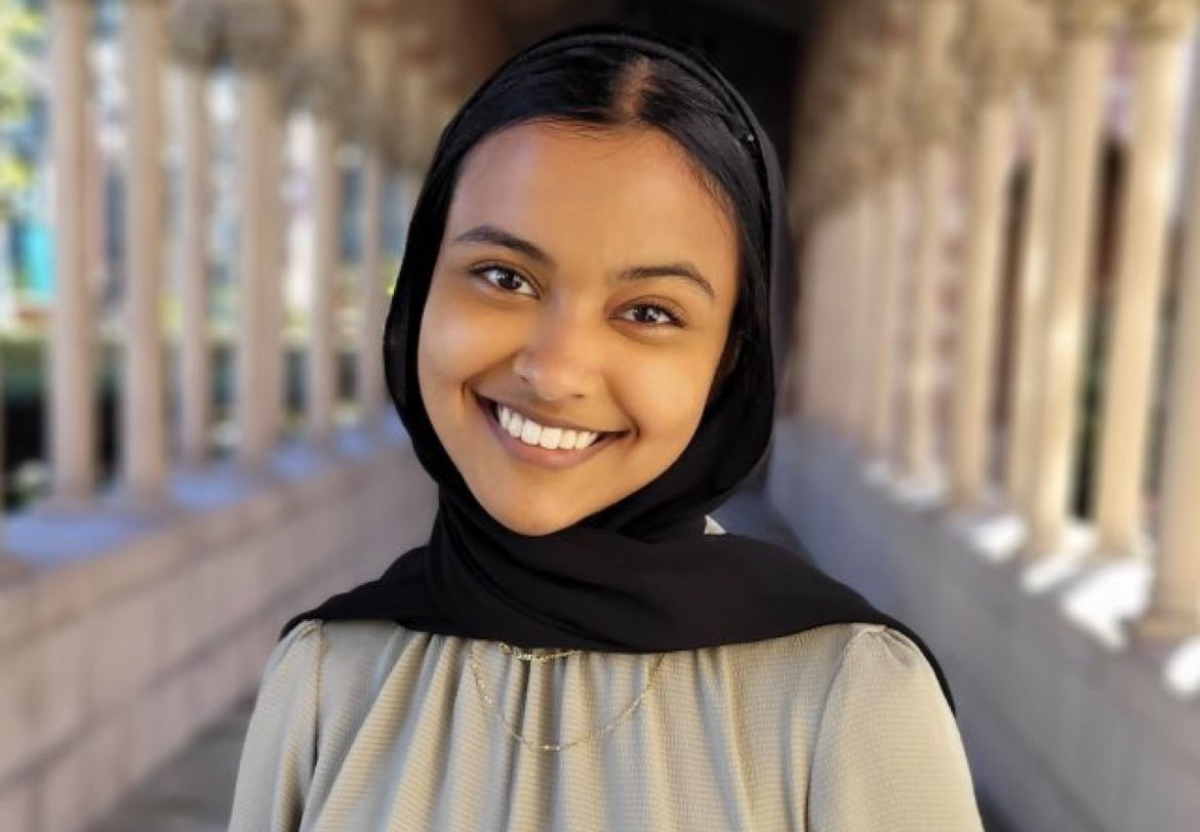


Asna Tabassum. (Photo/ social media)

But on Monday the university’s provost, Andrew Guzman, announced the May 10 ceremony would go ahead without the speech.
“Unfortunately, over the past several days, discussion relating to the selection of our valedictorian has taken on an alarming tenor,” Guzman said in a statement.
“The intensity of feelings, fueled by both social media and the ongoing conflict in the Middle East, has grown to include many voices outside of USC and has escalated to the point of creating substantial risks relating to security.”
Guzman’s statement gave no specifics, but the Los Angeles Times quoted Erroll Southers, the university’s associate senior vice president for safety and risk assurance, as saying the institution had received threats by email, phone and letter.
Individuals “say they will come to the campus,” he said.
Tabassum criticized the decision, which she said was the result of the university “succumbing to a campaign of hate meant to silence my voice.”
“Although this should have been a time of celebration for my family, friends, professors, and classmates, anti-Muslim and anti-Palestinian voices have subjected me to a campaign of racist hatred because of my uncompromising belief in human rights for all,” she said in a statement.
The Hamas attack that started the war on October 7 resulted in the deaths of 1,170 people, mostly civilians, according to Israeli figures.
Israel’s retaliatory offensive has killed at least 33,843 people in Gaza, mostly women and children, according to the health ministry in the Hamas-run territory.
The fallout from the conflict has been felt around the world, and is particularly intense on US college campuses, where both pro-Israel and pro-Palestinian groups say they are being victimized and silenced.
On Wednesday the president of the prestigious Columbia University in New York will become the latest campus leader to face questions from US lawmakers about whether her institution is doing enough to combat anti-Semitism in the student body.

The children in Israel’s prisons
Ongoing hostage-for-prisoners exchange opens the world’s eyes to arrests, interrogations, and even abuse of Palestinian children by Israeli authorities

Enter


keywords

US allies, foes alarmed by capture of Venezuela’s Maduro

Updated 55 min 26 sec ago
Follow

US allies, foes alarmed by capture of Venezuela’s Maduro

  • Countries such as Russia and China, which had ties with Maduro’s government, were quick to condemn the operation but alarm also shared by France and EU
  • UN Secretary-General Antonio Guterres was “deeply alarmed” by the US strikes

PARIS: The US military operation that led to the seizure of Venezuelan President Nicolas Maduro on Saturday sparked alarm across the international community, with allies and foes of Washington and Caracas expressing disquiet.
US President Donald Trump said Maduro and his wife would be taken to New York to face federal charges after military strikes and an operation which he described as looking like a “television show.”
The Venezuelan government decried what it termed a “extremely serious military aggression” by Washington and declared a state of emergency.
Countries such as Russia and Iran, which had longstanding ties with Maduro’s government, were quick to condemn the operation but their alarm was also shared by Washington’s allies including France and the EU.
Here is a rundown of the main reaction.

Russia

Russia demanded the US leadership “reconsider its position and release the legally elected president of the sovereign country and his wife.”

China

Beijing said “China is deeply shocked and strongly condemns the US’s blatant use of force against a sovereign state and its action against its president.”

Iran

Iran, which Trump bombed last year, said it “strongly condemns the US military attack on Venezuela and a flagrant violation of the country’s national sovereignty and territorial integrity.”

Mexico

Mexico, which Trump has also threatened with military force over drug trafficking, strongly condemned the US military action in Venezuela, saying it “seriously jeopardizes regional stability.”

Colombia

Colombian President Gustavo Petro — whose country neighbors Venezuela — called the US action an “assault on the sovereignty” of Latin America which would lead to a humanitarian crisis.

Brazil

Brazilian President Luiz Inacio Lula da Silva slammed the US attacks as a “serious affront” to Venezuela’s sovereignty.

Cuba

Cuba, a strong ally of Venezuela, denounced “state terrorism against the brave Venezuelan people.”

Spain

Spain offered to mediate in the crisis to find a way to a peaceful solution, while calling for “de-escalation and restraint.”

France

France condemned the US operation, saying it undermined international law and no solution to Venezuela’s crisis can be imposed from the outside.

EU

The EU more generally expressed concern at the developments and urged respect for international law, even as it noted that Maduro “lacks legitimacy.”
EU candidate country North Macedonia, along with fellow Balkan nations Albania and Kosovo, backed Washington, however.
“We stand with the United States and the Venezuelan people for freedom and democracy,” North Macedonia FM Timco Mucunski said on X.

Britain

British Prime Minister Keir Starmer said all countries should “uphold international law” and added that “the UK was not involved in any way in this operation” as he urged patience in order to “establish the facts.”

Italy

In a rare expression of support for the US operation by a major European country, far-right Italian Prime Minister Giorgia Meloni — a Trump ally — argued the US military action in Venezuela was “legitimate” and “defensive.”

Israel

Israel also hailed the operation, saying Washington acted as the “leader of the free world.”

Ukraine

Ukraine — dependent on US support in its war against invading Russia — did not address the legality of a big country like America using military force against a much smaller one like Venezuela.
Foreign minister Andriy Sybiga instead focused on Maduro’s lack of legitimacy and the Venezuelan government’s repression, while backing “democracy, human rights, and the interests of Venezuelans.”

South Africa

South Africa, which Trump accuses of alleged discrimination — and even “genocide” — of minority white Afrikaners, said: “Unlawful, unilateral force of this nature undermines the stability of the international order and the principle of equality among nations.”

UN

UN Secretary-General Antonio Guterres was “deeply alarmed” by the US strikes, with his spokesman quoting him as saying it could “constitute a dangerous precedent.”