

Pakistan raises petroleum prices citing ‘increasing trend’ in international market

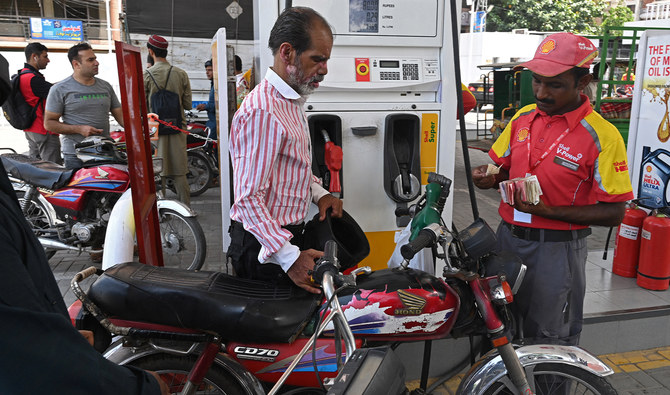
An employee fills petrol in a motorcycle at a fuel station in Lahore on August 1, 2023. (AFP/File)
Short Url
Updated 16 April 2024
Follow

Pakistan raises petroleum prices citing ‘increasing trend’ in international market

  • Pakistan has increased the prices of petrol by 4.53 rupees ($0.016) to 293.94 rupees
  • Government also increases price of high speed diesel by 8.14 rupees to 290.38 rupees

KARACHI: Pakistan has increased the price of petrol by 4.53 rupees ($0.016) to 293.94 rupees with effect from today, Tuesday, the finance ministry said in a statement, citing rising petroleum prices internationally. 

The government also increased the price of high speed diesel by 8.14 rupees to 290.38 rupees, the post said.

The price hikes come as Pakistan has initiated discussions with the IMF over a new multi-billion-dollar loan agreement as its current nine-month, $3 billion loan program expires with the disbursement of a final $1.1 billion tranche likely to be approved later this month.

Reforms linked to that bailout, including an easing of import restrictions and a demand that subsidies be removed, fueled record inflation, with the rupee hitting all-time lows. Authorities also raised petrol and diesel prices to record highs to meet conditionalities. 

“The prices of Petroleum products have seen an increasing trend in the international market during the last fortnight,” the finance ministry said as it announced the new prices. 

“The Oil & Gas Regulatory Authority (OGRA) has worked out the consumer prices, based on the price variations in the international market.”

Under the last IMF bailout, Pakistan was told to prevent further accumulation of circular debt in its power sector, arising from subsidies and unpaid bills. For a new program, the South Asian nation will need to implement reforms to reduce costs by improving electricity transmission and distribution, moving captive power into the grid, improving governance, and combating theft. 

It will also have to maintain power and gas tariffs at levels that ensure cost recovery, with adjustments made to safeguard the financially vulnerable, through existing progressive tariff structures.

In a report released in January, the IMF noted Pakistan missed its target for power sector arrears, largely due to lower-than-expected recoveries and tariffs.


Pakistani, Bangladeshi officials discuss trade, investment and aviation as ties thaw

Updated 28 December 2025
Follow

Pakistani, Bangladeshi officials discuss trade, investment and aviation as ties thaw

  • Pakistan and Bangladesh were once one nation, but they split in 1971 as a result of a bloody civil war
  • Ties between Pakistan, Bangladesh have warmed up since last year and both nations have resumed sea trade

ISLAMABAD: Pakistan's High Commissioner to Bangladesh Imran Haider on Sunday met Chief Adviser Muhammad Yunus in Dhaka, the latter's office said on, with the two figures discussing trade, investment and aviation.

Pakistan and Bangladesh were once one nation, but they split in 1971 as a result of a bloody civil war, which saw the part previously referred to as East Pakistan seceding to form the independent nation of Bangladesh.

Ties between Pakistan and Bangladesh have warmed up since former prime minister Sheikh Hasina’s ouster as a result of a student-led uprising in August 2024. Relations remain frosty between Dhaka and New Delhi over India’s decision to grant asylum to Hasina.

Pakistan has attempted to forge closer ties with Bangladesh in recent months and both South Asian nations last year began sea trade, followed by efforts to expand government-to-government commerce.

"During the meeting, both sides discussed ways to expand cooperation in trade, investment, and aviation as well as scaling up cultural, educational and medical exchanges to further strengthen bilateral relations between the two South Asian nations," Yunus's office said in a statement on X.

In 2023-24 Pakistan exported goods worth $661 million to Bangladesh, while its imports were only $57 million, according to the Trade Development Authority of Pakistan. In Aug. this year, the Pakistani and Bangladeshi commerce ministries signed a memorandum of understanding to establish a Joint Working Group on Trade, aiming to raise their bilateral trade volume to $1 billion in the financial year that began in July.

The Pakistani high commissioner noted that bilateral trade has recorded a 20 percent growth compared to last year, with business communities from both countries actively exploring new investment opportunities, according to the statement.

He highlighted a significant increase in cultural exchanges, adding that Bangladeshi students have shown strong interest in higher education opportunities in Pakistan, particularly in medical sciences, nanotechnology, and artificial intelligence. Haider also said that Dhaka-Karachi direct flights are expected to start in January.

"Chief Adviser Professor Muhammad Yunus welcomed the growing interactions between the two countries and emphasized the importance of increased visits as well as cultural, educational and people-to-people exchanges among SAARC (South Asian Association for Regional Cooperation) member states," the statement read.

"Professor Yunus also underscored the need to further boost Bangladesh–Pakistan trade and expressed hope that during Mr. Haider’s tenure, both countries would explore new avenues for investment and joint venture businesses."