

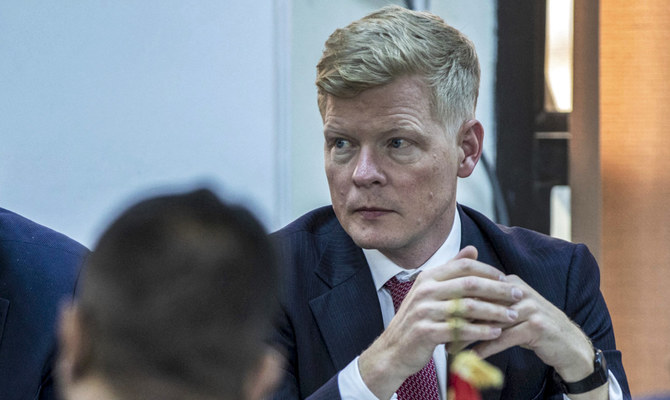

NEW YORK CITY: The UN’s special envoy for Yemen on Monday said that while it is clear that the war in the country has connections to other conflicts in the region, “we owe it to the Yemenis to ensure that resolving the conflict in Yemen is not made contingent upon the resolution of other issues.”
Hans Grundberg added: “We cannot risk Yemen’s chance for peace becoming collateral damage” caused by other conflicts.
Speaking during a meeting of the Security Council to discuss the latest developments in the country, he said the threat of further attacks the Red Sea persists in absence of a ceasefire in Gaza, the urgent need for which was underscored by the latest escalation in hostilities between Israel and Iran.
Since the war between Hamas and Israel in Gaza began in October, attacks by the Iran-backed, Yemen-based Houthis on international shipping have continued to cause disruption to trade routes in the Red Sea. The militant group has threatened to continue the attacks until Israel ends its assault on Gaza. The UK and the US began to launch retaliatory military strikes against Houthi targets in Yemen in January.
There is an acute need for a deescalation of conflicts on a broader regional basis, Grundberg said as he warned: “If we leave Yemen’s political process in the waiting room and continue down this path of escalation, the consequences could be catastrophic, not only for Yemen but also for the wider region.”
Grundberg lamented that in contrast to last year, there was not much to celebrate this year during Eid Al-Fitr in Yemen.
“Detainees we had hoped would be released in time to spend Eid with their loved ones remain in detention,” he said. “Roads we had hoped to see open remain closed.
“We also witnessed the tragic killing and injury of 16 civilians, including women and children, when a residence was demolished by Ansar Allah individuals in Al-Bayda governorate,” he added, using the official name for the Houthis.
Briefing council members on the humanitarian situation in Yemen, Edem Wosornu, the director of operations and advocacy at the UN Office for the Coordination of Humanitarian Affairs, highlighted the rising levels of food insecurity in the country over recent months.
She said the situation deteriorated further after the World Food Program suspended the distribution of food aid in areas controlled by the Houthis in December 2023. This pause followed disagreements with local authorities about who should receive priority assistance, and was compounded by the effects of a severe funding crisis on WFP humanitarian efforts in Yemen.
It comes as greater percentage of households in southern Yemen struggle to obtain sufficient supplies of food compared with those in the north, in part because of the historically low exchange rate of Yemeni rial against the US dollar in areas controlled by the internationally recognized government.
“The most vulnerable people — including women and girls, marginalized groups such as the Muhamasheen, internally displaced people, migrants, asylum seekers and refugees, and persons with disabilities — still depend on humanitarian assistance to survive,” said Wosornu.
She also voiced concern about an increase in cases of cholera in Yemen amid the continuing deterioration of public services and institutions.
“The reemergence of cholera, and growing levels of severe malnutrition, are telling indicators of the weakened capacity of social services,” she told the council.
“Almost one in every two children under 5 are stunted, more than double the global average: 49 per cent compared to 21.3 per cent.
“Emergency stocks of essential supplies are almost depleted. And water, sanitation and hygiene support systems need urgent strengthening.”
The humanitarian response plan for Yemen is only 10 percent funded, with funding of its food security and nutrition programs standing at just 5 percent and 3 percent respectively, according to an informal update presented to the Security Council by the OCHA this week. Wosornu appealed to the international community to take urgent action to help fill the funding gaps.
The US deputy ambassador to the UN, Robert Wood, urged council members to persist in their demands that the Houthis halt attacks on shipping in the Red Sea.
“We must also do more to underscore the council’s concern regarding the Iranian origin of weapons used by the Houthis, and the ongoing violations of the arms embargo,” he added.
“It is no secret that Iran provides weapons to the Houthis in violation of the UN arms embargo. We repeat our call for Iran to stop these illegal weapons transfers and to stop all activities that facilitate the Houthis’ reckless attacks.
“Iran’s continuous efforts to foment instability and terror in the region, as demonstrated through this weekend’s unprecedented attacks by Iran against the State of Israel, need to be strongly condemned by this council.”


