Finance minister discusses investment plans with US-Pakistani businessmen in Washington 

Pakistan's Federal Minister for Finance and Revenue, Muhammad Aurangzeb (left), attends a meeting in Washington, US, on April 15, 2024. (Pakistan Finance Ministry)
Short Url
Updated 15 April 2024
Follow

Finance minister discusses investment plans with US-Pakistani businessmen in Washington 

  • Muhammad Aurangzeb arrived in the US on Sunday to participate in spring meetings of the IMF, World Bank
  • Pakistan is in need of external financing to shore up forex reserves to escape another macroeconomic crisis

ISLAMABAD: Pakistan’s Finance Minister Muhammad Aurangzeb on Monday met with a delegation from the US-Pakistan Business Council (USPBC) in Washington D.C. and discussed with them his government’s commitment to improving business climate in Pakistan.

Aurangzeb arrived in Washington D.C. on Sunday to participate in spring meetings of the International Monetary Fund (IMF) and the World Bank, amid Islamabad’s efforts to reach an agreement with the IMF for a new loan program by June this year.

The South Asian country of more than 240 million people remains in desperate need of external financing to shore up its foreign exchange reserves and escape yet another macroeconomic crisis after it barely averted a default last year, thanks to a $3 billion IMF program.

In order to overcome the present economic woes, Islamabad has been making efforts to attract foreign direct investment to keep the $350 billion economy afloat.

“During the meeting, the Finance Minister highlighted the government’s dedication to attracting both foreign and domestic investments in key sectors,” Aurangzeb’s ministry said in a statement. “These sectors include agriculture, IT, mines & minerals, and energy.”
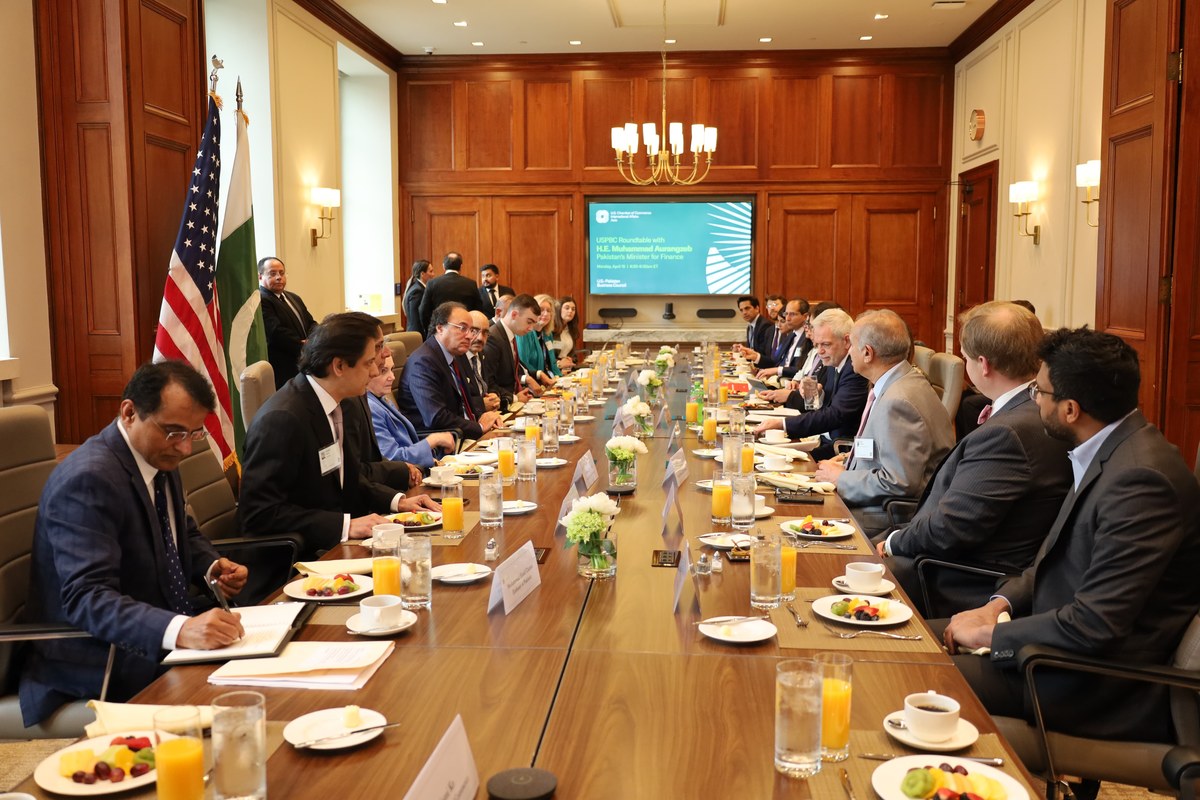


Pakistan's Federal Minister for Finance and Revenue, Muhammad Aurangzeb (5L), meets with a delegation from the US Pakistan Business Council in Washington, US, on April 15, 2024. (Pakistan Finance Ministry)

The statement came days after Aurangzeb met with Prime Minister Shehbaz Sharif to discuss Pakistan’s economic strategy ahead of his meetings with IMF and World Bank officials.

“He discussed with the prime minister his scheduled meetings with the International Monetary Fund, World Bank and other organizations during the visit,” the Pakistani finance ministry said. “The overall economic situation of the country was also discussed in the meeting.”

Pakistan this month completed a final review of its current $3 billion IMF deal that cleared the way for the disbursement of a final tranche of nearly $1.1 billion. The South Asian country is now looking for another bailout program.

Last week, IMF chief Kristalina Georgieva confirmed Pakistan was in discussions with her organization on a potential follow-up loan program to its nine-month, $3 billion stand-by arrangement (SBA).

The IMF chief recognized Pakistan’s commitment to structural economic reforms during an event at the Atlantic Council think tank in Washington. She, however, noted that some important issues, including the tax base and overall economic transparency, were yet to be addressed by Pakistani authorities.


Bangladesh approves new rice imports from Pakistan amid price pressures

Updated 10 sec ago
Follow

Bangladesh approves new rice imports from Pakistan amid price pressures

  • The deal follows Bangladesh’s resumption of direct rice trade with Pakistan earlier this year ⁠for the first time since independence in 1971
  • Diplomatic ties between the two nations have improved since the ouster of prime minister Sheikh Hasina after mass protests last year

DHAKA: Bangladesh has approved the import of 50,000 metric tons of white rice from Pakistan under a government-to-government deal as ​part of efforts to stabilize domestic prices, officials said on Tuesday.

The Cabinet Committee on Government Purchase cleared the deal at $395 per ton, reinforcing Dhaka’s renewed trade engagement with Islamabad.

Rice prices in Bangladesh have jumped by between 15 percent and 20 percent over ‌the past ‌year, with medium-quality ‌rice ⁠selling ​at about ‌80 taka ($0.66) per kilogram. Despite increased imports and the removal of duties to ease supply constraints, prices for the staple grain remain stubbornly high.

The deal follows Bangladesh’s resumption of direct rice trade with Pakistan earlier this year ⁠for the first time since independence in 1971. In ‌February, it imported 50,000 ‍tons of rice from ‍Pakistan at $499 per ton under a ‍similar agreement.

Diplomatic ties between the two South Asian nations have improved since an interim government led by Nobel laureate Muhammad Yunus took office after ​mass protests forced then prime minister Sheikh Hasina to flee to neighboring ⁠India last year.

Formerly East Pakistan, Bangladesh gained independence after a nine-month war in 1971, and relations with Pakistan have remained fraught in the decades since the conflict.

Separately, the government approved another 50,000 tons of parboiled rice through an international tender, part of a series of recent purchases aimed at cooling local prices. India’s Pattabhi Agro Foods secured ‌the contract with the lowest bid of $355.77 per ton.