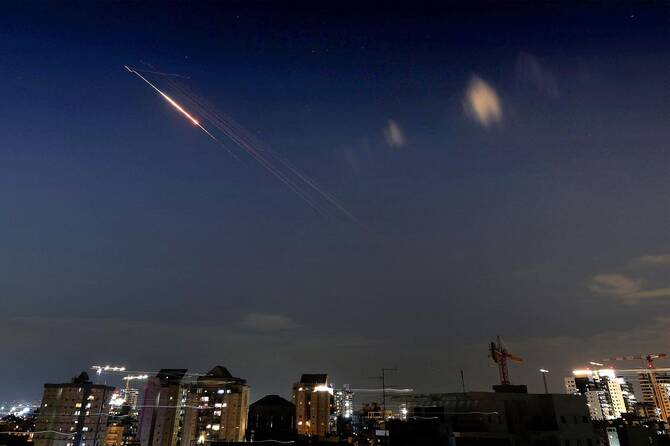

PALESTINIAN TERRITORIES: Israel struck war-battered Gaza overnight, Hamas and witnesses said Monday, as world leaders urged de-escalation awaiting Israel’s reaction to Iran’s unprecedented attack that heightened fears of wider conflict.
The health ministry in Hamas-run Gaza said Monday that at least 33,797 people have been killed in the territory during more than six months of war between Israel and Palestinian militants.
The toll includes at least 68 deaths over the past 24 hours, a ministry statement said, adding that 76,465 people have been wounded in the Gaza Strip since the war began when Hamas militants attacked Israel on October 7.
World powers have urged restraint after Iran launched more than 300 drones and missiles at Israel late Saturday, though the Israeli military has said nearly all were intercepted.
The Israeli military said it would not be distracted from its war against Tehran-backed Hamas in Gaza, triggered by the Palestinian armed group’s October 7 attack.
“Even while under attack from Iran, we have not lost sight... of our critical mission in Gaza to rescue our hostages from the hands of Iran’s proxy Hamas,” military spokesman Rear Admiral Daniel Hagari said late Sunday.
As mediators eye a deal to halt the fighting, fears persisted over Israeli plans to send ground troops into Rafah, a far-southern city where the majority of Gaza’s 2.4 million people have taken refuge.
“Hamas is still holding our hostages in Gaza,” Hagari said of the roughly 130 people, including 34 presumed dead, who Israel says remain in the hands of Palestinian militants since the Hamas attack.
“We also have hostages in Rafah, and we will do everything we can to bring them back home,” the military spokesman told a briefing.
The army said it was calling up “two reserve brigades for operational activities,” about a week after withdrawing most ground troops from Gaza.
The Hamas government media office said Israeli aircraft and tanks launched “dozens” of strikes overnight on central Gaza, reporting several casualties.
Witnesses told AFP that strikes hit the Nuseirat refugee camp, with clashes also reported in other areas of central and northern Gaza.
Hamas’s attack that sparked the fighting resulted in the deaths of 1,170 people, mostly civilians, according to Israeli figures.
Israel’s retaliatory offensive has killed at least 33,729 people in Gaza, mostly women and children, according to the Hamas-run territory’s health ministry.
The UN Security Council held an emergency meeting Sunday following the Iranian attack, where Secretary-General Antonio Guterres warned the region was “on the brink” of war.
“Neither the region nor the world can afford more war,” the UN chief said.
“Now is the time to defuse and de-escalate.”
More than six months of war have led to dire humanitarian conditions in the besieged Gaza Strip.
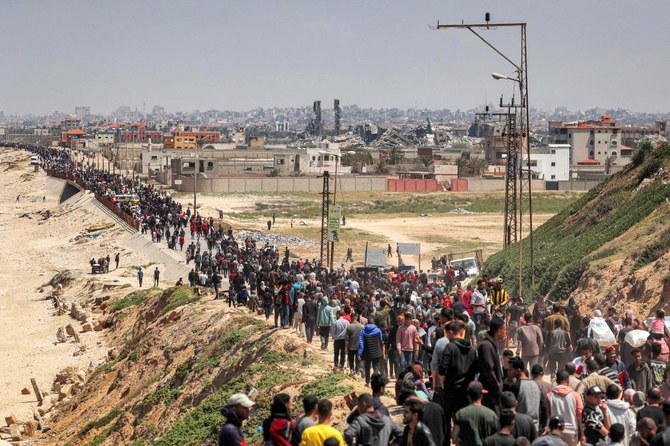
Rumours of a reopened Israeli checkpoint on the coastal road from the territory’s south to Gaza City sent thousands of Palestinians heading north on Sunday, despite Israel denying it was open.
Attempting the journey back to northern Gaza, displaced resident Basma Salman said, “even if it (my house) was destroyed, I want to go there. I couldn’t stay in the south.”
“It’s overcrowded. We couldn’t even take a fresh breath of air there. It was completely terrible.”
In Khan Yunis, southern Gaza’s main city, civil defense teams said they had retrieved at least 18 bodies from under the rubble of destroyed buildings.
Responding late Saturday to the latest truce plan presented by US, Qatari and Egyptian mediators, Hamas said it insists on “a permanent ceasefire” and the withdrawal of Israeli forces from Gaza.
Israel’s Mossad spy agency called this a “rejection” of the proposal, accusing Hamas of “continuing to exploit the tension with Iran.”
But the United States said mediation efforts continue.
“We’re not considering diplomacy dead there,” said the National Security Council’s Kirby.
“There’s a new deal on the table... It is a good deal” that would see some hostages released, fighting halted and more humanitarian relief into Gaza, he said.