

Pakistan PM lays foundation stone of Saudi-funded museum depicting life of Prophet Muhammad

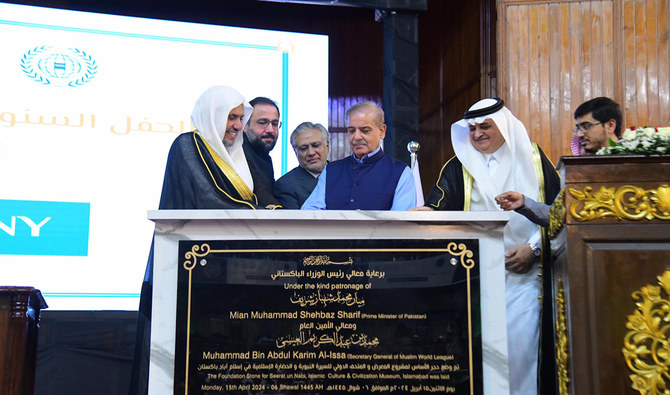
Prime Minister Shehbaz Sharif and Secretary General of Muslim World League Dr. Mohammad bin Abdulkarim Al-Issa unveiling a plaque to lay the foundation stone of Seerat Museum in Islamabad, Pakistan, on April 13, 2024. (Photo courtesy: @GovtofPakistan /X)
Short Url
Updated 15 April 2024
Follow

Pakistan PM lays foundation stone of Saudi-funded museum depicting life of Prophet Muhammad

  • Shehbaz Sharif says Seerat Museum will help counter Islamophobia, spread knowledge about teachings of Prophet Muhammad
  • The ceremony in Islamabad was attended by Muslim World League (MWL) secretary-general, Saudi Arabia’s ambassador to Pakistan

ISLAMABAD: Prime Minister Shehbaz Sharif on Saturday laid foundation stone of a museum that would exhibit relics related to the life of Prophet Muhammad (Peace Be Upon Him), Pakistani state media reported.

The ceremony to lay foundation stone of the Seerat Museum in Islamabad was attended by Muslim World League (MWL) Secretary-General Dr. Mohammad bin Abdulkarim Al-Issa and Saudi Arabia’s Ambassador to Pakistan Nawaf bin Said Al-Malki.

Speaking at the ceremony, PM Sharif said the museum would help counter Islamophobia and spread knowledge about the teachings and life of Prophet Muhammad (PBUH) among people living in Pakistan and abroad.

“The Seerat Museum would not only raise awareness about the life, character and teachings of Prophet Muhammad (PBUH) but would also educate people how to live their lives and manage relationships with other people,” he was quoted as saying by the APP news agency.

The prime minister thanked Saudi Arabia’s King Salman and Crown Prince Mohammed bin Salman for extending their cooperation for Seerat Museum. He lauded the MWL secretary-general for his guidance and support for the project.

The development came during Dr. Al-Issa’s nine-day visit to Pakistan, aimed at fostering interfaith harmony and strengthening Saudi Arabia’s bilateral relations with Pakistan.

During his ongoing visit that began on April 7, Dr. Al-Issa has delivered the Eid Al-Fitr sermon at the Shah Faisal Mosque in Islamabad and visited an orphanage in the Pakistani capital, where he shared the joy of Eid Al-Fitr with orphaned children.

In his sermon, Al-Issa called on Muslims to keep Palestinians close to their hearts and in their prayers as they celebrated Eid. He also spoke about the responsibility of Muslims to use their actions to project Islam in its true light.


Pakistan moves to digitize payments for 10 million women under flagship poverty initiative

Updated 5 sec ago
Follow

Pakistan moves to digitize payments for 10 million women under flagship poverty initiative

  • BISP Official says accounts will be linked to phones to boost financial inclusion and curb payment deductions
  • Over 1.9 million SIMs issued as the nationwide rollout continues across provinces ahead of the March deadline

ISLAMABAD: Pakistan’s flagship poverty alleviation initiative, the Benazir Income Support Program (BISP), plans to equip 10 million women with digital bank accounts linked to their phone numbers within four months in one of the largest such exercises in the world, one of its top officials said on Wednesday.

Launched in 2008, the initiative is named after the late former prime minister Benazir Bhutto and has a budget of Rs716 billion ($2.5 billion) during the current fiscal year. Through its Benazir Kafaalat — or financial assistance — program, BISP provides quarterly stipends of Rs13,500 ($48) to around 10 million women.

In an exclusive interview with Arab News, BISP Secretary Amir Ali Ahmed said the opening of digital bank accounts for the beneficiaries was part of Prime Minister Shehbaz Sharif’s initiative related to a cashless economy and digital transformation of the country.

“I’m glad to share that 10 million bank accounts, wallet accounts were created,” he said. “This is a follow-up of the same exercise whereby now 10 million SIMs are being distributed.

“It is significant to share that the entire beneficiary network that we have is female-centric,” he continued. “So these are 10 million female accounts that have been created.”

Ahmed said the process of issuing mobile phone SIM cards to BISP beneficiaries had started on November 17 and would be completed by March next year.

“Let me share that this is one of the largest such exercises to be conducted in the world which is female-centric, linked with financial inclusion and financial empowerment.”

The BISP official added that out of the more than 10 million beneficiaries, only five to 10 percent had bank accounts, but nearly 90 to 95 percent were excluded from the system.

He said they were being linked to the banking system with cellphone SIMs that are being distributed with the help of the IT ministry, Pakistan Telecommunication Authority, National Database and Registration Authority and telecom companies across the country.

“We feel that this initiative of the government of Pakistan will not only result in financial empowerment of our beneficiaries, it will also result in financial inclusion of a segment which was not part of the banking sector in Pakistan,” he said, adding that the move will also lead to transparency.

In the past, there have been complaints of women not getting their full payment from bank officials in the absence of their own accounts, but Ahmed said this was going to change.

“They will be free from any exploitation at the agent networks, the queues that one would witness, the complaints of corruption or deductions that would emerge,” he continued.

According to official data, more than 1.9 million SIMs have so far been issued for BISP beneficiaries across the country.

The province of Punjab leads the rollout with 810,597 SIMs, followed by Sindh with 523,629 and Khyber Pakhtunkhwa with 371,427 SIMs.

In other regions, Azad Jammu and Kashmir has received 59,617, Balochistan 82,826, Gilgit-Baltistan 45,184, and Islamabad 4,508 SIMs.