BERLIN: A prominent British-Palestinian surgeon who volunteered in Gaza hospitals during the first weeks of the Israel-Hamas war said he was denied entry to Germany Friday to take part in a pro-Palestinian conference — an event that police later ended early.
Dr. Ghassan Abu Sitta said he arrived at Berlin airport on Friday morning before being stopped at passport control, where he was held for several hours and then told he had to return to the UK
Airport police said he was refused entry due to “the safety of the people at the conference and public order,” Abu Sitta told The Associated Press by phone. There was no immediate comment from German federal police.
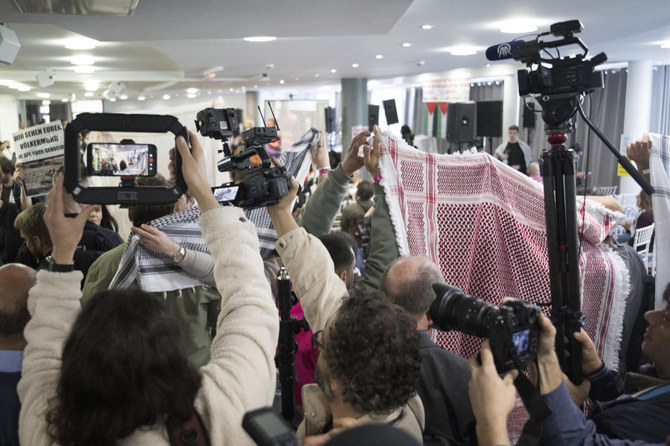
Abu Sitta said his ban was to last until Sunday, covering the planned duration of the Berlin conference he was to attend, entitled the Palestine Congress. The gathering was to discuss a range of topics, including German arms shipments to Israel and solidarity with what organizers called the Palestinian struggle.
Berlin police said later Friday they pulled the plug on the event, attended by up to 250 people, on its first day after a livestream was shown of a person who is banned from political activity in Germany. They wouldn’t identify the person, but said they decided after a legal assessment to end the congress and asked those attending to leave.
Organizers wrote on social network X that the conference was “banned by the police without reason.”
Germany remains one of Israel’s staunchest defenders, even at a time of growing international outrage over the soaring Palestinian death toll in Gaza, which has surpassed 33,000.
German officials have stressed Israel’s right and duty to defend itself since the start of the war — though their tone has gradually shifted, with Chancellor Olaf Scholz and Foreign Minister Annalena Baerbock increasingly decrying the worsening humanitarian situation in Gaza and calling on Israel to allow more aid to reach the territory.
Shortly after Hamas’ Oct. 7. attack on Israel, the German government implemented a formal ban on activity by or in support of Hamas.
Since the war erupted, Germany has clamped down on many pro-Palestinian activities and demonstrations, with officials citing fears of possible antisemitic or anti-Israel incitement.
The hard line has broad political support at home, but has drawn criticism.
“Germany’s deportation of Dr. Abu Sitta is a naked act of authoritarian censorship, more in line with the policies of dictatorships like Saudi Arabia and China than a rights-respecting democracy,” Sarah Leah Whitson, the executive director of Washington-based human rights watchdog Democracy for the Arab World Now, or DAWN, said in a statement.
Abu Sitta, who recently volunteered with Doctors Without Borders in Gaza, has worked during multiple conflicts in the Palestinian territories, beginning in the late 1980s during the first Palestinian uprising. He has also worked in other conflict zones, including in Iraq, Syria and Yemen.
Friday’s congress was viewed with great wariness by German officials before it started and was heavily policed.
Earlier on Friday, German Interior Ministry spokesperson Maximilian Kall told reporters in Berlin that federal security authorities had been in touch with their local counterparts in the capital “about questions of, for instance, entry bans,” he said. He added that he couldn’t give details.


![]()
![]()

Prominent surgeon says he was denied entry to Germany for a pro-Palestinian conference

Short Url
https://arab.news/5czhr
Prominent surgeon says he was denied entry to Germany for a pro-Palestinian conference
- Dr. Ghassan Abu Sitta said he arrived at Berlin airport on Friday morning before being stopped at passport control, where he was held for several hours and then told he had to return to the UK
- Abu Sitta said his ban was to last until Sunday, covering the planned duration of the Berlin conference he was to attend, entitled the Palestine Congress


Latest updates


© 2026 SAUDI RESEARCH & PUBLISHING COMPANY, All Rights Reserved And subject to Terms of Use Agreement.