Thousands march in London pro-Palestinian rally

1 / 2
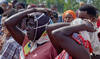
Demonstrators hold banners and flags as they gather ahead of a march in support of the Palestinian people in Gaza, in London, on Mar. 9, 2024. (AP)
2 / 2
A demonstrator holds a megaphone ahead of a march in support of the Palestinian people in Gaza, in London, on Mar. 9, 2024. (AP)
Short Url
Updated 13 March 2024
Follow

Thousands march in London pro-Palestinian rally

  • Regular marches protesting Israel’s military response to the attacks have seen dozens arrested for anti-Semitic chanting and banners
  • The march, from Hyde Park Corner to the US Embassy, was the fifth major demonstration of the year so far in the capital

LONDON: Thousands of protesters marched in central London on Saturday to call for a ceasefire in Gaza amid ongoing bombardments by Israel after the deadly Hamas attack on its territory on October 7.
Regular marches protesting Israel’s military response to the attacks have seen dozens arrested for anti-Semitic chanting and banners, promoting a proscribed organization and assaulting emergency workers.
The march, from Hyde Park Corner to the US Embassy, was the fifth major demonstration of the year so far in the capital.
“We will continue to protest until a ceasefire is called, and until there is an end to all UK complicity with Israel’s decades long oppression of the Palestinian people,” march organizer Ben Jamal said ahead of the protest.

“Despite further attempts by government ministers, including the prime minister, to demonize those protesting and suppress calls for a ceasefire, hundreds of thousands will again be taking to the streets, calling for an end to Israel’s genocidal war on the Palestinian people,” said Jamal, who is director of the Palestine Solidarity Campaign.

PSC added: “Coming just after International Women’s Day, the focus will be on what the UN Women organization describes as an unprecedented ‘war on women’.”

Last week Prime Minister Rishi Sunak called for the police to take tougher action against the protesters, saying the events “had descended into intimidation, threats and planned acts of violence.”
The prime minister said that “police have a tough job in policing the protests” but that “we must draw a line.”
“I say this to the police, we will back you when you take action,” he added.
Itai Galmudy, the organizer of a counter-protest on Saturday, said pro-Palestine demonstrations had created “no-go zones for Jewish people” in the capital and “ballooned into anti-Israeli hate marches.”
“We will just not accept that Jews can’t go out in the street because somebody wants to protest,” he said.
“We think it’s enough. We don’t want to live in fear and we will not accept it.”
London’s Metropolitan Police have also criticized the protests, saying the cost of policing such events had reached £32.3 million ($41 million) since October 7.
“We are clearly operating in a context where we understand our Jewish and Muslim communities continue to be highly concerned about antisemitic and anti-Muslim hate crime and their own sense of safety in London,” said Karen Findlay, who oversaw policing across London on Saturday.
On Friday a pro-Palestinian UK protest group said one of its activists had “ruined” a portrait on display of Arthur Balfour, the British politician whose declaration helped lead to Israel’s creation.
Police confirmed officers had received an online report of criminal damage to a painting at the University of Cambridge’s Trinity College, in south-eastern England.
Palestine Action, which describes itself as a direct-action network of groups and individuals, posted video footage online of the activist spraying the artwork with red paint from a cannister and then slashing the surface of the framed painting multiple times.
The Balfour Declaration was a 67-word letter in 1917 from Britain’s then-foreign secretary to Lionel Rothschild, a prominent British Zionist, supporting the creation of a Jewish homeland in Palestine.
The document is credited with eventually helping to spur the creation of Israel in 1948, which also led to the displacement of around 750,000 Palestinians and decades of strife between the two communities.
The war in Gaza began after Hamas launched an unprecedented attack on southern Israel that resulted in about 1,160 deaths, most of them civilians, according to an AFP tally based on official Israeli figures.
Militants also took around 250 hostages. Israel believes 99 of them remain alive in Gaza and that 31 have died.
Israel’s retaliatory offensive has killed at least 30,717 people, mostly women and children, according to Gaza’s Hamas-run health ministry.

(With AFP)


Louvre thieves escaped with 30 seconds to spare, probe reveals

Updated 2 sec ago
Follow

Louvre thieves escaped with 30 seconds to spare, probe reveals

  • Probe found only one of two security cameras was working near the site where the intruders broke in on the morning of Sunday October 19
PARIS: The thieves who stole crown jewels from the Louvre in October evaded police with just 30 seconds to spare due to avoidable security failures at the Paris museum, a damning investigation revealed on Wednesday.
The probe, ordered by the culture ministry after the embarrassing daylight heist, revealed that only one of two security cameras was working near the site where the intruders broke in on the morning of Sunday October 19.
Agents in the security control room did not have enough screens to follow the images in real-time, while a lack of coordination meant police were initially sent to the wrong place once the alarm was raised, the report unveiled at the French Senate’s Culture Commission stated.
“It highlights an overall failure of the museum, as well as its supervisory authority, to address security issues,” the head of the commission, Laurent Lafon, said at the start of a hearing.
One of the most startling revelations was that the robbers left only 30 seconds before police and private security guards arrived on the scene.
“Give or take 30 seconds, the Securitas (private security) guards or the police officers in a car could have prevented the thieves from escaping,” the head of the investigation, Noel Corbin, told senators.
He said that measures such as a modern CCTV system, more resistant glass in the door cut open with angle grinders, or better internal coordination could have prevented the loss of the jewels — worth an estimated $102 million — which have still not been found.
Major security vulnerabilities were highlighted in several studies seen by management of the Louvre over the last decade, including a 2019 audit by experts at the jewelry company Van Cleef & Arpels.
Their findings stressed that the riverside balcony targeted by the thieves was a weak point and could be easily reached with an extendable ladder — exactly what transpired in the heist.
‘Stunned’
Corbin confirmed that under-fire Louvre boss Laurence des Cars had not been aware of the audit which was ordered by her predecessor, Jean-Luc Martinez.
“The recommendations were not acted on and they would have enabled us to avoid this robbery,” Corbin said, adding that there had been a lack of coordination between the two government-appointed administrators.
Police believe they have arrested all four intruders, who escaped on powerful motorbikes, having carried out the heist in the Apollo Gallery in around 10 minutes in total, according to the investigation.
The revelations on Wednesday are likely to pile more pressure des Cars, the first woman in the role who was appointed by President Emmanuel Macron in 2021.
Questions have swirled since the break-in over whether it was avoidable and why a national treasure that is the world’s most-visited museum appeared to be so poorly protected.
France’s lower house of parliament is carrying out its own inquiry, while des Cars and Martinez are set to be grilled by senators next week.
Last month, France’s state auditor said security upgrades had been carried out at a “woefully inadequate pace” and the museum had prioritized “high-profile and attractive operations” instead of protecting itself.
Senior police officer Guy Tubiana, a security adviser at the culture ministry who took part in the investigation, told senators he was “stunned” by what he had discovered at the museum.
“There was a succession of malfunctions that led to catastrophe but I never would have thought the Louvre could have so many malfunctions,” he said.
Staff at the Louvre at set to go on strike on Monday to demand management act against what they see as understaffing and overcrowding at the museum, which welcomed 8.7 million people last year.
At the weekend, the museum revealed that a water leak had damaged 300 to 400 journals, books and documents in the Egyptian department in late November.