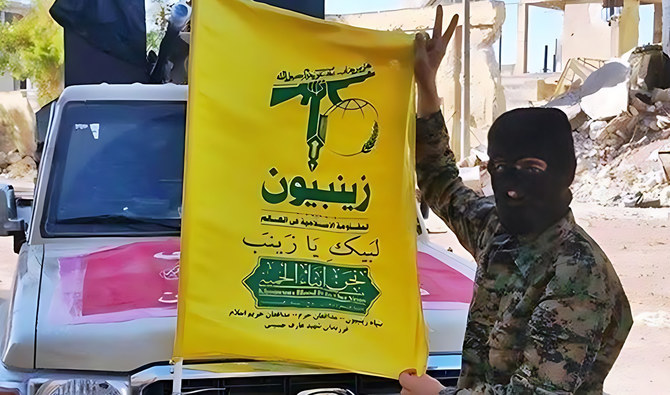

KARACHI: Pakistan designated the Zainebiyoun Brigade, an Iran-backed militant group comprising Pakistani nationals that has been active in Syria, as a “terrorist” organization after it became a potential threat to the country’s security, experts said on Friday.
The Pakistani government had reasons to believe that Zainebiyoun Brigade was engaged in certain activities “prejudicial to the peace and security of the country,” read a notification, issued by the country’s interior minister on March 29, which emerged on Thursday. Subsequently, Pakistan’s National Counter Terrorism Authority (NACTA) updated its official list of proscribed organizations, placing the Iran-backed group at 79th spot.
The development came a day after Iran’s supreme leader, Ayatollah Ali Khamenei, warned that Israel “must be punished and will be punished,” following an April 1 attack that destroyed Iran’s consulate building in Damascus and killed seven Revolutionary Guards, including two generals. Some analysts believe Tehran might be planning an attack on Israeli interests in the world and could move the Zainebiyoun Brigade for this purpose.
Since the US Treasury added the Zainebiyoun Brigade to its financial blacklist in Jan. 2019, Pakistani authorities have arrested several militants affiliated with the group, notably in the country’s commercial hub of Karachi, a significant recruitment hub for the militant outfit, along with three other regions – Parachinar, Quetta and Gilgit Baltistan.
Security experts say Islamabad moved to outlaw the Zainebiyoun Brigade due to the threat it posed to Pakistan’s security in the current scenario.
“Its [Zainebiyoun’s] activities may trigger major sectarian conflict as it used to be in Pakistan sometimes ago as retaliation by Sunni extremist groups may further complicate the environment,” Abdullah Khan, an Islamabad-based security expert, told Arab News.
Previously, Zainebiyoun members fighting in Syria and Iraq were considered an “indirect threat,” but now the group’s members have reportedly returned to Pakistan and replaced banned sectarian outfit Sipa-e-Muhammad “as the main militant group targeting opponents,” according to Khan. The Zainebiyoun Brigade has now become “a very serious threat to Pakistan’s sectarian harmony.”
A Pakistani official, who spoke on condition of anonymity, said the decision to designate Zainebiyoun Brigade as a proscribed entity was made after Iran’s attacks inside Pakistan.
“The decision, implemented on March 29, was taken in a high-level meeting following Iran’s attack inside Pakistan,” the official told Arab News. “Increasing attacks in Balochistan by militants based in Iran further pushed for the implementation of this decision.”
In January, Iran targeted two suspected bases of the Jaish-ul-Adl militant group in Pakistan with missiles, prompting a rapid military riposte from Islamabad targeting what it said were separatist militants in Iran.
The tit-for-tat strikes were the highest-profile cross-border intrusions by the two countries in recent years and raised alarm about a wider conflict.
“Iran-Pakistan relations have been strained since the Iranians fired missiles in Pakistan earlier this year, which has triggered questions about Iranian relationship with various armed groups active in Pakistan, including the Zainebiyoun,” Dr. Asfandyar Mir, a senior expert at the US Institute of Peace, told Arab News.
“Even if not a decisive factor in Pakistani calculus to designate Zainebiyoun, it is difficult to separate the decision from the state of Iran-Pakistan bilateral ties.”
Pakistan’s designation of the Zainebiyoun Brigade as a militant outfit also comes days before an expected visit by Iranian President Ebrahim Raisi in the third week of April and is likely to put pressure on Tehran in the talks later this month.
Abdul Sayed, a Sweden-based independent scholar on militancy, politics and security, concurred the move was also linked to “growing tensions” between the two countries.
“Recently, amid growing tensions between Pakistan and Iran, this move can be interpreted as Pakistan’s attempt to thwart potential sectarian attacks aimed at destabilizing the country,” he said.
“Iran has accused Pakistan of harboring sanctuaries for Jaish-ul-Adl [militant group] and has threatened repercussions.”
Sayed said the group had emerged as a “dangerous” organization as significant number of youths previously associated with other outfits had joined its ranks.
“Its militants have also been implicated in terrorist attacks against rival sects within Pakistan,” he added.
In January this year, the counter-terrorism department (CTD) in Pakistan’s southern Sindh province said they had apprehended Syed Muhammad Mehdi, a suspected militant associated with the Zainebiyoun Brigade who had been involved in an assassination attempt on Mufti Taqi Usmani, a top Pakistani cleric, in Karachi in 2019. The attack had killed two of Mufti Usmani’s guards.
In July 2022, then Pakistan interior minister Rana Sanaullah Khan told the Senate that Zainebiyoun Brigade members were among the militants “found actively involved in terrorist activities” in the country in 2019-2021.
In recent years, Pakistani authorities have announced the arrest of a number of suspects who they said were affiliated with the Zainebiyoun Brigade and were trained in Iran.
In Nov 2020, an Associated Press report said a number of Pakistanis were among 19 pro-Iran militia fighters killed in eastern Syria.
In March 2020, a senior official told Arab News that up to 50 Pakistani fighters were killed by the Turkish army and Syrian forces in a major rebel stronghold in the northwest of Syria.