Putin: Russia had to attack Ukraine energy sites in response to Kyiv’s strikes

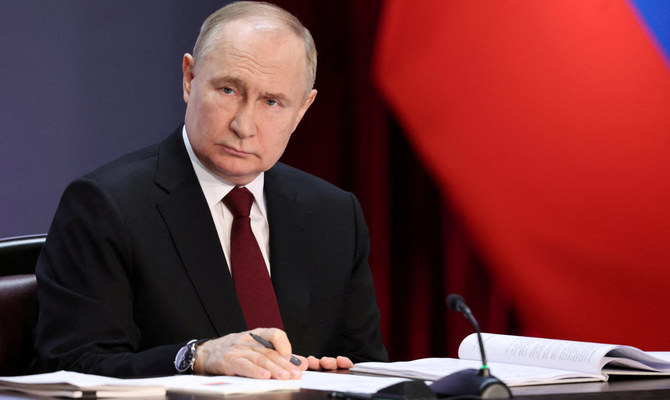
Russian President Vladimir Putin attends an extended meeting of the Interior Ministry board in Moscow, Russia. (Reuters)
Short Url
Updated 12 April 2024
Follow

Putin: Russia had to attack Ukraine energy sites in response to Kyiv’s strikes

  • Putin again rejected any notion of holding peace talks without Russia’s participation

President Vladimir Putin said on Thursday that Russia had been obliged to launch strikes that have inflicted heavy damage on Ukrainian energy sites in response to Kyiv’s attacks on Russian targets.
The Kremlin leader, quoted by Russian news agencies, was speaking to his ally, Belarusian President Alexander Lukashenko, after overnight attacks destroyed a large electricity plant near Kyiv and hit power facilities in several regions of Ukraine.
The president said the strikes were part of the process of “demilitarization” of Ukraine — one of the objectives he cited when he sent Russian troops into Ukraine in February 2022.
“Unfortunately, we observed a series of strikes on our energy sites recently and were obliged to respond,” Putin was quoted as saying.
“The strikes on energy are linked in part with solving one of the tasks we set for ourselves, and that is demilitarization. We believe above all that in this way we will affect Ukraine’s military industrial complex and in a very direct way.”
Russia, he said, had refrained from carrying out such attacks in winter “out of humanitarian considerations.”
“What I mean is that we didn’t want to leave social institutions without power, hospitals and the like,” he said. But he said the Ukrainian strikes — mainly on oil refineries in many different Russian regions in recent weeks — prompted Moscow to respond.
In his comments to Lukashenko, Putin again dismissed any suggestion by Ukraine’s Western allies that Russia had plans to attack any European countries beyond Ukraine.
“That is nonsense. It is necessary for the ruling circles, as we used to say, to explain and justify their expenditure on the war in Ukraine,” he said.
Putin again rejected any notion of holding peace talks without Russia’s participation — Switzerland has said it will host a “world summit” on Ukraine in June but Russia said it would not take part.
Both Putin and Lukashenko agreed that the best starting point for any settlement in Ukraine was the series of talks held in Turkiye in 2022 in the early weeks of the war, which broke up with no agreement.
Ukrainian President Volodymyr Zelensky says talks on peace must be based on his plan which calls for withdrawal of Russian troops, restoration of Ukraine’s 1991 post-Soviet borders and a mechanism to bring Russian to account for its actions.


US to cut roughly 200 NATO positions, sources say

Updated 21 January 2026
Follow

US to cut roughly 200 NATO positions, sources say

  • Trump famously threatened to withdraw from NATO during ⁠his first presidential term and said on the campaign trail that he would encourage Russia to attack NATO members that did not pay their fair share on defense

WASHINGTON: The United States plans to reduce the number of personnel it has stationed within several key NATO command centers, a move that could intensify concerns ​in Europe about Washington’s commitment to the alliance, three sources familiar with the matter said this week.
As part of the move, which the Trump administration has communicated to some European capitals, the US will eliminate roughly 200 positions from the NATO entities that oversee and plan the alliance’s military and intelligence operations, said the sources, who requested anonymity to discuss private diplomatic conversations.
Among the bodies that will be affected, said the sources, are the UK-based NATO Intelligence Fusion Center and the Allied Special Operations Forces Command in Brussels. Portugal-based STRIKFORNATO, which oversees some maritime operations, will also be cut, as will several other similar NATO entities, the sources said.
The sources did not specify why the US had decided to cut the number of staff dedicated to the NATO roles, but the moves broadly align with the ‌Trump administration’s stated intention to ‌shift more resources toward the Western Hemisphere.
The Washington Post first reported the decision.

TRUMP ‌RE-POSTS ⁠MESSAGE ​IDENTIFYING NATO ‌AS THREAT
The changes are small relative to the size of the US military force stationed in Europe and do not necessarily signal a broader US shift away from the continent. Around 80,000 military personnel are stationed in Europe, almost half of them in Germany. But the moves are nonetheless likely to stoke European anxiety about the future of the alliance, which is already running high given US President Donald Trump’s stepped-up campaign to wrest Greenland away from Denmark, raising the unprecedented prospect of territorial aggression within NATO.
On Tuesday morning, the US president, who is scheduled to fly to the World Economic Forum in Switzerland in the evening, shared another user’s post on social media that identified NATO as a threat to the ⁠United States. The post described China and Russia as merely “boogeymen.”
Asked for comment, a NATO official said changes to US staffing are not unusual and that the US presence in ‌Europe is larger than it has been in years.
“NATO and US authorities are in ‍close contact about our overall posture – to ensure NATO retains our ‍robust capacity to deter and defend,” the NATO official said.
The White House and the Pentagon did not respond to requests for ‍comment.

MILITARY IMPACT UNCLEAR, SYMBOLIC IMPACT OBVIOUS
Reuters could not obtain a full list of NATO entities that will be affected by the new policy. About 400 US personnel are stationed within the entities that will see cuts, one of the sources said, meaning the total number of Americans at the affected NATO bodies will be reduced by roughly half.
Rather than recalling servicemembers from their current posts, the US will for the most part decline to ​backfill them as they move on from their positions, the sources said.
The drawdown comes as the alliance traverses one of the most diplomatically fraught moments in its 77-year history. Trump famously threatened to withdraw from NATO during ⁠his first presidential term and said on the campaign trail that he would encourage Russian President Vladimir Putin to attack NATO members that did not pay their fair share on defense. But he appeared to warm to NATO over the first half of 2025, effusively praising NATO Secretary-General Mark Rutte and other European leaders after they agreed to boost defense spending at a June summit.
In recent weeks, however, his administration has again provoked alarm across Europe. In early December, Pentagon officials told diplomats that the US wants Europe to take over the majority of NATO’s conventional defense capabilities, from intelligence to missiles, by 2027, a deadline that struck European officials as unrealistic. A key US national security document released shortly after called for the US to dedicate more of its military resources to the Western Hemisphere, calling into question whether Europe will continue to be a priority theater for the US
In the first weeks of 2026, Trump has revived his longstanding campaign to acquire Greenland, an overseas territory of Denmark, enraging officials in Copenhagen and throughout Europe, many of whom believe any territorial aggression within the alliance would mark the end of NATO. Over the weekend, ‌Trump said he would slap several NATO countries with tariffs starting February 1 due to their support for Denmark’s sovereignty over the island. That has caused European Union officials to mull retaliatory tariffs of their own.