


DUBAI: Here are the highlights from Sotheby’s Modern & Contemporary Middle East sale, which runs Apr. 11-25.
Abdulhalim Radwi
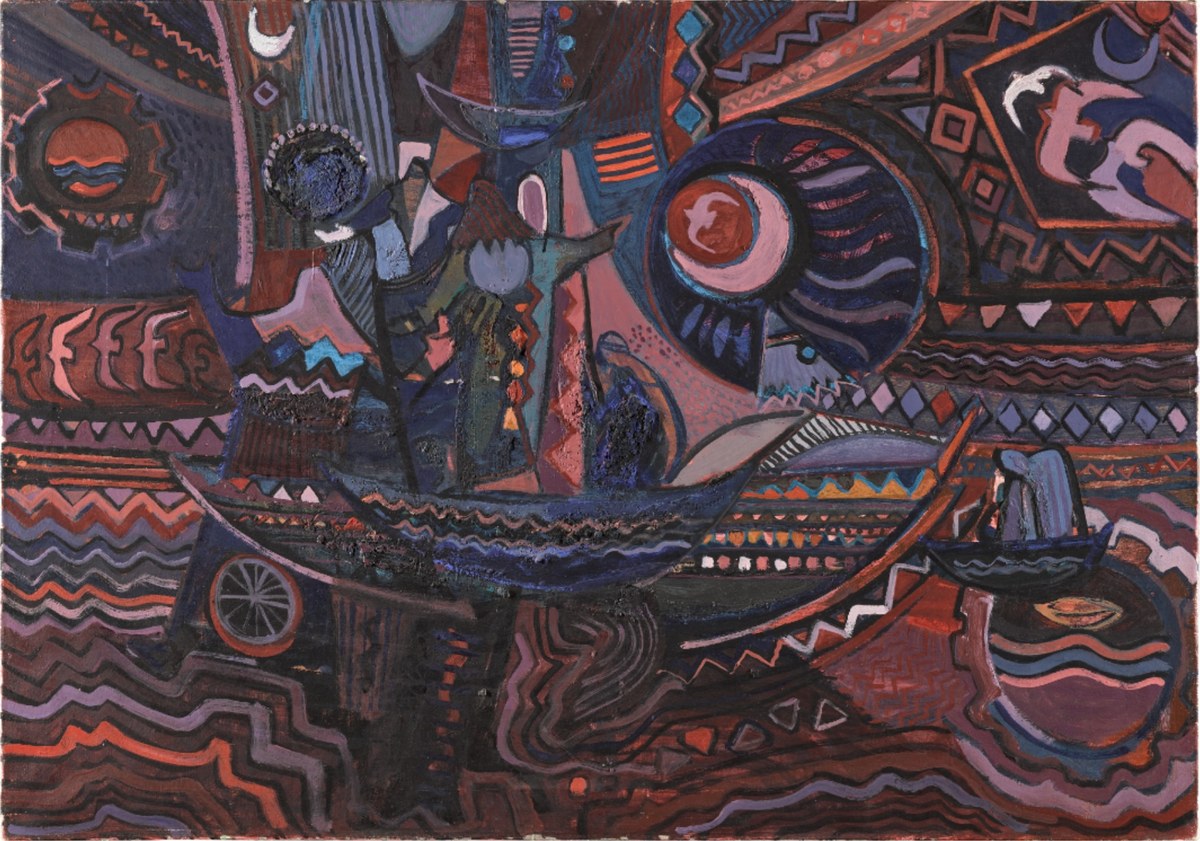
‘Untitled’
Radwi’s ability “to merge popular culture and sentiments with newly acquired artistic techniques serves as a precursor to contemporary Saudi art today,” Sotheby’s states in its auction notes. Radwi’s mother — an artist herself — is credited with nurturing his ability as a child, but it was in Rome in the 1960s that his skills truly flourished as he began to explore abstraction. He is recognized as one of the first Saudis to pursue further education abroad, and in the seven years he lived in Italy, he exhibited nine times. When he returned to his homeland in 1968, he began to teach art. “Though absorbed by Western artistic discourses, Radwi did not stray from local heritage and traditions, and instead invoked his own narrative of the Arab world through cubism and expressionism, setting himself apart from his contemporaries,” the auction notes state.
This piece, according to Sotheby’s is “exemplary” of Radwi’s later work, “which became more engaged with the artist’s cultural identity.” It depicts the old neighborhoods of Saudi towns “through a futurist scene blending traditional Ottoman architecture with contemporary influences.”
The notes continue: “The very essence of his works lies not in their physicality but in the emotions they trigger.”
Taha Al-Sabban

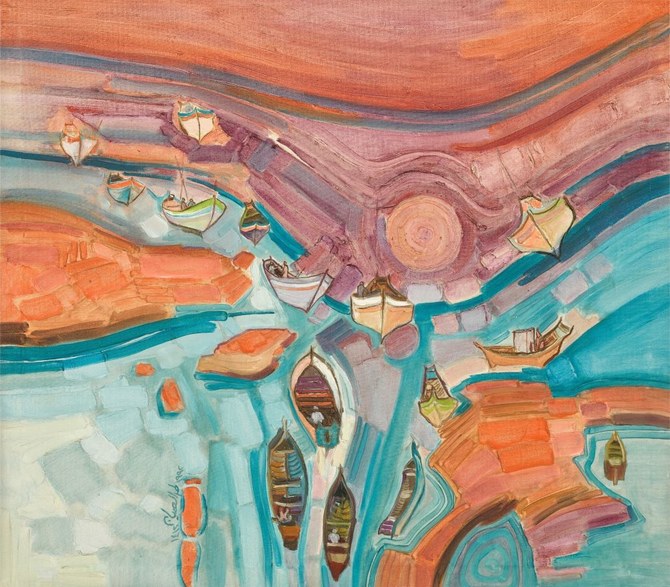
‘Untitled (Boats)’
Al-Sabban was born in Makkah in 1948, just eight years after Abdulhalim Radwi. The latter became something of a mentor to Al-Sabban, having, according to Sotheby’s “a profound effect” on his development as an artist, selecting him for one of the first exhibitions at the Jeddah Centre of Fine Arts. Encouraged by Radwi, Al-Sabban, too, studied abroad, first in Beirut and then in Rome.
“Al-Sabban recognized the cultural necessity of art in Europe, which lent itself to his enduring fascination with his own culture and traditions. The holy city of Mecca, his birthplace, and the ancient city of Jeddah, to which he relocated, are central influences to the artist’s oeuvre; he derived inspiration from the rich history and variety of the people that he encountered in the city, its rituals, landscape, and social life,” the auction notes state. This expressionistic work was produced while he lived in Jeddah, where he had developed a deep love for the sea. “Here, he captures in abstract the nature of the ocean through a cool, deep palette and vertical energy, as if the forms rise, swaying, from the sea floor.”
Inji Efflatoun
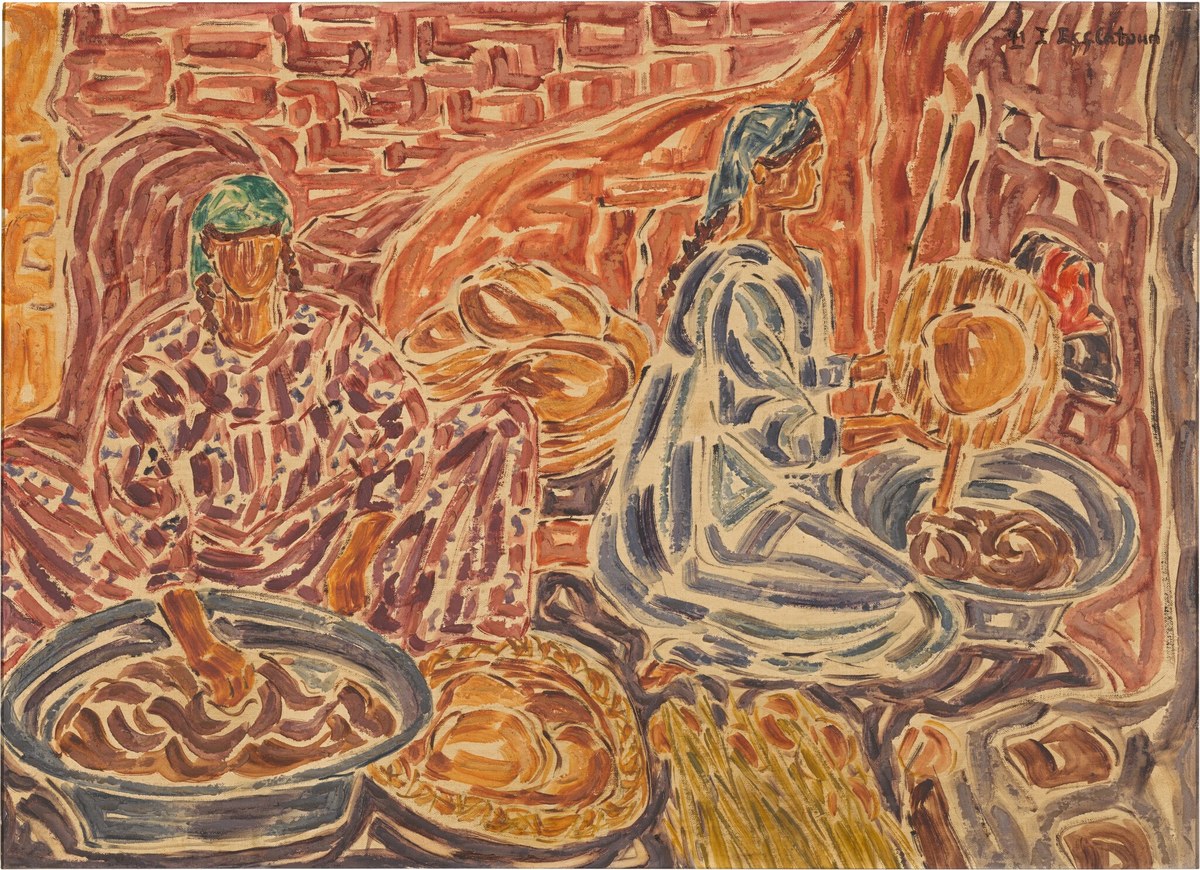
‘Untitled (Baking)’
Efflatoun was an important figure in Egyptian culture not just for her artworks, but for her social activism. As a young adult, she shunned her privileged aristocratic background, joining several left-wing organizations, and promoting anti-imperialist and anti-nationalist causes. “Her political convictions are mirrored in her compositions, depicting the predicaments of Egyptians under social inequalities,” Sotheby’s states.
In 1959, Efflatoun was imprisoned as part of a crackdown on communism in Egypt. Upon her release four years later, she continued to paint, but produced less overtly political work. However, as Sotheby’s notes, and as this 1971 work shows, “she persisted in representing the working class and its living conditions, the one cause which always animated her.”
Mohamed Hamidi
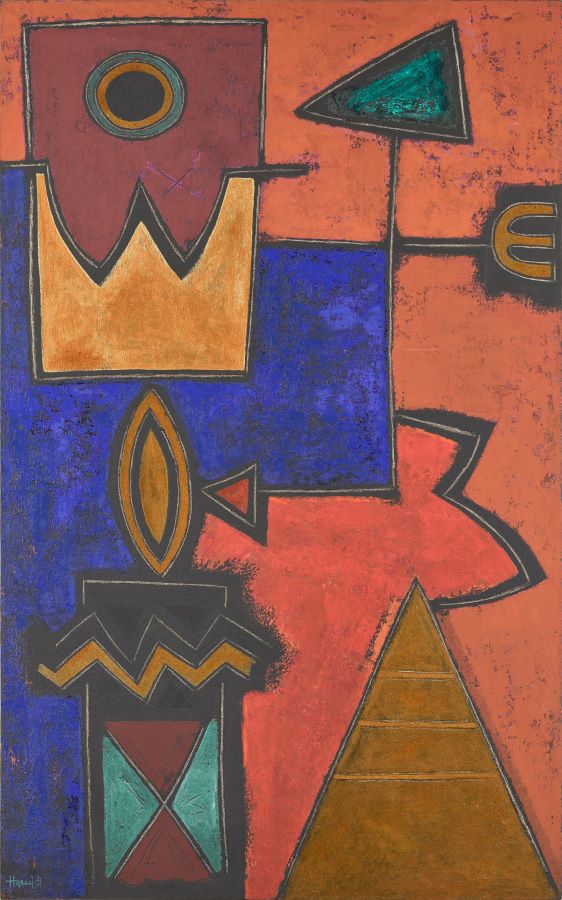
‘Untitled’
This veteran painter is considered one of Morocco’s finest artists. He studied in France before returning to teach in his homeland, where he took part in the seminal “Manifesto” exhibition in Marrakech in 1969, as one of the co-founders of the Moroccan Association of Plastic Arts.
Morocco’s Loft Art Gallery says of the artist, “The whole of Hamidi's work focuses on the body, whose representation he pushes to the limits of abstraction with the use of increasingly refined forms. He demonstrates a keen interest in African art and its symbols. Bright colors also characterize his work.”
Faik Hassan
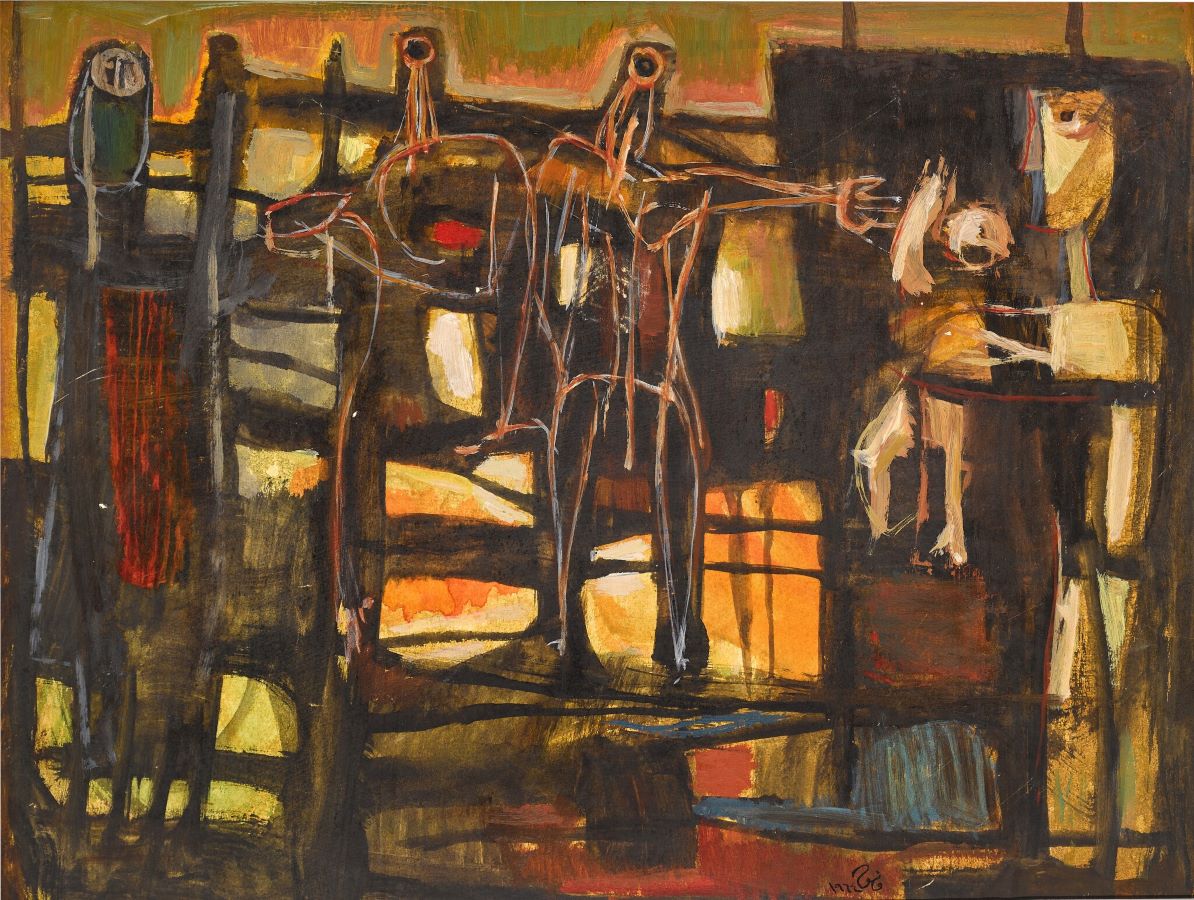
‘Untitled (The Three Wise Men)’
Recognized as a central figure in Iraqi contemporary art, Hassan’s work, Sotheby’s states, is “marked by technical skill and variation through a vast exploration of stylistic genres, Hassan has been labelled a primitivist, an impressionist, and a cubist,” according to the auction notes. “His exploration of styles prompted a break with academic restrictions. He is most commonly known for his realistic depictions of everyday life in Iraq. His works are dominated by Iraqi villagers, laborers, horsemen, and landscapes, all conveyed with an emotional fragility, regardless of style.”
Tarek Al-Ghoussein
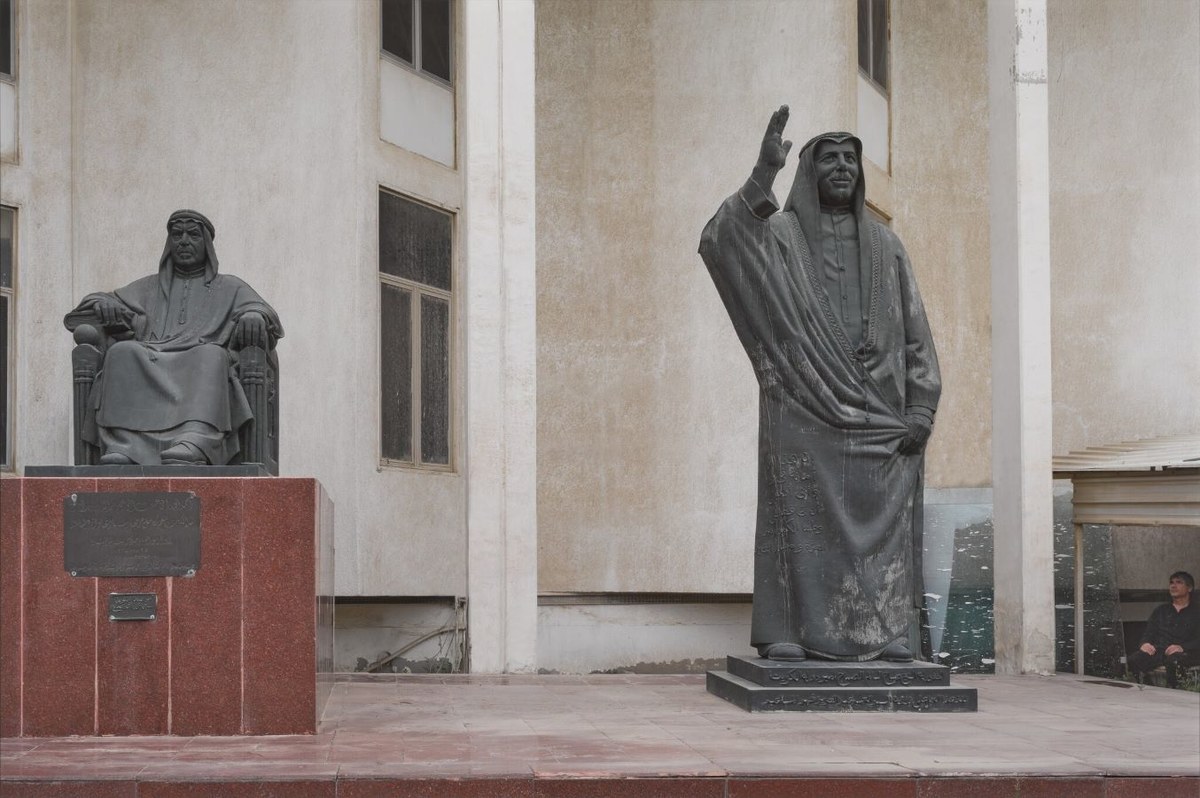
‘K Files – 655’
This work is from the late Kuwaiti artist’s “K Files” series, which, according to The Third Line gallery in Dubai, “documents found material from family albums, antique shops, the Internet and other sources in an ongoing process. The performative photographs feature interactions between the artist and sites of grandness and importance in an attempt to track significant places in Kuwait’s development.”
Chant Avedissian

‘Tahiya Carioca (no 45)’
Much of Avedissian’s work focuses on figures from Cairo’s “Golden Age,” although the vibrant images are inspired by the often-dark nationalism of those times. In this work, Sotheby’s states, “the artist’s nostalgia manifests itself through an image of Tahiya Carioca, the Egyptian belly dancer and film actress who is a household name across the Middle East. Carioca’s life intertwined with the forces of liberation and was filled with art and rebellion. Avedissian deploys sophisticated stencils to readapt a popular picture of Carioca. In doing so, he linked himself directly to media imagery from the mid-20th century.”


