Kabul: The Taliban’s hyper-reclusive supreme leader made a rare public appearance Wednesday, an Afghan government spokesman said, berating the international community in a speech for criticizing his rule.
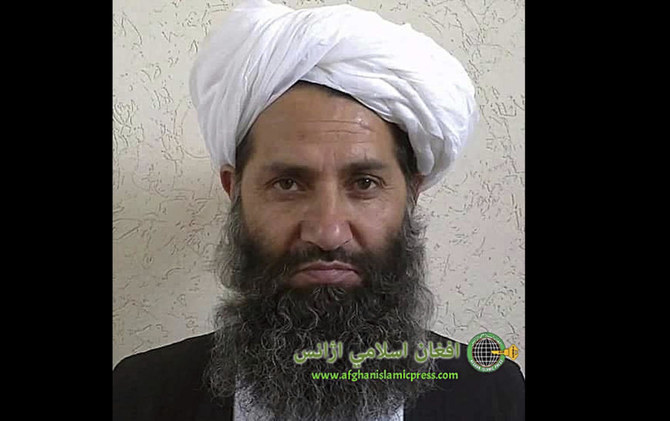
Hibatullah Akhundzada has made only a handful of public appearances since inheriting the leadership of the Taliban in 2016 and leading the movement back to power with the withdrawal of US forces in 2021.
Over the past three years the bearded “Emir” of the Taliban has ruled by decree, enforcing an austere vision of Islam largely ostracizing Afghanistan on the world stage.
In a 35-minute audio address, released by a Taliban government spokesman, Akhundzada said countries involved in the US-led invasion were still attacking Afghanistan with “propaganda” and “evil tactics.”
“Today, they want to divide you,” he said, according to the audio address. “They blame the leaders as defective, saying they are not able to govern.”
“Don’t let these infidels mislead you,” he added. “Stay alert for them, they will trick you, they want to fail you.”
“I will not take even a step away from the Islamic law,” he pledged.
Taliban government spokesman Zabihullah Mujahid said Akhundzada’s address marking the Muslim holiday of Eid Al-Fitr in the largest mosque of southern Kandahar province “was attended by thousands of compatriots.”
An AFP source who attended the service said Akhundzada was not visible to large crowds in the courtyard of the complex, but a voice over a loudspeaker introduced the sermon as his words.
Tight security restricted access to the main worship mall, the source said, though several high-ranking Taliban officials claimed on social media they had met the Taliban chief on Wednesday.
There is only one photograph of Akhundzada. The press have generally been barred from attending his public engagements and Afghan attendees forbidden from taking photos or recording on their phones.
While the Taliban government ostensibly sits in the capital Kabul, Akhundzada operates from hideouts in Kandahar — considered the heartland of the Islamist movement.
Since the fall of the foreign-backed government in August 2021, his Taliban administration has ushered in curbs on women and girls which the United Nations has condemned as “gender apartheid.”
Unease over dealing with the Taliban government has seen foreign aid nosedive, dramatically worsening what was already one of the world’s worst humanitarian crises.
Kabul’s Taliban rulers insist they want friendly relations with other countries, but say they will not cave to pressure over human rights concerns about their domestic policies.
The religious affairs ministry issued instructions that during Wednesday prayer Afghan imams should read out a message published by Akhundzada earlier in the Muslim holy month of Ramadan.
“We seek diplomatic and economic relations with all nations,” it said, while adding, “we expect and demand respect for Afghanistan’s sovereignty, integrity, and dignity.”
Akhundzada previously appeared in Kandahar in 2022 to mark Eid Al-Fitr with a speech congratulating Afghans “on victory, freedom and success,” his back to the crowd to preserve his anonymity.
In the capital Kabul, the third Eid Al-Fitr festivities under the Taliban government were accompanied by heightened security.
Extra checkpoints were erected around mosques as morning prayers began, with police and Taliban government security forces deployed and mobile phone signals disrupted.
Security forces prevented AFP journalists from recording services at numerous sites in Kabul.
Nonetheless, worshippers gathered in the thousands, spilling out into the streets as mosques were packed to capacity.

Taliban leader hits back at global critics in rare address
Short Url
https://arab.news/yngcg
Taliban leader hits back at global critics in rare address
- Hibatullah Akhundzada has made only a handful of public appearances since inheriting the leadership of the Taliban in 2016
Hungary’s Orbán stakes his reelection on anti-Ukraine message
- Orbán is running an aggressive media campaign that Hungarians should refuse to align with the rest of Europe in supporting Ukraine against Russia’s invasion
- He also promises to restore democratic institutions which have eroded during Orbán’s 16 years in power
BUDAPEST: Facing tough odds in an upcoming election, Hungary’s pro-Russian prime minister is trying to convince voters that the greatest threat to the country is not economic stagnation — the focus of his top opponent — but neighboring Ukraine.
Viktor Orbán is running an aggressive media campaign replete with disinformation whose central message is that Hungarians should refuse to align with the rest of Europe in supporting Ukraine against Russia’s invasion. That path, he argues, risks bankrupting the country and getting its youth killed on the front lines.
Billboards erected across the country show AI-generated images of Ukrainian President Volodymyr Zelensky flanked by European officials, holding out his hand as if demanding money. It’s a not-so-subtle reference to the European Union’s efforts to help Ukraine financially and bolster its defenses as the war enters its fifth year.
“Our message to Brussels: We won’t pay!” the publicly funded billboards read.
If there had been any doubt, it became clear on Monday why the outcome of Hungary’s upcoming election will reverberate beyond its borders. Hungary blocked a new package of EU sanctions on Russia in response to interruptions in Russian oil supplies that pass through Ukraine, and vowed to veto any further pro-Ukraine policies until oil flows resume.
Orbán is widely seen as the Kremlin’s strongest ally in the EU. While almost all of the bloc’s other 26 nations have distanced themselves from Russia since it launched the war on Feb. 24, 2022, Hungary has deepened cooperation.
The prime minister has cast his relationship with Russian President Vladimir Putin as pragmatic, stemming from Hungary’s access to reliable supplies of Russian oil and gas. But Orbán’s anti-LGBTQ+ policies, crackdowns on the media and nongovernmental organizations, and his labeling of critics as “foreign agents” have led to accusations that he’s reading from Putin’s authoritarian playbook.
Campaign of fear
Orbán, who retook office in 2010, faces the strongest challenge to his power in an election set for April 12. The EU’s longest-serving leader and his right-wing Fidesz party are trailing in most independent polls to an upstart center-right challenger, Péter Magyar.
A 44-year-old lawyer and former Fidesz insider who broke with the party in 2024, Magyar has focused his campaign on stemming the rising costs of living, improving social services and reining in corruption. He also promises to restore Hungary’s Western orientation and bolster democratic institutions which have eroded during Orbán’s 16 years in power.
His rise was aided by political scandals that have damaged the credibility of Orbán’s party; a presidential pardon given to an accomplice in a child sexual abuse case led to a public outcry, prompting the president and justice minister to resign.
Losing ground to Magyar and his Tisza party, Orbán and Fidesz have sought to change the conversation. They have blanketed the country with taxpayer-funded billboards, as well as advertisements on radio, television and social media. A petition mailed to every Hungarian of voting age claimed the EU’s plans to help Ukraine financially would bring economic ruin.
Other ads, paid for by a shadowy pro-government organization with Fidesz ties, depict Magyar as a puppet of Zelensky and the EU who would sell out the country to foreign interests and draw Hungary into the war.
Hungary’s public media, along with many private news outlets loyal to Orbán’s government, faithfully mimic the claims. They say Ukraine wants to prolong the bloody conflict that has killed tens of thousands of its citizens — and is conspiring with the EU to do it.
Disinformation is fueled by artificial intelligence
Orbán has recently claimed that the EU — not Russia — poses the greatest threat to Hungary. He says rising defense spending across Europe — driven by Russia’s war and pressure from the US to increase NATO contributions — is evidence that the EU is preparing for conflict with Moscow and plans to forcibly conscript Hungarians to fight.
In an AI-generated video Fidesz released on social media last week, a little girl asks her forlorn mother in Hungarian: “Mommy, when is daddy coming home?”
In the next frame, the fictional father — bound, blindfolded and kneeling on a muddy battlefield — is approached by a soldier, and shot in the head. “We won’t allow others to decide on the fates of our families,” a narrator says. “Let’s not take a risk. Fidesz is the safe choice.”
Although some EU countries have proposed sending troops to Ukraine to monitor any future ceasefire, they are not intended to engage in combat, and participation would be voluntary, said András Rácz, a Russia expert at the German Council on Foreign Relations.
Rácz notes that, despite the false premise behind many of Orbán’s claims, Fidesz has won two previous elections after raising fears that its political opponent would drag the country into the war.
“They are trying to max this out. They have nothing else,” Rácz said. “Populists often try to define an enemy, often an imaginary one, and then offer protection to the society from that enemy. Ukraine has been ideal from this perspective.”
Escalating tensions
For years, Orbán has sought to stymie EU efforts to provide financial and military support to Ukraine, and he has vigorously opposed sanctions targeting Russian oil and officials.
Tensions with Ukraine grew recently after Russian oil shipments to Hungary were interrupted; Ukraine blamed the disruption on a Russian drone strike in late January that damaged a pipeline. Orbán called it blackmail.
Last week, his government retaliated by halting diesel shipments to Ukraine and threatening to veto a 90-billion-euro ($106-billion) EU loan destined for Kyiv. On Monday, it blocked the 20th round of EU sanctions against Russia.
The anti-Ukraine campaign has resonated with many Hungarians loyal to Fidesz. Despite Tisza’s advantage in the polls, its victory is far from assured.
Still, many Hungarians are dubious of Orban’s anti-Ukraine messaging. On Sunday, hundreds of Hungarians and Ukrainians, many of them refugees, gathered in central Budapest to commemorate the four-year anniversary of Russia’s invasion. Marching toward a demonstration outside the Russian embassy, participants held Ukrainian and Hungarian flags, and chanted, “Stop Putin, stop the war!”
Budapest’s liberal mayor, Gergely Karácsony, told The Associated Press that Orbán’s messaging and policies are “a betrayal not only of Ukraine, but of Hungary’s national interest.”
“I hope that this will go into history as a failed policy, but that history will also remember that there were some who stood up for what is right,” he said.
One of the marchers was Ester Zhivatovska, a 19-year-old veterinary medicine student who came from the Ukrainian port city of Odesa to study in Budapest. She said the billboards depicting her country’s president are laughable.
“The main message of these billboards is that Ukraine will steal Hungarian money,” she said. “But come on, you’re using these AI images from the Hungarian budget to do what? To win elections.”
Viktor Orbán is running an aggressive media campaign replete with disinformation whose central message is that Hungarians should refuse to align with the rest of Europe in supporting Ukraine against Russia’s invasion. That path, he argues, risks bankrupting the country and getting its youth killed on the front lines.
Billboards erected across the country show AI-generated images of Ukrainian President Volodymyr Zelensky flanked by European officials, holding out his hand as if demanding money. It’s a not-so-subtle reference to the European Union’s efforts to help Ukraine financially and bolster its defenses as the war enters its fifth year.
“Our message to Brussels: We won’t pay!” the publicly funded billboards read.
If there had been any doubt, it became clear on Monday why the outcome of Hungary’s upcoming election will reverberate beyond its borders. Hungary blocked a new package of EU sanctions on Russia in response to interruptions in Russian oil supplies that pass through Ukraine, and vowed to veto any further pro-Ukraine policies until oil flows resume.
Orbán is widely seen as the Kremlin’s strongest ally in the EU. While almost all of the bloc’s other 26 nations have distanced themselves from Russia since it launched the war on Feb. 24, 2022, Hungary has deepened cooperation.
The prime minister has cast his relationship with Russian President Vladimir Putin as pragmatic, stemming from Hungary’s access to reliable supplies of Russian oil and gas. But Orbán’s anti-LGBTQ+ policies, crackdowns on the media and nongovernmental organizations, and his labeling of critics as “foreign agents” have led to accusations that he’s reading from Putin’s authoritarian playbook.
Campaign of fear
Orbán, who retook office in 2010, faces the strongest challenge to his power in an election set for April 12. The EU’s longest-serving leader and his right-wing Fidesz party are trailing in most independent polls to an upstart center-right challenger, Péter Magyar.
A 44-year-old lawyer and former Fidesz insider who broke with the party in 2024, Magyar has focused his campaign on stemming the rising costs of living, improving social services and reining in corruption. He also promises to restore Hungary’s Western orientation and bolster democratic institutions which have eroded during Orbán’s 16 years in power.
His rise was aided by political scandals that have damaged the credibility of Orbán’s party; a presidential pardon given to an accomplice in a child sexual abuse case led to a public outcry, prompting the president and justice minister to resign.
Losing ground to Magyar and his Tisza party, Orbán and Fidesz have sought to change the conversation. They have blanketed the country with taxpayer-funded billboards, as well as advertisements on radio, television and social media. A petition mailed to every Hungarian of voting age claimed the EU’s plans to help Ukraine financially would bring economic ruin.
Other ads, paid for by a shadowy pro-government organization with Fidesz ties, depict Magyar as a puppet of Zelensky and the EU who would sell out the country to foreign interests and draw Hungary into the war.
Hungary’s public media, along with many private news outlets loyal to Orbán’s government, faithfully mimic the claims. They say Ukraine wants to prolong the bloody conflict that has killed tens of thousands of its citizens — and is conspiring with the EU to do it.
Disinformation is fueled by artificial intelligence
Orbán has recently claimed that the EU — not Russia — poses the greatest threat to Hungary. He says rising defense spending across Europe — driven by Russia’s war and pressure from the US to increase NATO contributions — is evidence that the EU is preparing for conflict with Moscow and plans to forcibly conscript Hungarians to fight.
In an AI-generated video Fidesz released on social media last week, a little girl asks her forlorn mother in Hungarian: “Mommy, when is daddy coming home?”
In the next frame, the fictional father — bound, blindfolded and kneeling on a muddy battlefield — is approached by a soldier, and shot in the head. “We won’t allow others to decide on the fates of our families,” a narrator says. “Let’s not take a risk. Fidesz is the safe choice.”
Although some EU countries have proposed sending troops to Ukraine to monitor any future ceasefire, they are not intended to engage in combat, and participation would be voluntary, said András Rácz, a Russia expert at the German Council on Foreign Relations.
Rácz notes that, despite the false premise behind many of Orbán’s claims, Fidesz has won two previous elections after raising fears that its political opponent would drag the country into the war.
“They are trying to max this out. They have nothing else,” Rácz said. “Populists often try to define an enemy, often an imaginary one, and then offer protection to the society from that enemy. Ukraine has been ideal from this perspective.”
Escalating tensions
For years, Orbán has sought to stymie EU efforts to provide financial and military support to Ukraine, and he has vigorously opposed sanctions targeting Russian oil and officials.
Tensions with Ukraine grew recently after Russian oil shipments to Hungary were interrupted; Ukraine blamed the disruption on a Russian drone strike in late January that damaged a pipeline. Orbán called it blackmail.
Last week, his government retaliated by halting diesel shipments to Ukraine and threatening to veto a 90-billion-euro ($106-billion) EU loan destined for Kyiv. On Monday, it blocked the 20th round of EU sanctions against Russia.
The anti-Ukraine campaign has resonated with many Hungarians loyal to Fidesz. Despite Tisza’s advantage in the polls, its victory is far from assured.
Still, many Hungarians are dubious of Orban’s anti-Ukraine messaging. On Sunday, hundreds of Hungarians and Ukrainians, many of them refugees, gathered in central Budapest to commemorate the four-year anniversary of Russia’s invasion. Marching toward a demonstration outside the Russian embassy, participants held Ukrainian and Hungarian flags, and chanted, “Stop Putin, stop the war!”
Budapest’s liberal mayor, Gergely Karácsony, told The Associated Press that Orbán’s messaging and policies are “a betrayal not only of Ukraine, but of Hungary’s national interest.”
“I hope that this will go into history as a failed policy, but that history will also remember that there were some who stood up for what is right,” he said.
One of the marchers was Ester Zhivatovska, a 19-year-old veterinary medicine student who came from the Ukrainian port city of Odesa to study in Budapest. She said the billboards depicting her country’s president are laughable.
“The main message of these billboards is that Ukraine will steal Hungarian money,” she said. “But come on, you’re using these AI images from the Hungarian budget to do what? To win elections.”
© 2026 SAUDI RESEARCH & PUBLISHING COMPANY, All Rights Reserved And subject to Terms of Use Agreement.


