Indonesia’s annual exodus starts ahead of Eid Al-Fitr festivities

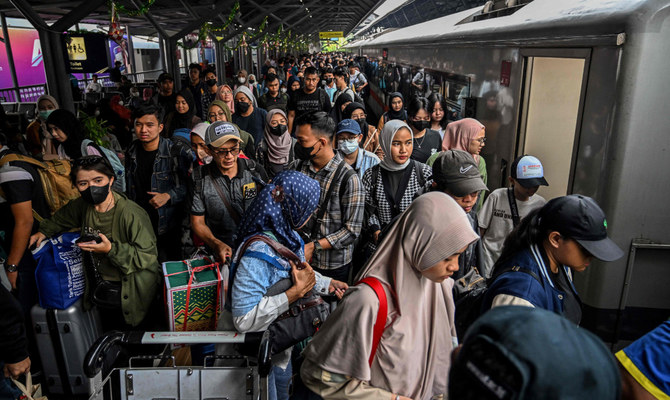
Passengers prepare to board a train for their long distance train to return home ahead of Eid Al-Fitr, which marks the end of the Muslim fasting month of Ramadan, at Gubeng station in Surabaya on April 7, 2024. (AFP)
Short Url
Updated 09 April 2024
Follow

Indonesia’s annual exodus starts ahead of Eid Al-Fitr festivities

  • People living in Jakarta, a city of 11 million people, started leaving the capital over the weekend, according to the Transport Ministry

JAKARTA: Aditya Nugraha, a 21-year-old Indonesian, was traveling from the capital city of Jakarta to his hometown of Palembang on Sumatra island, over 500 km (310 miles) away, to celebrate the Islamic holiday of Eid Al-Fitr this week.
The festival, also called Lebaran in Indonesia, marks the end of the holy month of Ramadan. It falls on Wednesday this year and the entire week will be celebrated by more than 220 million people in Indonesia, which has one of the world’s largest Muslim populations.
Aditya was one of the many millions traveling to his home town in a mass exodus known locally as “mudik” and usually marked by hours of traffic jams, especially on the main island of Java.
“We departed from home last night around 9, and now it’s been 13 hours and we are still stuck in this very long traffic. Hopefully, there will be a solution to this soon,” Aditya told Reuters on Monday, waiting to enter the port in the town of Merak for a ferry to cross from Java to Sumatra.
Drone footage on Monday showed thousands of vehicles queuing to enter the ferries, while many more were on the road heading to the port, stretching far outside Merak.
People living in Jakarta, a city of 11 million people, started leaving the capital over the weekend, according to the Transport Ministry.
Around 193 million people were expected to travel during the festivities this year, according to a survey by the ministry, around 56 percent higher compared to the number of travelers during the Eid holidays last year.


Russia says foreign forces in Ukraine would be ‘legitimate targets’

Updated 5 sec ago
Follow

Russia says foreign forces in Ukraine would be ‘legitimate targets’

  • Moscow has repeatedly said it will not tolerate the presence in Ukraine of troops from Western countries

MOSCOW: Russia would regard the deployment of any foreign military forces or infrastructure in Ukraine as foreign intervention and treat those forces as legitimate ​targets, the Foreign Ministry said on Monday, citing Minister Sergei Lavrov.
The ministry’s comment, one of many it said were in response to questions put to Lavrov, also praised US President Donald Trump’s efforts at working for a resolution of the war and said he understood the fundamental reasons behind the conflict.
“The deployment of ‌military units, facilities, ‌warehouses, and other infrastructure of ‌Western ⁠countries ​in Ukraine ‌is unacceptable to us and will be regarded as foreign intervention posing a direct threat to Russia’s security,” the ministry said on its website.
It said Western countries — which have discussed a possible deployment to Ukraine to help secure any peace deal — had to understand “that all foreign military contingents, including German ⁠ones, if deployed in Ukraine, will become legitimate targets for the Russian ‌Armed Forces.”
The United States has spearheaded ‍efforts to hold talks aimed ‍at ending the conflict in Ukraine and a second three-sided ‍meeting with Russian and Ukrainian representatives is to take place this week in the United Arab Emirates.
The issue of ceding internationally recognized Ukrainian territory to Russia remains a major stumbling block. ​Kyiv rejects Russian calls for it to give up all of its Donbas region, including territory Moscow’s ⁠forces have not captured.
Moscow has repeatedly said it will not tolerate the presence in Ukraine of troops from Western countries.
The ministry said Moscow valued the “purposeful efforts” of the Trump administration in working toward a resolution and understanding Russia’s long-running concerns about NATO’s eastward expansion and its overtures to Ukraine.
It described Trump as “one of the few Western politicians who not only immediately refused to advance meaningless and destructive preconditions for starting a substantive dialogue with Moscow on the ‌Ukrainian crisis, but also publicly spoke about its root causes.”