

China Southern Airlines to operate regular flights to Riyadh

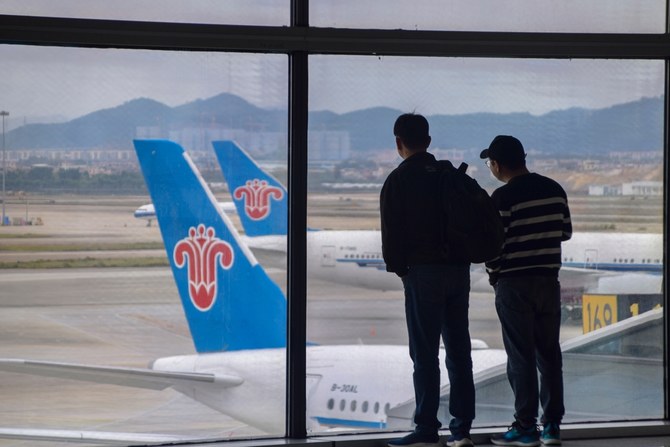
Guangzhou Baiyun International Airport. Passengers view China Southern Airlines aircraft from afar. Shutterstock
Short Url
Updated 08 April 2024
Follow

China Southern Airlines to operate regular flights to Riyadh

RIYADH: Aviation firm China Southern Airlines has been given the green light by Saudi Arabia to operate flights between Riyadh and three cities in the Asian country.    

The Kingdom’s General Authority of Civil Aviation, through its Air Transport and International Cooperation Sector, authorized the company to commence regular operations from Beijing, Guangzhou, and Shenzhen to the Saudi capital, according to a statement.   

Starting April 16, the travel schedule will include four passenger or commercial flights, as well as three air cargo trips, a week.  

This initiative is part of GACA’s continuous efforts to strengthen connectivity and broaden the Kingdom’s air transport network as part of the objectives of Saudi Vision 2030.   

These measures aim to transform the region into a global logistics hub and open new opportunities for the sector, aligning with the ambitions of the Saudi Aviation Strategy. 

These developments come as a new air route between Riyadh and Shanghai was established in March, thanks to a collaboration between the Saudi Air Connectivity Program and China Eastern Airlines.  

The pair had agreed to enter into a partnership directly linking Pudong Airport and King Khalid International Airport in the Kingdom’s capital, the Saudi Press Agency reported at that time. 

The services were scheduled to commence on April 8, with the route set to operate with an A330-200 aircraft, offering an annual capacity of 35,880 inbound seats. 

This move is set to enhance air connectivity between Saudi Arabia and China and falls in line with the growing interest and demand for travel between the two nations.   

In February, top officials from both countries convened for a high-level meeting in Beijing, focusing on investment opportunities, technology transfer, and enhancing economic cooperation. 

The high-level delegation, led by Abdulaziz Al-Duailej, president of the Kingdom’s General Authority of Civil Aviation, visited the Asian country to convene a joint round table meeting, exploring cooperation in connectivity and discussing partnership aspects across various areas. 

During the visit, both nations also discussed the exploration of innovative solutions in aviation, including sustainable fuels, advanced air mobility, and traffic management systems.  

Interest was also expressed in integrating artificial intelligence and digital technologies to enhance the aviation experience and operational efficiency. 

Additionally, during its visit, the Saudi delegation emphasized the substantial investments in the sector and reiterated the Kingdom’s openness to further opportunities.  

This aligns with GACA’s goal of modernizing the airport system and supports the Kingdom’s tourism sector target of attracting 150 million visitors by 2030. 


Kuwait to boost Islamic finance with sukuk regulation

Updated 05 February 2026
Follow

Kuwait to boost Islamic finance with sukuk regulation

  • The move supports sustainable financing and is part of Kuwait’s efforts to diversify its oil-dependent economy

RIYADH: Kuwait is planning to introduce legislation to regulate the issuance of sukuk, or Islamic bonds, both domestically and internationally, as part of efforts to support more sustainable financing for the oil-rich Gulf nation, Prime Minister Sheikh Ahmad Abdullah Al-Ahmad Al-Sabah said on Wednesday.

Speaking at the World Governments Summit in Dubai, Al-Sabah highlighted that Kuwait is exploring a variety of debt instruments to diversify its economy. The country has been implementing fiscal reforms aimed at stimulating growth and controlling its budget deficit amid persistently low oil prices. Hydrocarbons continue to dominate Kuwait’s revenue stream, accounting for nearly 90 percent of government income in 2024.

The Gulf Cooperation Council’s debt capital market is projected to exceed $1.25 trillion by 2026, driven by project funding and government initiatives, representing a 13.6 percent expansion, according to Fitch Ratings.

The region is expected to remain one of the largest sources of US dollar-denominated debt and sukuk issuance among emerging markets. Fitch also noted that cross-sector economic diversification, refinancing needs, and deficit funding are key factors behind this growth.

“We are about to approve the first legislation regulating issuance of government sukuk locally and internationally, in accordance with Islamic laws,” Al-Sabah said.

“This enables us to deal with financial challenges flexibly and responsibly, and to plan for medium and long-term finances.”

Kuwait returned to global debt markets last year with strong results, raising $11.25 billion through a three-part bond sale — the country’s first US dollar issuance since 2017 — drawing substantial investor demand. In March, a new public debt law raised the borrowing ceiling to 30 billion dinars ($98 billion) from 10 billion dinars, enabling longer-term borrowing.

The Gulf’s debt capital markets, which totaled $1.1 trillion at the end of the third quarter of 2025, have evolved from primarily sovereign funding tools into increasingly sophisticated instruments serving governments, banks, and corporates alike. As diversification efforts accelerate and refinancing cycles intensify, regional issuers have become regular participants in global debt markets, reinforcing the GCC’s role in emerging-market capital flows.

In 2025, GCC countries accounted for 35 percent of all emerging-market US dollar debt issuance, excluding China, with growth in US dollar sukuk issuance notably outpacing conventional bonds. The region’s total outstanding debt capital markets grew more than 14 percent year on year, reaching $1.1 trillion.