

Oil Updates – crude slides more than 1% as Middle East tensions ease

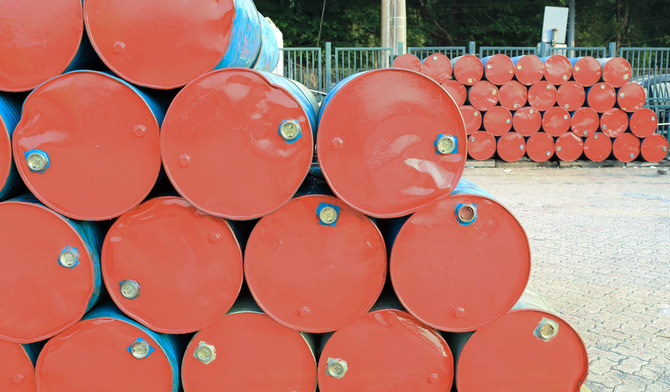
Brent crude futures dropped $1.48, or 1.6 percent, to $89.69 a barrel by 9:15 a.m. Saudi time. Shutterstock
Short Url
Updated 01 October 2024
Follow

Oil Updates – crude slides more than 1% as Middle East tensions ease

SINGAPORE: Oil prices slid more than $1 a barrel on Monday, with Brent falling below $90, as Middle East tensions eased after Israel withdrew more soldiers from southern Gaza and committed to fresh talks on a potential ceasefire in the six-month conflict, according to Reuters.

Brent crude futures dropped $1.48, or 1.6 percent, to $89.69 a barrel by 9:15 a.m. Saudi time. US West Texas Intermediate crude was at $85.54 a barrel, down $1.37, or 1.5 percent.

“It appears the catalyst is Israel saying it has withdrawn all troops except one brigade from the Southern Gaza strip, likely in response to growing international pressure and to deescalate tensions after it killed senior Iranian commanders in Syria last week,” IG market analyst Tony Sycamore said.

Auckland-based independent analyst Tina Teng said: “This could be just a temporary pullback as the event did not offer any fundamental changes.”

Israel and Hamas sent teams to Egypt for fresh talks on a potential ceasefire ahead of the Eid holidays, easing tensions in the Middle East that drove up oil prices by more than 4 percent last week on concerns of supply disruption.

Israeli Defense Minister Yoav Gallant said on Sunday that Israel is ready to handle any scenario that may arise with Iran, after Tehran threatened to retaliate for the killing of Iranian generals on April 1.

The world’s top oil exporter, Saudi Arabia, raised official selling prices for all crude grades to Asia in May, in line with expectations, after heavy oil supply tightened.

Fire struck an offshore platform operated by Mexico’s national oil company Pemex on Saturday, killing at least one contractor. This comes after Pemex requested its trading unit to cancel up to 436,000 barrels per day of crude exports in April.

However, Goldman Sachs analysts expect Brent to stay below $100 a barrel in its base case scenario that assumes already solid demand, no further geopolitical hits to oil supply and that elevated spare capacity will lead the Organization of the Petroleum Exporting Countries and its allies, known as OPEC+, to raise production in the third quarter.

In the US, oil rigs rose by two to 508 last week while gas rigs fell by two to 110, the lowest since January 2022, Baker Hughes said in its report on Friday.

The US employment report on Friday beat expectations, suggesting the economy ended the first quarter on solid ground and potentially delaying anticipated Federal Reserve interest rate cuts this year.

The Fed may push out rate cuts amid strong US economic data and a tight labor market, Teng said.

Investors will be scouring consumer price index data from US and China due later this week for further clues on the timing of possible Fed rate cuts and to gauge the economic health of the world’s top two oil consumers.


Jordan’s industry fuels 39% of Q2 GDP growth

Updated 31 December 2025
Follow

Jordan’s industry fuels 39% of Q2 GDP growth

JEDDAH: Jordan’s industrial sector emerged as a major contributor to economic performance in 2025, accounting for 39 percent of gross domestic product growth in the second quarter and 92 percent of national exports.

Manufactured exports increased 8.9 percent year on year during the first nine months of 2025, reaching 6.4 billion Jordanian dinars ($9 billion), driven by stronger external demand. The expansion aligns with the country’s Economic Modernization Vision, which aims to position the country as a regional hub for high-value industrial exports, the Jordan News Agency, known as Petra, quoted the Jordan Chamber of Industry President Fathi Jaghbir as saying.

Export growth was broad-based, with eight of 10 industrial subsectors posting gains. Food manufacturing, construction materials, packaging, and engineering industries led performance, supported by expanded market access across Europe, Arab countries, and Africa.

In 2025, Jordanian industrial products reached more than 144 export destinations, including emerging Asian and African markets such as Ethiopia, Djibouti, Thailand, the Philippines, and Pakistan. Arab countries accounted for 42 percent of industrial exports, with Saudi Arabia remaining the largest market at 955 million dinars.

Exports to Syria rose sharply to nearly 174 million dinars, while shipments to Iraq and Lebanon totaled approximately 745 million dinars. Demand from advanced markets also strengthened, with exports to India reaching 859 million dinars and Italy about 141 million dinars.

Industrial output also showed steady improvement. The industrial production index rose 1.47 percent during the first nine months of 2025, led by construction industries at 2.7 percent, packaging at 2.3 percent, and food and livestock-related industries at 1.7 percent.

Employment gains accompanied the sector’s expansion, with more than 6,000 net new manufacturing jobs created during the period, lifting total industrial employment to approximately 270,000 workers. Nearly half of the new jobs were generated in food manufacturing, reflecting export-driven growth.

Jaghbir said industrial exports remain among the economy’s highest value-added activities, noting that every dinar invested generates an estimated 2.17 dinars through employment, logistics, finance, and supply-chain linkages. The sector also plays a critical role in narrowing the trade deficit and supporting macroeconomic stability.

Investment activity accelerated across several subsectors in 2025, including food processing, chemicals, pharmaceuticals, mining, textiles, and leather, as manufacturers expanded capacity and upgraded production lines to meet rising demand.

Jaghbir attributed part of the sector’s momentum to government measures aimed at strengthening competitiveness and improving the business environment. Key steps included freezing reductions in customs duties for selected industries, maintaining exemptions for production inputs, reinstating tariffs on goods with local alternatives, and imposing a 16 percent customs duty on postal parcels to support domestic producers.

Additional incentives in industrial cities and broader structural reforms were also cited as improving the investment climate, reducing operational burdens, and balancing consumer needs with protection of local industries.