Khan Younis pullout ‘to prepare for Rafah attack,’ says Israeli defense chief

1 / 2
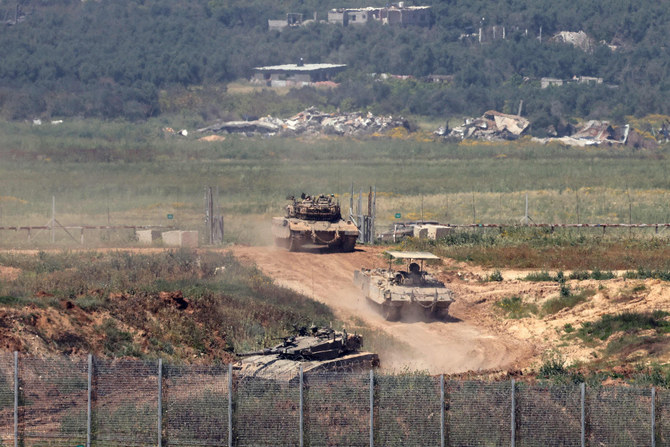
Israeli army vehicles move in an area along the border with the Gaza Strip and southern Israel on April 4, 2024. On Sunday, most of Israel's troops pulled out of Khan Younis in the southern Gaza Stirop after six months of war. (AFP)
2 / 2
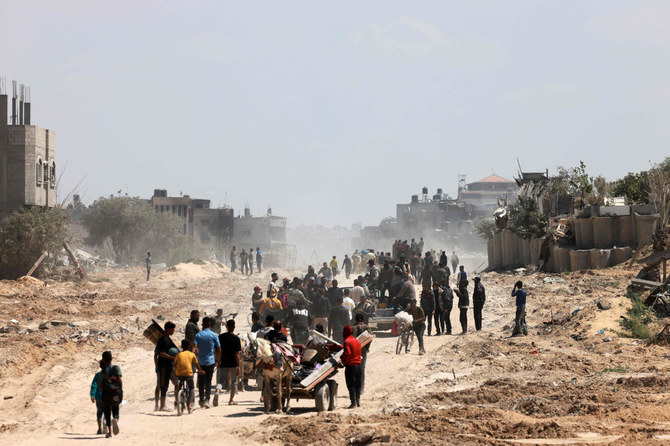
Palestinians who had taken refuge in Rafah in leave the city to return to Khan Younis after Israel pulled its ground forces out of the southern Gaza Strip, on April 7, 2024, six months into the devastating war sparked by the October 7 attacks. (AFP)
Short Url
Updated 08 April 2024
Follow

Khan Younis pullout ‘to prepare for Rafah attack,’ says Israeli defense chief

  • Minister Yoav Gallant claims Hamas ceased to exist as ‘military framework’
  • Netanyahu said Israel was “one step away from victory,” but his military chief said "we are far from stopping"

JEDDAH:  Israeli troops pulled out of Khan Younis in southern Gaza on Sunday after months of fierce fighting half a year into the war sparked by the attack against Israel by Hamas militants on October 7.

Israel’s Defense Minister Yoav Gallant said the withdrawal was because “Hamas ceased to exist as a military framework” in Khan Younis, just north of Rafah, where more than 1.5 million Palestinians are sheltering. He also said the pullout was “to prepare for future missions, including ... in Rafah.”

Israel said it had withdrawn more soldiers from southern Gaza, leaving just one brigade, as it and Hamas sent teams to Egypt for fresh talks on a potential ceasefire in the six-month conflict.

After troops left areas in and around the largely destroyed city of Khan Yunis, a stream of displaced Palestinians walked there, hoping to return to their homes from temporary shelters in Rafah, a little further south.
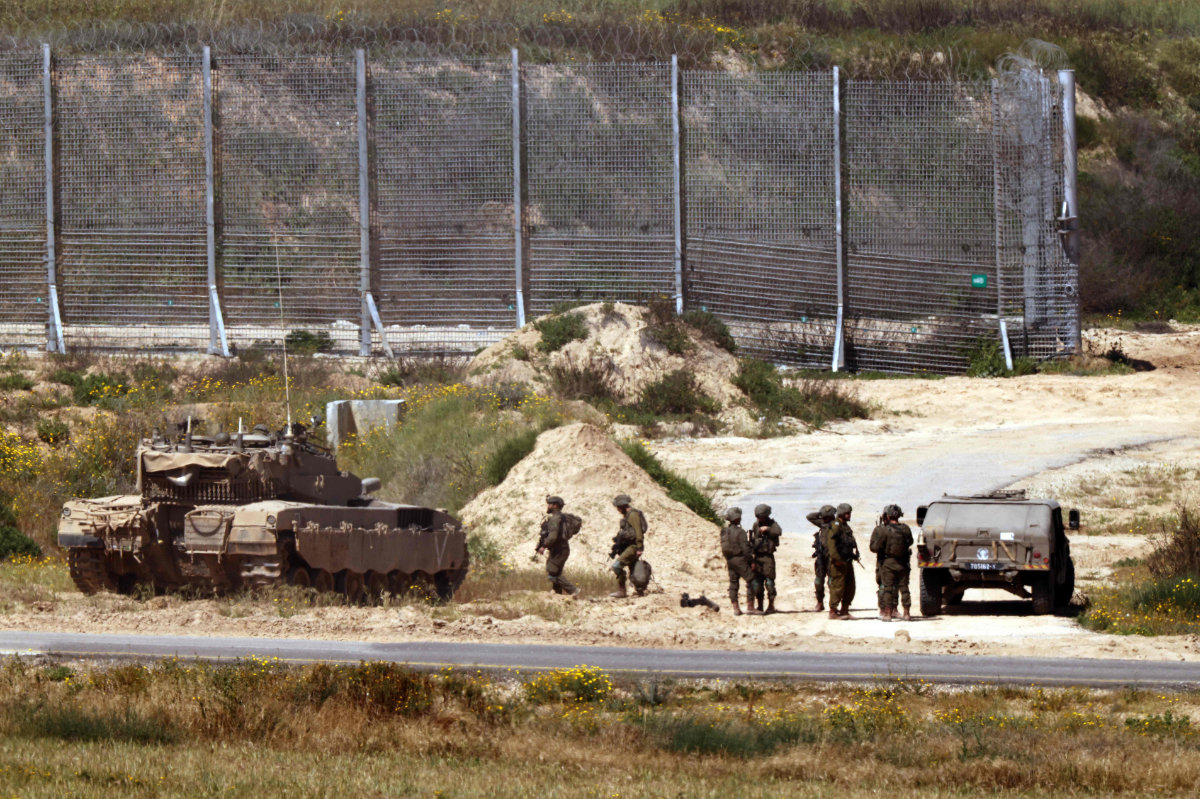


Israeli army vehicles move in an area along the border with the Gaza Strip and southern Israel on April 4, 2024. On Sunday, most of Israel's troops pulled out of Khan Younis in the southern Gaza Stirop after six months of war. (AFP)

Khan Yunis is the hometown of Hamas’s Gaza chief Yahya Sinwar, whom Israel accuses of being the mastermind of the October 7 attacks.

The Israeli army said a “significant force” would stay on elsewhere in the besieged territory as Prime Minister Benjamin Netanyahu said Israel was “one step away from victory.”

“Israel is ready for a deal. Israel is not ready to surrender,” Netanyahu said to his Cabinet in a speech to mark six months since Hamas’s attack that resulted in the deaths of 1,170 people, mostly civilians, Israeli figures show.

On a day when talks toward a truce deal were set to resume in Cairo, Netanyahu also stressed that “there will be no ceasefire without the return of hostages.”

He is facing intense pressure at home from families and supporters of captives seized by the militants as well as from a resurgent anti-government protest movement.

“The war in Gaza continues, and we are far from stopping,” said Israel’s military Chief of Staff Herzi Halevi. “This is a long war, with varying intensity.”

Growing global opposition

World leaders have expressed alarm at the prospect of an invasion of the city, near the Egyptian border, where most of Gaza’s population has taken shelter.

The UN and international aid organizations decried the devastating toll of the war, warning that the Palestinian territory had become “beyond catastrophic.”

“Six months is an awful milestone,” the International Federation of Red Cross and Red Crescent Societies said, warning that “humanity has been all but abandoned.”

The war broke out on Oct. 7 with an attack by Hamas militants that resulted in the deaths of 1,170 people. Hamas and Islamic Jihad militants also took more than 250 hostages — 129 of whom remain in Gaza, including 34 who the army says are dead.

Israel’s retaliatory offensive has killed at least 33,175 people in Gaza, mostly women and children, according to the Hamas Health Ministry.

British Prime Minister Rishi Sunak said the “terrible” war “must end.” He said in a statement: “We continue to stand by Israel’s right to defeat the threat from Hamas terrorists and defend their security. But the whole of the UK is shocked by the bloodshed.
“This terrible conflict must end. The hostages must be released. The aid — which we have been straining every sinew to deliver by land, air and sea — must be flooded in.”

The outcry intensified after an Israeli drone strike killed seven aid workers — most of them Westerners — for the US-based food charity World Central Kitchen on April 1.

Vast areas of Gaza have been turned into a rubble-strewn wasteland with damage estimated at $18.5 billion to critical infrastructure, mostly housing, a World Bank report said.
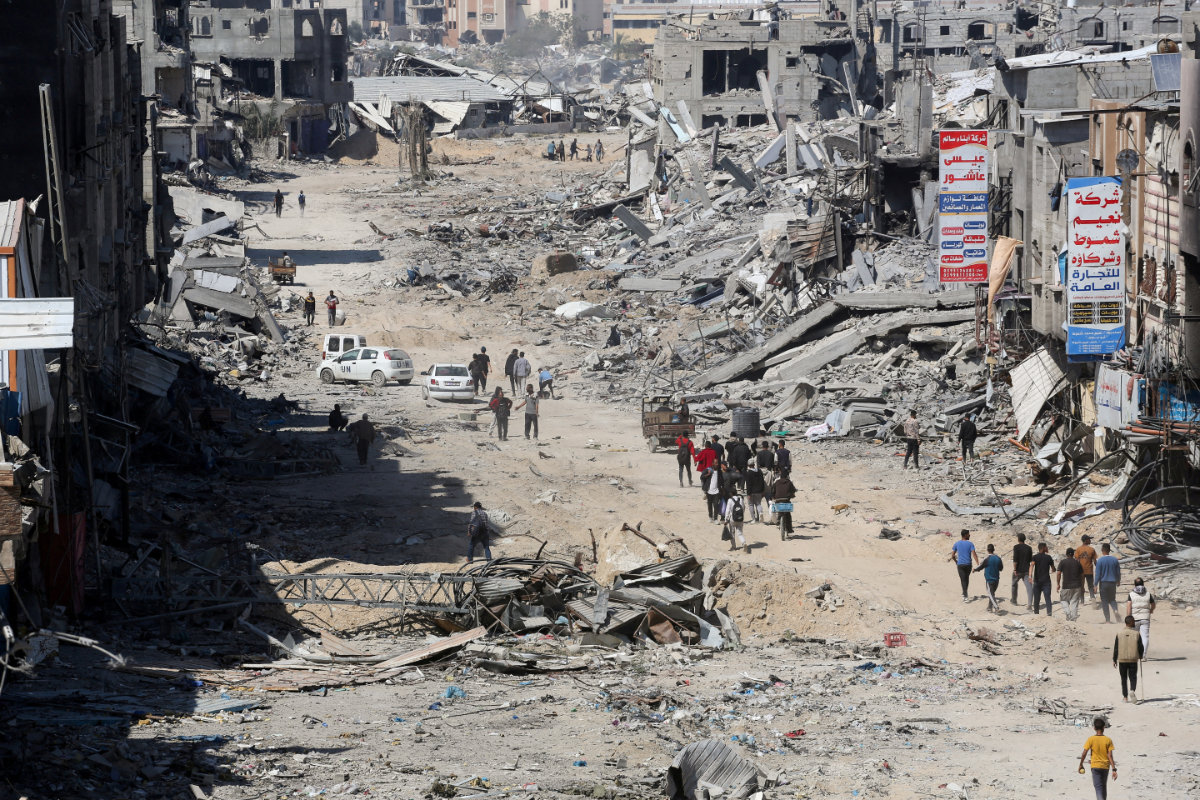


Palestinians inspect destroyed residential buildings in Khan Younis, in the southern Gaza Strip, after the Israeli military withdrew most of its ground troops on April 7, 2024. (REUTERS)

Charities have accused Israel of blocking aid, but Israel has defended its efforts and blamed shortages on aid organizations’ inability to distribute assistance once it gets in.

“The denial of basic needs — food, fuel, sanitation, shelter, security and health care — is inhumane and intolerable,” World Health Organization chief Tedros Adhanom Ghebreyesus wrote on X, formerly Twitter.

Israeli security expert Omer Dostri predicted that, as more displaced Palestinians leave densely crowded Rafah, “within two months there will be a move in Rafah to destroy the remaining Hamas brigades.”

The partial withdrawal came as talks toward a truce and hostage release deal were expected to resume in Cairo, including United States, Qatari and Egyptian mediators.

United States President Joe Biden told Netanyahu on Thursday he wants a ceasefire and hostage release deal and ramped-up aid deliveries.

After the deaths of the seven aid workers, Biden — whose government is Israel’s top arms supplier and political backer — also hinted at making US support for Israel conditional on curtailing the killing of civilians and improving humanitarian conditions.

Hours after Biden’s comments, Netanyahu said Israel would allow “temporary” aid flow through Erez and Ashdod.
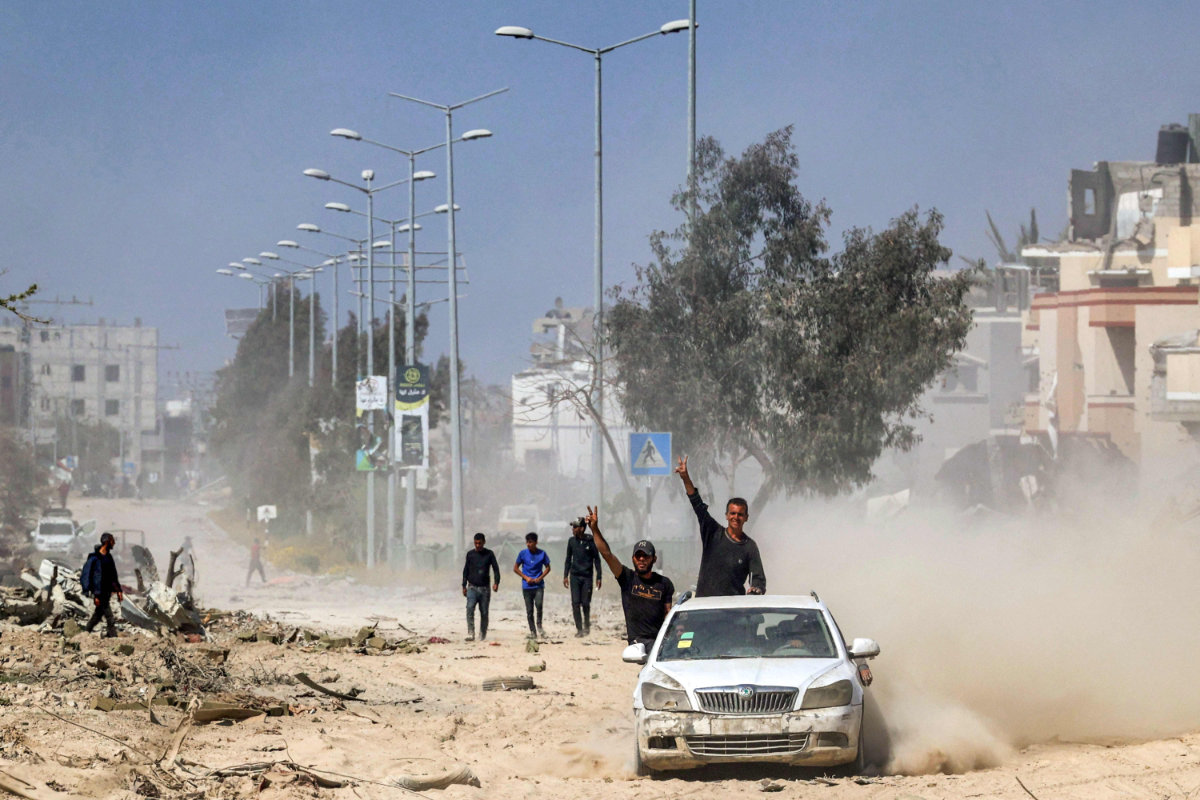


A man gestures from a vehicle moving past destroyed buildings along a road in Khan Yunis on April 7, 2024 after Israel pulled its ground forces out of the southern Gaza Strip, six months into the devastating war sparked by the October 7 attacks. (AFP)

Maha Thaer, a mother of four returning to Khan Yunis, said she would move back into her badly damaged apartment, “even though it is not suitable for living, but it is better than tents.”

Muhammad Yunis, 51, a Palestinian in northern Gaza, sees nothing but loss.

“Isn’t the bombing, death and destruction enough?” he asked. “There are bodies still under the rubble. We can smell the stench.”

(With AFP)

Battleground: Jerusalem
The biblical battle for the Holy City

Enter


keywords

US military launches strikes in Syria against Daesh fighters after American deaths

Updated 20 December 2025
Follow

US military launches strikes in Syria against Daesh fighters after American deaths

  • “This is not the beginning of a war — it is a declaration of vengeance,” Defense Secretary Pete Hegseth says
  • President Trump earlier pledged “very serious retaliation” but stressed that Syria was fighting alongside US troops

WASHINGTON: The Trump administration launched military strikes Friday in Syria to “eliminate” Daesh group fighters and weapons sites in retaliation for an ambush attack that killed two US troops and an American interpreter almost a week ago.
A US official described it as “a large-scale” strike that hit 70 targets in areas across central Syria that had Daesh (also known as Islamic State or IS) infrastructure and weapons. Another US official, who also spoke on condition of anonymity to discuss sensitive operations, said more strikes should be expected.
The attack was conducted using F-15 Eagle jets, A-10 Thunderbolt ground attack aircraft and AH-64 Apache helicopters, the officials said. F-16 fighter jets from Jordan and HIMARS rocket artillery also were used, one official said.
“This is not the beginning of a war — it is a declaration of vengeance. The United States of America, under President Trump’s leadership, will never hesitate and never relent to defend our people,” Defense Secretary Pete Hegseth said on social media.


President Donald Trump had pledged “very serious retaliation” after the shooting in the Syrian desert, for which he blamed Daesh. The troops were among hundreds of US troops deployed in eastern Syria as part of a coalition fighting the terrorist group.
Trump in a social media post said the strikes were targeting Daesh “strongholds.” He reiterated his support for Syrian President Ahmad Al-Sharaa, who he said was “fully in support” of the US effort to target the militant group.
Trump also offered an all-caps threat, warning the group against attacking US personnel again.
“All terrorists who are evil enough to attack Americans are hereby warned — YOU WILL BE HIT HARDER THAN YOU HAVE EVER BEEN HIT BEFORE IF YOU, IN ANY WAY, ATTACK OR THREATEN THE USA.,” the president added.
The attack was a major test for the warming ties between the United States and Syria since the ouster of autocratic leader Bashar Assad a year ago. Trump has stressed that Syria was fighting alongside US troops and said Al-Sharaa was “extremely angry and disturbed by this attack,” which came as the US military is expanding its cooperation with Syrian security forces.
Syria’s foreign ministry in a statement on X following the launch of US strikes said that last week’s attack “underscores the urgent necessity of strengthening international cooperation to combat terrorism in all its forms” and that Syria is committed “to fighting Daesh and ensuring that it has no safe havens on Syrian territory and will continue to intensify military operations against it wherever it poses a threat.”


Daesh has not claimed responsibility for the attack on the US service members, but the group has claimed responsibility for two attacks on Syrian security forces since, one of which killed four Syrian soldiers in Idlib province. The group in its statements described Al-Sharaa’s government and army as “apostates.” While Al-Sharaa once led a group affiliated with Al-Qaeda, he has had a long-running enmity with Daesh.
Syrian state television reported that the US strikes hit targets in rural areas of Deir ez-Zor and Raqqa provinces and in the Jabal Al-Amour area near Palmyra. It said they targeted “weapons storage sites and headquarters used by Daesh as launching points for its operations in the region.”

Trump this week met privately with the families of the slain Americans at Dover Air Force Base in Delaware before he joined top military officials and other dignitaries on the tarmac for the dignified transfer, a solemn and largely silent ritual honoring US service members killed in action.

President Donald Trump, from left, Defense Secretary Pete Hegseth and Chairman of the Joint Chiefs Air Force Gen. Dan Caine attend a casualty return ceremony at Dover Air Force Base, Delaware, on Dec. 17, 2025,of soldiers who were killed in an attack in Syria last week. (AP)

The guardsmen killed in Syria last Saturday were Sgt. Edgar Brian Torres-Tovar, 25, of Des Moines, and Sgt. William Nathaniel Howard, 29, of Marshalltown, according to the US Army. Ayad Mansoor Sakat, of Macomb, Michigan, a US civilian working as an interpreter, was also killed.
The shooting nearly a week ago near the historic city of Palmyra also wounded three other US troops as well as members of Syria’s security forces, and the gunman was killed. The assailant had joined Syria’s internal security forces as a base security guard two months ago and recently was reassigned because of suspicions that he might be affiliated with Daesh, Interior Ministry spokesperson Nour Al-Din Al-Baba has said.
The man stormed a meeting between US and Syrian security officials who were having lunch together and opened fire after clashing with Syrian guards.
When asked for further information, the Pentagon referred AP to Hegseth’s social media post.