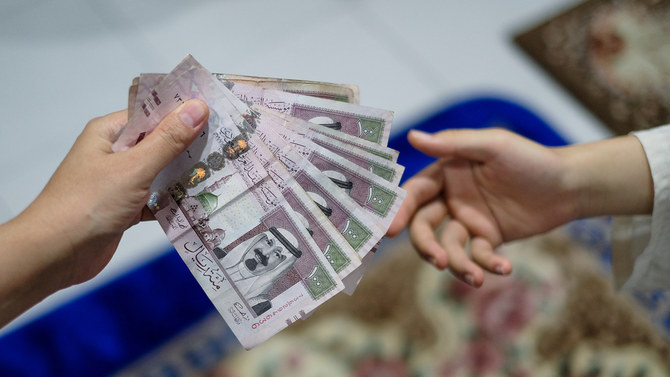
Deposits at Saudi banks increased 10.26% in February 

Analysis conducted on the data released by the Saudi Central Bank confirmed that growth was primarily fueled by a 26 percent annual increase in time and savings deposits. Shutterstock
Short Url
Updated 07 April 2024
Follow

Deposits at Saudi banks increased 10.26% in February 

RIYADH: Saudi banks’ total deposits reached SR2.54 trillion ($677 billion) in February, marking a 10.26 percent increase from the same month last year, the official data showed. 

Analysis conducted on the data released by the Saudi Central Bank confirmed that growth was primarily fueled by a 26 percent annual increase in time and savings deposits, which reached SR838.53 billion.  

Demand reserves also saw a 2.85 percent rise during this period, totaling SR1.25 trillion, while other quasi-money increased by 7.57 percent, reaching SR352 billion. 

Demand deposits constitute the highest share at 53 percent, slightly down from 57 percent a year ago. This shift is a result of the increasing popularity of term reserves due to rising interest rates, making this account category more attractive to clients seeking higher income-generating holdings. 

However, term deposits experienced a 3 percent decrease month-on-month, the first decline in 18 months. 

The rising interest rate bolstered the popularity of term deposits during this period, as they were increasing in alignment with the US Fed rates as part of recent monetary policy efforts to combat inflation. However, this upward trend appears to be approaching its end, given the Fed’s decision to maintain rates unchanged in their latest meeting in March. The last hike took place in July 2023. 

Meanwhile, Saudi Arabia has displayed remarkable resilience and stability in managing inflation. This success can be credited to the steadfast implementation of robust government policies aimed at safeguarding the economy. However, the country’s currency pegged to the US dollar means the central bank closely follows the Fed interest rate movement. 

Among term deposits, the segment that witnessed the highest growth was from businesses and individuals, increasing by 36 percent during this period to reach SR450 billion. In contrast, government entities saw a rise of 16.4 percent, reaching SR388.15 billion. 

Despite the increase in bank deposits, the growth in loans has exceeded the liability side, putting pressure on the support for the expanding local economy.  

MEED Projects, a Dubai-based analysis firm, forecasts that Saudi Arabia will need $640 billion for construction spending over the next five years, based on current project pipelines. 

This implies that banks potentially have to raise nearly $384 billion over this period if they fund 60 percent of the initiatives through increased deposits and debt. 

Although the growth in Saudi Arabia’s reserves remains a key funding source, about 15 percent of the required amount may have to be sourced from debt, according to Edmond Christou, a senior financial analyst at Bloomberg Intelligence, in an April report. This could mean issuing new debt of approximately $11.5 billion annually. 

Christou also noted that financial institutes currently need more liquidity to fully support the significant construction needs, but they anticipate gathering more deposits and accessing the international debt market. 

Debt issuance is already increasing, with approximately $6.8 billion sold just this year, compared to $5.4 billion for the entire previous year, as reported by Bloomberg Intelligence. 

Despite the ambitious funding needs, the balance sheets of Saudi Arabia’s banks are generally viewed as healthy, according to the report. S&P Global Ratings categorizes most major lenders as investment grade with a stable outlook. However, S&P also points out that these financial institutions will not be able to carry the full financial burden of Vision 2030, the country’s long-term economic development plan. 

According to Bloomberg’s report, projects are also largely funded by the central government and associated entities. The well-financed Public Investment Fund has announced intentions to invest $70 billion annually after 2025 and is considering its own fundraising strategies. 

The analysis indicated there is still some time before banks venture into the fixed-income market, especially as liquidity has been showing signs of improvement since the beginning of the year. 

This is evidenced by Saibor, a significant indicator of borrowing costs in Saudi Arabia, easing back from the 6.4 percent peak in January. However, it remains considerably above 6 percent due to elevated rates in the US. 


‘The future is renewables,’ Indian energy minister tells World Economic Forum

Updated 22 January 2026
Follow

‘The future is renewables,’ Indian energy minister tells World Economic Forum

  • ‘In India, I can very confidently say, affordability (of renewables) is better than fossil fuel energy,’ says Pralhad Venkatesh Joshi during panel discussion
  • Renewables are an increasingly important part of the energy mix and the technology is evolving rapidly, another expert says at session titled ‘Unstoppable March of Renewables?’

BEIRUT: “The future is renewables,” India’s minister of new and renewable energy told the World Economic Forum in Davos on Wednesday.
“In India, I can very confidently say, affordability (of renewables) is better than fossil fuel energy,” Pralhad Venkatesh Joshi said during a panel discussion titled “Unstoppable March of Renewables?”
The cost of solar power has has fallen steeply in recent years compared with fossil fuels, Joshi said, adding: “The unstoppable march of renewables is perfectly right, and the future is renewables.”
Indian authorities have launched a major initiative to install rooftop solar panels on 10 million homes, he said. As a result, people are not only saving money on their electricity bills, “they are also selling (electricity) and earning money.”
He said that this represents a “success story” in India in terms of affordability and “that is what we planned.”
He acknowledged that more work needs to be done to improve reliability and consistency of supplies, and plans were being made to address this, including improved storage.
The other panelists in the discussion, which was moderated by Godfrey Mutizwa, the chief editor of CNBC Africa, included Marco Arcelli, CEO of ACWA Power; Catherine MacGregor, CEO of electricity company ENGIE Group; and Pan Jian, co-chair of lithium-ion battery manufacturer Contemporary Amperex Technology.
Asked by the moderator whether she believes “renewables are unstoppable,” MacGregor said: “Yes. I think some of the numbers that we are now facing are just proof points in terms of their magnitude.
“In 2024, I think it was 600 gigawatts that were installed across the globe … in Europe, close to 50 percent of the energy was produced from renewables in 2024. That has tripled since 2004.”
Renewables are an increasingly important and prominent part of the energy mix, she added, and the technology is evolving rapidly.
“It’s not small projects; it’s the magnitude of projects that strikes me the most, the scale-up that we are able to deliver,” MacGregor said.
“We are just starting construction in the UAE, for example. In terms of solar size it’s 1.5 gigawatts, just pure solar technology. So when I see in the Middle East a round-the-clock project with just solar and battery, it’s coming within reach.
“The technology advance, the cost, the competitiveness, the size, the R&D, the technology behind it and the pace is very impressive, which makes me, indeed, really say (renewables) is real. It plays a key role in, obviously, the energy demand that we see growing in most of the countries.
“You know, we talk a lot about energy transition, but for a lot of regions now it is more about energy additions. And renewables are indeed the fastest to come to market, and also in terms of scale are really impressive.”
Mutizwa asked Pan: “Are we there yet, in terms of beginning to declare mission accomplished? Are renewables here to stay?”
“I think we are on the road but (its is) very promising,” Pan replied. There is “great potential for future growth,” he added, and “the technology is ready, despite the fact that there are still a lot of challenges to overcome … it is all engineering questions. And from our perspective, we have been putting in a lot of resources and we are confident all these engineering challenges will be tackled along the way.”
Responding to the same question, Arcelli said: “Yes, I think we are beyond there on power, but on other sectors we are way behind … I would argue today that the technology you install by default is renewables.
“Is it a universal truth nowadays that renewables are the cheapest?” asked Mutizwa.
“It’s the cheapest everywhere,” Arcelli said.