Iraq tightens grip on autonomous Kurdish region

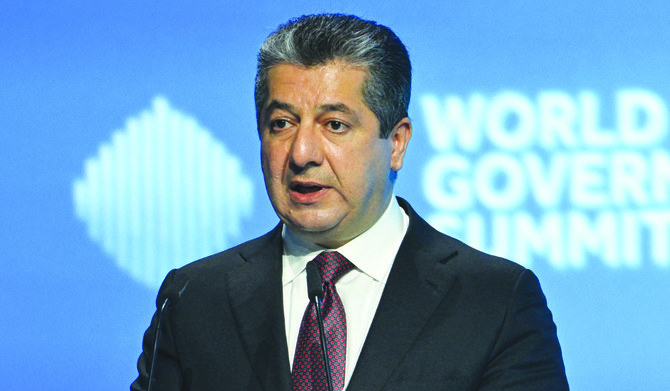
Masrour Barzani, Prime Minister of Iraq's Autonomous Kurdistan Region, speaks at the World Government Summit in Dubai on February 12, 2024. (AFP)
Short Url
Updated 07 April 2024
Follow

Iraq tightens grip on autonomous Kurdish region

  • Recent tension undermines Irbil’s relationship with Baghdad, analyst says

BAGHDAD: Iraq is using a period of relative stability to assert more control over the autonomous Kurdistan region that has long had fraught relations with federal authorities, analysts and politicians say.

Long-simmering disputes between Baghdad and Irbil, the capital of the northern region, came to a head recently after several Supreme Court rulings that the Kurds saw as an attempt to weaken the region’s autonomy.
Regional Prime Minister Masrour Barzani warned last week of “conspiracies aimed at undermining and dismantling the Kurdistan region” with “internal support within Kurdistan.”
The pressure is aimed at Barzani’s Kurdistan Democratic Party or KDP, which has been locked in a never-ending rivalry with the other main party, the Patriotic Union of Kurdistan or PUK.

BACKGROUND

Regional Prime Minister Masrour Barzani warned last week of ‘conspiracies aimed at undermining and dismantling the Kurdistan region’ with ‘internal support within Kurdistan.’

Kurds in Iraq were persecuted under the Sunni Arab-dominated regime of the late dictator Saddam Hussein but the 2005 constitution formalized their autonomy after the 2003 US-led invasion that toppled Saddam.
But mending the volatile ties between the central government in Baghdad and Kurdistan has been a persistent challenge.
Consecutive federal governments have long been preoccupied with “crises and complex challenges,” said a senior official in Baghdad about years of war, the fight against the Daesh group, and anti-government protests.
“That is why they never looked into Kurdistan’s mistakes ... (such as) oil deals and exports, the region’s financial system, and several illegal decisions that have been made,” he added.
But, he added: “Now is the time to fix these mistakes.”
Despite facing the same problems as Baghdad, such as endemic corruption, fractious politics, and entrenched ruling elites, the US-backed Kurdistan region has portrayed itself as a hub of stability and economic growth in contrast to the conflicts and crises that have besieged federal Iraq.
Last year, civil servants and lawyers from the city of Sulaimaniyah, the PUK stronghold, had taken the regional and national authorities to court over unpaid salaries in Kurdistan, where officials have long accused Baghdad of not sending the necessary funds.
In February, the Federal Supreme Court in Baghdad ordered the federal government to pay public sector salaries in Kurdistan directly instead of via the regional administration under a previous long-standing arrangement.
It also demanded that Irbil hand over all “oil and non-oil revenues” to Baghdad.
In a separate case, the court ruled to reduce the number of seats in the Kurdish parliament from 111 to 100, effectively eliminating a quota reserved for Turkmen, Armenian, and Christian minorities.
In response, Barzani’s KDP, the largest party in the outgoing parliament with 45 seats against 21 for the PUK, said it would boycott legislative polls due to take place in June.
The tussle with the federal court has aggravated an already tense disagreement over oil exports.
In March 2023, the federal government won international arbitration, recognizing its right to control Kurdish oil exports through Turkiye.
The ruling led to the suspension of exports, which blocked a significant source of income for the regional administration.
Irbil later agreed in principle that sales of Kurdish oil would pass through Baghdad in exchange for 12.6 percent of Iraq’s public spending, but the agreement’s implementation has stalled.
When Prime Minister Mohammed Shia Al-Sudani first came to power in 2021, Baghdad and Irbil enjoyed better relations than they had seen in years.
But experts say that some parties that brought Al-Sudani to power are now determined to weaken the autonomous Kurdistan region.
“Some politicians desire to undermine the constitutional state of the Kurdistan region out of political vengeance,” said Ihsan Al-Shammari, a political scientist at the University of Baghdad.
Although court decisions concerning Kurdistan are “constitutional,” they are “political,” Al-Shammari said.
The recent tension undermines Irbil’s relationship with Baghdad and aims to “politically” weaken the KDP, Al-Shammari added.
Political bickering between the KDP and its main rival, the PUK, which enjoys friendlier ties with the federal government, has always shaped politics in the autonomous region.
PUK chief Bafel Jalal Talabani announced his support for the Supreme Court’s decisions — an institution he said helped “protect the political system in Iraq.”
But Sabah Sobhi, a KDP lawmaker, said the decisions undermined Iraq’s current political system.
He said some political parties wanted to replace “the federal and decentralized” system with a “centralized and authoritarian” rule.
“Disagreements among Kurds would undoubtedly” worsen the situation, Sobhi warned.


US military launches strikes in Syria against Daesh fighters after American deaths

Updated 20 December 2025
Follow

US military launches strikes in Syria against Daesh fighters after American deaths

  • “This is not the beginning of a war — it is a declaration of vengeance,” Defense Secretary Pete Hegseth says
  • President Trump earlier pledged “very serious retaliation” but stressed that Syria was fighting alongside US troops

WASHINGTON: The Trump administration launched military strikes Friday in Syria to “eliminate” Daesh group fighters and weapons sites in retaliation for an ambush attack that killed two US troops and an American interpreter almost a week ago.
A US official described it as “a large-scale” strike that hit 70 targets in areas across central Syria that had Daesh (also known as Islamic State or IS) infrastructure and weapons. Another US official, who also spoke on condition of anonymity to discuss sensitive operations, said more strikes should be expected.
The attack was conducted using F-15 Eagle jets, A-10 Thunderbolt ground attack aircraft and AH-64 Apache helicopters, the officials said. F-16 fighter jets from Jordan and HIMARS rocket artillery also were used, one official said.
“This is not the beginning of a war — it is a declaration of vengeance. The United States of America, under President Trump’s leadership, will never hesitate and never relent to defend our people,” Defense Secretary Pete Hegseth said on social media.


President Donald Trump had pledged “very serious retaliation” after the shooting in the Syrian desert, for which he blamed Daesh. The troops were among hundreds of US troops deployed in eastern Syria as part of a coalition fighting the terrorist group.
Trump in a social media post said the strikes were targeting Daesh “strongholds.” He reiterated his support for Syrian President Ahmad Al-Sharaa, who he said was “fully in support” of the US effort to target the militant group.
Trump also offered an all-caps threat, warning the group against attacking US personnel again.
“All terrorists who are evil enough to attack Americans are hereby warned — YOU WILL BE HIT HARDER THAN YOU HAVE EVER BEEN HIT BEFORE IF YOU, IN ANY WAY, ATTACK OR THREATEN THE USA.,” the president added.
The attack was a major test for the warming ties between the United States and Syria since the ouster of autocratic leader Bashar Assad a year ago. Trump has stressed that Syria was fighting alongside US troops and said Al-Sharaa was “extremely angry and disturbed by this attack,” which came as the US military is expanding its cooperation with Syrian security forces.
Syria’s foreign ministry in a statement on X following the launch of US strikes said that last week’s attack “underscores the urgent necessity of strengthening international cooperation to combat terrorism in all its forms” and that Syria is committed “to fighting Daesh and ensuring that it has no safe havens on Syrian territory and will continue to intensify military operations against it wherever it poses a threat.”


Daesh has not claimed responsibility for the attack on the US service members, but the group has claimed responsibility for two attacks on Syrian security forces since, one of which killed four Syrian soldiers in Idlib province. The group in its statements described Al-Sharaa’s government and army as “apostates.” While Al-Sharaa once led a group affiliated with Al-Qaeda, he has had a long-running enmity with Daesh.
Syrian state television reported that the US strikes hit targets in rural areas of Deir ez-Zor and Raqqa provinces and in the Jabal Al-Amour area near Palmyra. It said they targeted “weapons storage sites and headquarters used by Daesh as launching points for its operations in the region.”

Trump this week met privately with the families of the slain Americans at Dover Air Force Base in Delaware before he joined top military officials and other dignitaries on the tarmac for the dignified transfer, a solemn and largely silent ritual honoring US service members killed in action.

President Donald Trump, from left, Defense Secretary Pete Hegseth and Chairman of the Joint Chiefs Air Force Gen. Dan Caine attend a casualty return ceremony at Dover Air Force Base, Delaware, on Dec. 17, 2025,of soldiers who were killed in an attack in Syria last week. (AP)

The guardsmen killed in Syria last Saturday were Sgt. Edgar Brian Torres-Tovar, 25, of Des Moines, and Sgt. William Nathaniel Howard, 29, of Marshalltown, according to the US Army. Ayad Mansoor Sakat, of Macomb, Michigan, a US civilian working as an interpreter, was also killed.
The shooting nearly a week ago near the historic city of Palmyra also wounded three other US troops as well as members of Syria’s security forces, and the gunman was killed. The assailant had joined Syria’s internal security forces as a base security guard two months ago and recently was reassigned because of suspicions that he might be affiliated with Daesh, Interior Ministry spokesperson Nour Al-Din Al-Baba has said.
The man stormed a meeting between US and Syrian security officials who were having lunch together and opened fire after clashing with Syrian guards.
When asked for further information, the Pentagon referred AP to Hegseth’s social media post.