NEW DELHI: Farmers in Punjab have begun putting up posters in a bid to stop Bharatiya Janata Party leaders from entering their villages ahead of this month’s general election, in which India’s ruling party is seeking a third consecutive term in power.
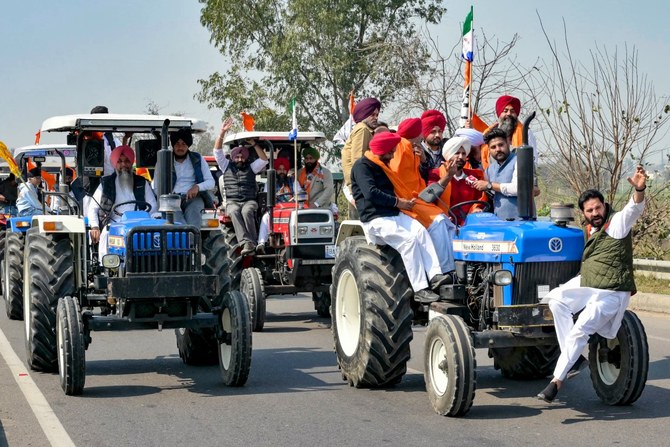
Banners reading “Farmers are barred from entering Delhi, BJP is banned from entering villages” refer to a February rally in which entry points to the Indian capital were blocked by police, as thousands of farmers tried to take their protest to the city after failed negotiations with the government.
Tens of thousands of protesters marched from the states of Punjab, Haryana and Uttar Pradesh, where the country’s agriculture is concentrated, to demand higher income and minimum support prices — guaranteed prices for their crops at government-controlled wholesale markets — which were promised in 2022.
“They stopped farmers from boarding trains and buses. They forced farmers to break their journey to Delhi. If we don’t let farmers come to the national capital, then how can we allow you to come to our village?” Avik Saha, member of the national coordination committee of Sanyukt Kisan Morcha, a coalition of over 40 Indian farmers’ unions, told Arab News.
“If you don’t allow us to come to our capital, just then see what we can do in our village. You close Delhi for us, then the villages are also closed for you. We have put up posters in almost all villages of Punjab.”
The SKM is a part of the alliance that coordinated a protest against laws deregulating the agriculture sector in 2021-22, when tens of thousands of farmers camped out on major highways leading to New Delhi for more than a year. Farmer groups estimate that 750 protesters have lost their lives — either killed in clashes with security forces or due to freezing cold when the rallies took place in winter.
While the government eventually rolled back the controversial legislation, it has yet to fulfill the promise to increase farmers’ incomes.
“Two years ago, they promised in writing that they would legalize laws promising minimum support price for farm produce, take action against those who killed farmers and many other things, but they have not done anything about it since,” Saha said.
“Now we have decided to continue on the democratic path. Since this is the election time and the BJP is expected to win, we are going to villages and to tell people what the real face of the party is, what their real intention is, and how they are anti-people, and how they just use people to stay in power. We are telling people not to vote for the BJP.”
The anti-BJP campaign in Punjab, a state of 28 million people, takes place as India prepares to hold a seven-phase general vote starting on April 19, with Prime Minister Narendra Modi seeking a third straight term.
Sarwan Singh Pandher, leader of the All India Kisan Sangarsh Coordination Committee, an umbrella organization representing 250 farmers’ groups, told Arab News they had decided to “question each and every” BJP leader seeking to visit Punjab villages for campaigning.
“If they won’t engage us in talks, then we will protest. This is our strategy. We want to show how undemocratic this party is. Recently, we wanted to march to Delhi to register our protest over the non-fulfillment of the promises made to us in 2022 when we ended the 13-month agitation over the three farm bills. But they stopped our march and created walls, plastered the road to Delhi with nails and created barriers everywhere. The BJP is not honoring the democratic rights of the people and farmers.”
Although it is confined to Punjab for now, farmers’ resentment resonates more widely across India’s huge rural hinterland, where the BJP government has done little to increase living standards.
Punjab contributes nearly two-thirds to the total production of food grains in the country, where 40 percent of people are dependent on agriculture.
“Farmers exert influence in the Punjab society, they have a presence all across. Naturally, the farmers’ no-entry call for BJP leaders in villages will create a buzz across the state and it might have some impact on the ground,” said Prof. Ronki Ram, a political scientist from Punjab University.
“Punjab always throws surprises, and it does not go with the popular national trend. You never know how this anti-BJP sentiment among farmers is going to play out in a crucial northern India state.”
The BJP said it was the farmers’ “democratic right” to protest, but they were not allowed to block the entry of party workers.
“I don’t think that the Election Commission of India and the state administration will permit them to block (us). They can show black flags or protest in a democratic manner, but they can’t stop any kind of gatherings and functions,” Sarwan Singh Channy, BJP spokesperson in Punjab told Arab News.
“It’s not only farmers in the villages, there are other people, too, and everyone has the right to participate in the election process.”


![]()

Farmers in Punjab bar India’s ruling party from entering villages ahead of polls
Short Url
https://arab.news/gx25t
Farmers in Punjab bar India’s ruling party from entering villages ahead of polls
- Voting to begin on April 19 as PM Narendra Modi seeks third straight term
- BJP says farmers have the right to protest, but not to block the electoral process


Latest updates





© 2026 SAUDI RESEARCH & PUBLISHING COMPANY, All Rights Reserved And subject to Terms of Use Agreement.