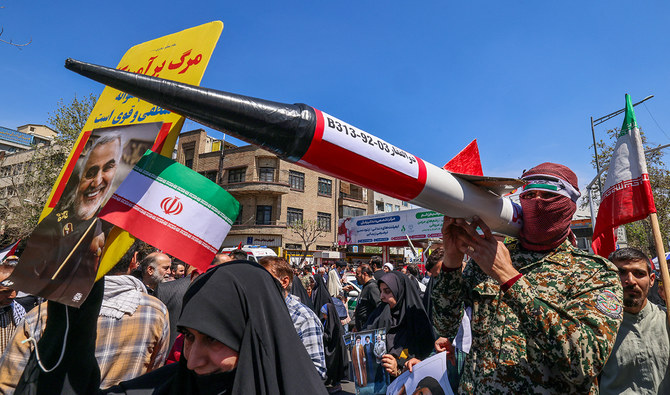
WASHINGTON: The United States is on high alert and preparing for a possible attack by Iran targeting Israeli or American assets in the region in response to Israel’s strike on the Iranian embassy in Syria, a US official said on Friday.
“We’re definitely at a high state of vigilance,” the official said in confirming a CNN report that said an attack could come in the next week.
Suspected Israeli warplanes bombed Iran’s embassy in Damascus on Monday in a strike that killed an Iranian military commander and marked a major escalation in Israel’s war with its regional adversaries.
Iran’s Islamic Revolutionary Guard Corps has said that seven Iranian military advisers died in the strike, including Mohammad Reza Zahedi, a senior commander in its Quds Force, which is an elite foreign espionage and paramilitary arm.
Iran has said it reserves the right “to take a decisive response.”
US President Joe Biden discussed the threat from Iran in a phone call on Thursday with Israeli Prime Minister Benjamin Netanyahu.
“Our teams have been in regular and continuous contact since then. The United States fully supports the defense of Israel against threats from Iran,” a senior Biden administration official said.

US on high alert for Iran threat in region after Israeli strike in Syria
Short Url
https://arab.news/jcc4j
US on high alert for Iran threat in region after Israeli strike in Syria
- Suspected Israeli warplanes bombed Iran’s embassy in Damascus on Monday
- Iranian military commander was killed in attack that marked a major escalation
Lebanese army shows ambassadors efforts to disarm Hezbollah
- The Lebanese army has set a goal of dismantling Hezbollah’s military infrastructure south of the Litani River by year’s end
- Army chief said the tour was intended to highlight the army’s commitment to the efforts in spite of its “limited capabilities”
BEIRUT: Lebanon’s army gave several ambassadors and foreign military officials a tour on Monday meant to demonstrate its efforts to disarm Hezbollah, as Beirut contends with fears of expanded Israeli strikes and mounting diplomatic pressure to show results.
Lebanon has committed to disarming Iran-backed Hezbollah, and the army has set a goal of dismantling the group’s military infrastructure south of the Litani River — around 30 kilometers (20 miles) north of Israel — by year’s end before tackling the rest of the country.
In a statement, the military said it “organized a field tour for a number of ambassadors, charges d’affaires, and military attaches to learn about the implementation of the first phase of the army’s plan in the south of the Litani sector.”
Army chief Rodolphe Haykal said the tour was intended to highlight the army’s commitment to the efforts in spite of its “limited capabilities.”
Israel and Hezbollah clashed for over a year after the outbreak of the Gaza war in October 2023, and a November 2024 ceasefire was meant to put an end to the hostilities.
According to the agreement, Hezbollah was required to pull its forces north of the Litani River and have its military infrastructure in the vacated area dismantled.
Israel was meant to pull back its forces and halt its attacks, though it has carried out regular strikes in the south and has kept troops deployed in five border points it deems strategic.
Hezbollah has repeatedly rejected calls to disarm, and many fear a wider Israeli escalation should Beirut fail to deliver on its plans.
The ceasefire is monitored by a committee that includes the United States, France, UN peacekeepers, Lebanon and Israel, and is slated to meet on December 19.
Lebanon has committed to disarming Iran-backed Hezbollah, and the army has set a goal of dismantling the group’s military infrastructure south of the Litani River — around 30 kilometers (20 miles) north of Israel — by year’s end before tackling the rest of the country.
In a statement, the military said it “organized a field tour for a number of ambassadors, charges d’affaires, and military attaches to learn about the implementation of the first phase of the army’s plan in the south of the Litani sector.”
Army chief Rodolphe Haykal said the tour was intended to highlight the army’s commitment to the efforts in spite of its “limited capabilities.”
Israel and Hezbollah clashed for over a year after the outbreak of the Gaza war in October 2023, and a November 2024 ceasefire was meant to put an end to the hostilities.
According to the agreement, Hezbollah was required to pull its forces north of the Litani River and have its military infrastructure in the vacated area dismantled.
Israel was meant to pull back its forces and halt its attacks, though it has carried out regular strikes in the south and has kept troops deployed in five border points it deems strategic.
Hezbollah has repeatedly rejected calls to disarm, and many fear a wider Israeli escalation should Beirut fail to deliver on its plans.
The ceasefire is monitored by a committee that includes the United States, France, UN peacekeepers, Lebanon and Israel, and is slated to meet on December 19.
© 2025 SAUDI RESEARCH & PUBLISHING COMPANY, All Rights Reserved And subject to Terms of Use Agreement.


