

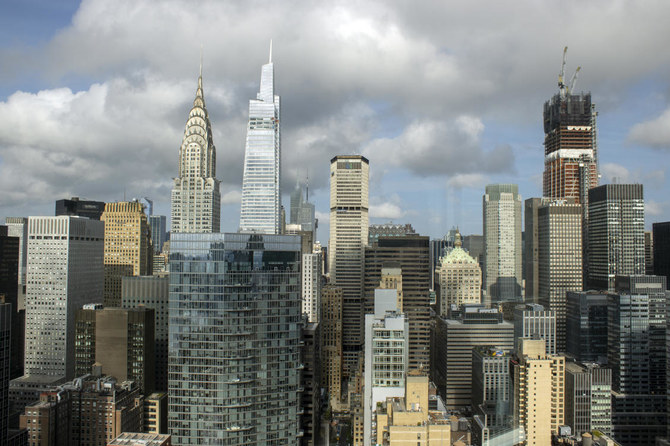
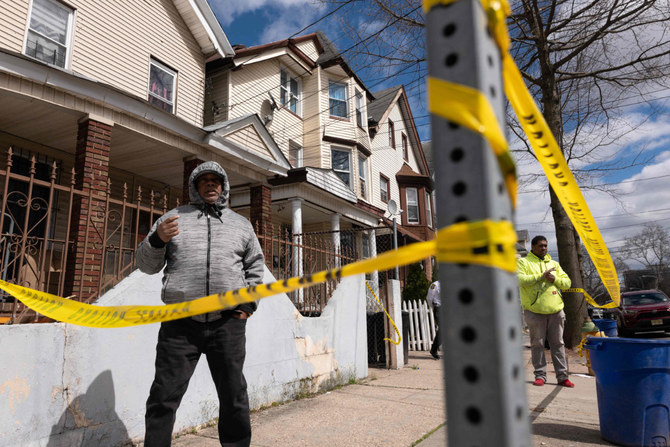

NEW YORK: An unusual East Coast earthquake shook millions of people from New York and Philadelphia skyscrapers to rural New England on Friday, causing no widespread damage but startling an area unaccustomed to temblors.
The US Geological Survey said over 42 million people might have felt the midmorning quake with a preliminary magnitude of 4.8, centered near Whitehouse Station, New Jersey, or about 45 miles (72 kilometers) west of New York City and 50 miles (80 kilometers) north of Philadelphia.
People from Baltimore to Boston and beyond felt the ground shake. Nearly 30 people were displaced when officials evacuated three multifamily homes in Newark, New Jersey, to check for damage. Officials around the region were inspecting bridges and other major infrastructure, some flights were diverted or delayed, Amtrak slowed trains throughout the busy Northeast Corridor, and a Philadelphia-area commuter rail line suspended service as a precaution.
Pictures and decorative plates tumbled off the wall in Christiann Thompson’s house near Whitehouse Station, she said, relaying what her husband had told her by phone as she volunteered at a library.
“The dogs lost their minds and got very terrified and ran around,” she said.
Whitehouse Station Fire Chief Tim Apgar said no injuries were reported, but responders fielded some calls from people who smelled gas. Nearby, the upper portion of the 264-year-old Col. John Taylor’s Grist Mill historic site collapsed onto a roadway, according to Readington Township Mayor Adam Mueller.
In a 26th-floor midtown Manhattan office, Shawn Clark felt the quake and initially feared an explosion or construction accident. It was “pretty weird and scary,” the attorney said.
Earthquakes are less common on the eastern than western edges of the US because the East Coast does not lie on a boundary of tectonic plates. But 13 earthquakes of magnitude 4.5 or stronger have been recorded since 1950 within 500 km (311 miles) of Friday’s tremblor, the USGS said. The strongest was a 5.8-magnitude quake in Mineral, Virginia, on Aug. 23, 2011, that jolted people from Georgia to Canada.
Rocks under the East Coast are better than their western counterparts at spreading earthquake energy across long distances, scientists note.
“If we had the same magnitude quake in California, it probably wouldn’t be felt nearly as far away,” said USGS geophysicist Paul Caruso.
Over a dozen aftershocks were reported in the ensuing hours in the region, including a 4.0-magnitude quake early Friday evening, according to the USGS.
A 4.8-magnitude quake isn’t large enough to cause damage, except for some minor effects near the epicenter, the agency posted on the social platform X. By comparison, the temblor that killed at least 12 people and injured more than 1,000 in Taiwan on Wednesday was variously measured at a magnitude of 7.2 or 7.4.
Still, Friday’s quake caused some disruption.
Flights to the New York, Newark and Baltimore airports were held at their origins for a time while officials inspected runways for cracks. The Seton Hall University men’s basketball team was delayed getting back to New Jersey from Indianapolis for a welcome-home celebration of the team’s National Invitational Tournament win Thursday.
At least five flights en route to Newark were diverted and landed at Lehigh Valley International Airport in Allentown, Pennsylvania, where some passengers rented cars to get home.
Traffic through the Holland Tunnel between Jersey City, New Jersey, and lower Manhattan was stopped for about 10 minutes for inspections, the Port Authority of New York and Jersey said.
In midtown Manhattan, motorists blared their horns on shuddering streets. Some Brooklyn residents heard a boom and felt their building shaking. Cellphone circuits were overloaded for a time as people tried to reach loved ones. Later, phones blared with earthquake-related notifications during the New York Philharmonic’s morning performance, where Anton Webern’s Six Pieces for Orchestra “literally ended with a cellphone alert,” said spokesperson Adam Crane.
At UN headquarters in New York, the shaking interrupted Save The Children’s chief executive, Janti Soeripto, as she briefed an emergency Security Council session on conditions in Gaza amid the Israel-Hamas war. In the Bronx, baseball’s Yankees were taking batting practice ahead of their home opener against the Toronto Blue Jays when the quake struck. Manager Aaron Boone later said he “thought it was the sound system booming.”
In New York City’s Astoria neighborhood, Cassondra Kurtz was giving her 14-year-old Chihuahua, Chiki, a cocoa-butter rubdown for her dry skin. Kurtz was recording the moment on video when her apartment started shaking hard enough that a large mirror banged audibly against a wall.
The video captured Kurtz looking around, perplexed. Chiki, however, “was completely unbothered.”
Friday’s quake was felt as far as Maine, where “it felt like the floor was almost doing the wave” in Meghan Hebert’s South Portland apartment. Some Vermont and New Hampshire residents initially figured it was snow falling off their roofs or plow trucks rumbling by. In

Hartford, Connecticut, paralegal Stacy Santa Cruz watched her computer screen shake.
Philadelphia high school student Ian Ventura took the quake as a sign of ominous times, coming between the Taiwan tremblor and Monday’s total solar eclipse in North America.
Scared for the world’s future, “I might take some risks, text this one girl,” said Ventura, 16. “I got the message typed out. I might send it.”
President Joe Biden said he spoke to New Jersey Gov. Phil Murphy about the earthquake. The White House said the administration would provide help if needed.
New York City had no indications of major safety or infrastructure problems from the earthquake, Mayor Eric Adams said. City Buildings Commissioner James Oddo said officials would watch for any delayed cracks or other effects on the Big Apple’s 1.1 million buildings.
Engineers said New York’s skyscrapers are made of high-strength materials and designed to sway slowly to withstand winds and other impacts. Modern high rises also have other features to help absorb any shock.
“High-rise buildings can be one of the safest places you can be in an earthquake,” said Ahmad Rahimian of the engineering firm WSP Global.
Meanwhile, even the delicately placed eggs that form part of a sculpture at a Chinatown art gallery stayed in place during Friday’s quake, to the relief of gallerist Kristen Thomas.


