

Iran’s Raisi vows response to Damascus consulate strike

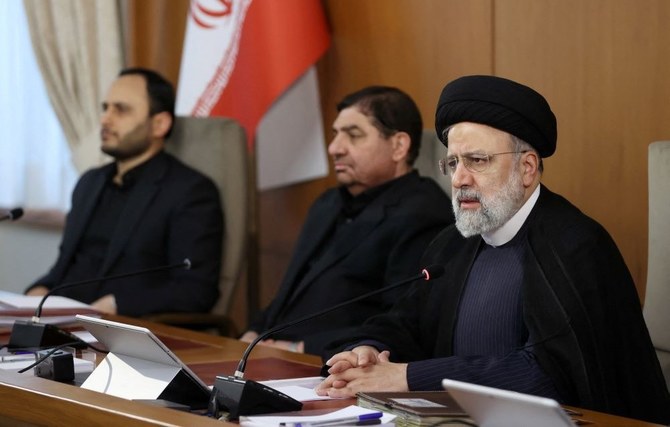
Iranian President Ebrahim Raisi during a cabinet meeting in Tehran, Iran, Apr. 2, 2024. (Reuters)
Short Url
Updated 04 April 2024
Follow

Iran’s Raisi vows response to Damascus consulate strike

  • Iranian President Ebrahim Raisi, speaking via video at a Hezbollah event in Beirut’s southern suburb, described the Israeli missile strike as ‘the pinnacle of failure and loss’
  • Raisi: ‘Washington is an inevitable partner in the Israeli crimes in Gaza. The attack on the Iranian consulate will receive a response from the brave resistance’

BEIRUT: Iran has vowed to respond to Israel’s attack on its Damascus consulate.

Iranian President Ebrahim Raisi, speaking via video at a Hezbollah event in Beirut’s southern suburb on Wednesday, described the Israeli missile strike as “the pinnacle of failure and loss.”

On the giant screen at the Jerusalem Day celebrations, Raisi added: “Washington is an inevitable partner in the Israeli crimes in Gaza. The attack on the Iranian consulate will receive a response from the brave resistance.”

The celebration saw speeches from Iran-backed movement leaders broadcast live through affiliated TV stations in Baghdad, Beirut, Tehran, Damascus and Sanaa.

Hamas political bureau chief Ismail Haniyeh said in his speech: “The occupation government is determined to continue the aggression against the Gaza Strip, and Netanyahu and those with him only care about remaining in their chairs for the longest period.”

He added: “We are adhering to our demands of a ceasefire, a comprehensive withdrawal from the Gaza Strip, the return of the displaced, the entry of aid, the reconstruction of the strip, the lifting of the siege and the conclusion of a prisoner exchange deal.”

Hassan Nasrallah, Hezbollah’s secretary general, condemned “the Israeli aggression that Syria is being exposed to,” adding that “Syria’s position in support of all resistance movements has not changed.”

He said: “What we need today is steadfastness, and to focus on the achievements that were achieved as a result of Operation Al-Aqsa Flood, and not focus on the losses.

“There are great sacrifices, yes, but there are great results and achievements, especially the strategic ones, which we must explain to the people through all platforms that support the path of the resistance.

“The enemy seeks to transform the image of the historical achievements of the resistance into an image of defeat by distorting the facts.”

Other speeches were delivered by the head of Yemen’s Houthi movement, Abdul-Malik Al-Houthi; the secretary-general of the Islamic Jihad movement in Palestine, Ziyad Al-Nakhalah; the secretary-general of the Iraqi Nujaba movement, Sheikh Akram Al-Kaabi; and Iraq’s Badr Organization and Fatah Alliance chief Hadi Al-Amiri.

Meanwhile, the Lebanese branch of the Islamic Jihad movement announced the killing of one of its members — Mohammad Abdulaziz Al-Rantisi, 32 — in southern Lebanon.

Battleground: Jerusalem
The biblical battle for the Holy City

Enter


keywords

Hundreds mourn in Syria’s Homs after deadly mosque bombing

Updated 27 December 2025
Follow

Hundreds mourn in Syria’s Homs after deadly mosque bombing

  • Officials have said the preliminary investigations indicate explosive devices were planted inside the mosque but have not yet publicly identified a suspect

HOMS: Hundreds of mourners gathered Saturday despite rain and cold outside of a mosque in the Syrian city of Homs where a bombing the day before killed eight people and wounded 18.

The crowd gathered next to the Imam Ali ibn Abi Talib Mosque in the Wadi Al-Dhahab neighborhood, where the population is predominantly from the Alawite minority, before driving in convoys to bury the victims.

Officials have said the preliminary investigations indicate explosive devices were planted inside the mosque but have not yet publicly identified a suspect.

A little-known group calling itself Saraya Ansar Al-Sunna claimed responsibility for the attack in a statement posted on its Telegram channel, in which it indicated that the attack intended to target members of the Alawite sect, an offshoot of Shia Islam whom hard-line Islamists consider to be apostates.

The same group had previously claimed a suicide attack in June in which a gunman opened fire and then detonated an explosive vest inside a Greek Orthodox church in Dweil’a, on the outskirts of Damascus, killing 25 people as worshippers prayed on a Sunday.

A neighbor of the mosque, who asked to be identified only by the honorific Abu Ahmad (“father of Ahmad“) out of security concerns, said he was at home when he heard the sound of a “very very strong explosion.”

He and other neighbors went to the mosque and saw terrified people running out of it, he said. They entered and began trying to help the wounded, amid blood and scattered body parts on the floor.

While the neighborhood is primarily Alawite, he said the mosque had always been open to members of all sects to pray.

“It’s the house of God,” he said. “The mosque’s door is open to everyone. No one ever asked questions. Whoever wants to enter can enter.”

Mourners were unable to enter the mosque to pray Saturday because the crime scene remained cordoned off, so they prayed outside.

Some then marched through the streets chanting “Ya Ali,” in reference to the Prophet Muhammad’s cousin and son-in-law whom Shiite Muslims consider to be his rightful successor.