

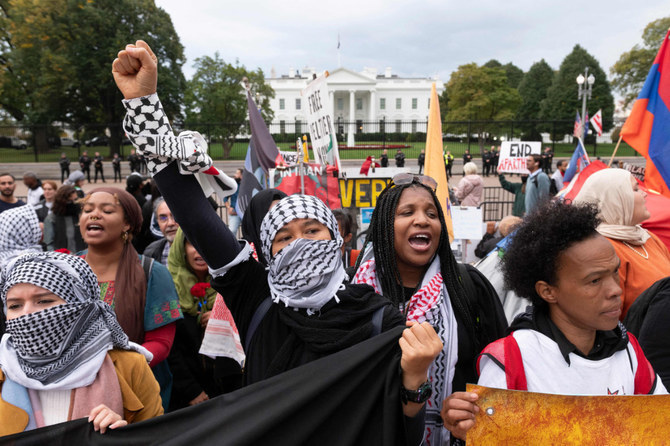

CHICAGO: Americans are seeing a significant uptick in discrimination against both the Jewish and Muslim communities, according to a survey by the PEW Research Center in Washington.
The survey, which was conducted in February and released this week, followed a separate study by PEW that explored American attitudes toward the Israel-Hamas war in Gaza. That showed that more younger Americans sympathized with the Palestinians, while more older Americans sympathized with Israel’s government.
PEW’s Associate Director Laura Silver said the two surveys showed that the Gaza war had not only fueled anti-Semitism and Islamophobia, but resulted in increased tensions between Jews and Muslims, with a measurable rise in blocking and unfriending on social media.
“When it comes to the share of Americans who say Jews face a lot of discrimination, the share who say this in the United States has doubled,” Silver told Arab News.
“Today, 40 percent say that, up from 20 percent who said the same in 2021. So, this is a pretty sharp increase.
“At the same time, we also see a somewhat larger share of Americans saying Muslims face a lot of discrimination. That is 44 percent and that is also up slightly, 5 percentage points since 2021, when 39 percent said the same. So, by and large, Americans perceive a fair bit of discrimination against Jews and Muslims and see this rising in society today.”
Silver said the survey showed that 70 percent of Muslims and 90 percent of Jews “say they have felt an increase in discrimination against their respective groups since the war began in October.”
An expert in international survey research, Silver said the surveys included how Americans were dealing with “permissible speech,” including speech opposing Israelis and Palestinians rights.
“We asked for examples about speech that opposes Israel’s right to exist as a Jewish state or speech that opposes Palestinians having their own state. And we see that actually large shares of Americans think this kind of speech should be allowed even if it offends others,” she said.
“But then there are limits to this. The vast majority of Americans don’t believe that violence against Jews or violence against Muslims should be allowed.
“You can say things that might offend others but you cannot call for violence seems to be how the majority of Americans feel.”
The survey also explores how people react to comments made on social media about the Israel-Hamas war.
“We find that there are large shares, particularly of Jews or Muslims, who feel offended by something they have either seen on the news or on social media,” Silver said.
“So, it is 74 percent of US Jews and 60 percent of US Muslims who felt offended by something they saw on the news or social media that they saw on the Israel-Hamas war. So that is large shares.”
Silver said that about 25 percent of Jews and Muslims acknowledged that they had cut off contacts with others because of anger over the conflict.
“About a quarter of both groups have stopped talking to someone or unfollowed or blocked someone because of something that they said about the war in particular. That is a high share of people who are offended to the point of cutting off ties,” Silver said.
“The Israel-Hamas war makes people, especially Jews and Muslims, feel more afraid, sad, angry and exhausted. Specifically, fear. A higher share of Jews and Muslims feel afraid when they receive news about the war than the general public.”
She continued: “A majority of Americans see that Israel has valid reasons for fighting the Israel-Hamas war, but many fewer are saying the way they are fighting is acceptable.
“When it comes to the acceptability in the way Israel is carrying out its response to Hamas’ Oct. 7 attack, 38 percent call it acceptable, 34 percent unacceptable and 26 percent not sure.
“So, a large majority say that Israel has a valid reason for fighting but many fewer call its tactics acceptable. The same is true when it comes to Hamas, though smaller shares say either it has valid reasons for fighting or that the tactics of Oct. 7 are acceptable. But there is a gap there where more see kind of the reason behind it as valid than say the way they attacked is acceptable.”
Silver said younger Americans differed from older Americans.
“Younger Americans are much more likely to say they have sympathies with the Palestinian people relative to the Israeli people. Much more likely to have positive views of the Palestinian people than the Israeli people. They have very negative views of the Israeli government.
“Americans by and large are much less supportive of providing military assistance to Israel than they are of providing humanitarian assistance to Gaza.”
The survey, which was conducted between Feb. 13-25 among a nationally representative sample of 12,693 adults, includes an oversample of American Jews and Muslims. It also probed the public’s views on the limits of free speech related to the war but allowed the views of Jewish and Muslim respondents to be analyzed separately.
You can view the latest survey of American attitudes on discrimination against Jews and Muslims posted on April 2 by clicking this link. You can view the PEW survey of American attitudes on the Israel-Hamas war posted on March 21 by clicking here.

keywords


