

Pakistan facing 30 percent water shortage for sowing season

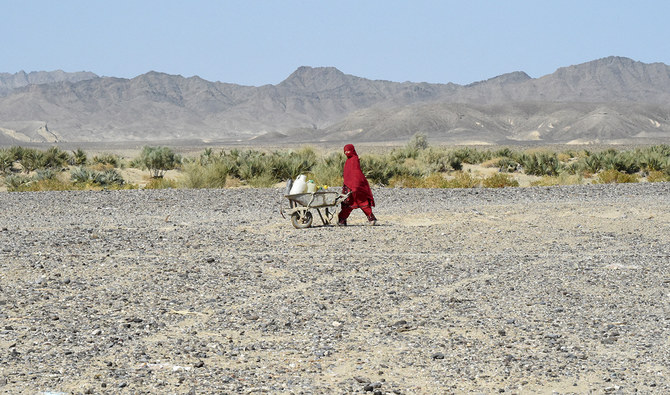
A woman carries water cans in a wheelbarrow at the Koh-e-Sabz area of Pakistan's south-west Baluchistan province where Iran launched an airstrike, on January 18, 2024. (AFP/File)
Short Url
Updated 03 April 2024
Follow

Pakistan facing 30 percent water shortage for sowing season

  • Authorities say gap due to lower-than-normal winter snowfall in Pakistan’s northern glacier region
  • Monsoon crops including rice, maize and cotton are sown in April, require heavy rainfall 

LAHORE: Pakistan is facing a 30 percent water shortage at the start of the sowing season for cash crops such as rice and cotton, the country’s water regulator said.

The Indus River System Authority (IRSA) said the gap is based on lower-than-normal winter snowfall in Pakistan’s northern glacier region, affecting catchment areas of the Indus and Jhelum Rivers that are used for irrigation.

Kharif crops, or monsoon crops, including rice, maize, sugarcane and cotton are sown in April and require a wet and warm climate with high levels of rainfall.

“There was less snow than normal as a result of climate change affecting the country’s glaciers,” Muhammad Azam Khan, assistant researcher with IRSA, which regulates the distribution of water resources along the Indus river, told AFP on Wednesday.

“This will have a direct impact on the availability of water for kharif crops in the summer.”

The water shortage gap is expected to narrow as the monsoon rains arrive later in the season.

However, the country’s meteorological department has also forecast higher than normal temperatures during monsoon season, increasing uncertainty.

Agriculture is the largest sector of Pakistan’s economy, contributing about 24 percent of its GDP.

But it has been criticized for being water inefficient.

“What this current water shortfall means for the crops is that authorities will have to better plan on how to utilize the water that is allotted to them,” said IRSA’s Khan.

Pakistan, the world’s fifth-largest country with a population of more than 250 million, has recently been grappling with the profound impacts of climate change which includes shifting and unpredictable weather patterns.

Devastating floods in 2022 — which scientists linked to climate change — that affected more than 30 million people also severely impacted Pakistan’s cotton crop that year.


Pakistan urges ‘time-bound and irreversible’ path to Palestinian statehood at UN

Updated 5 sec ago
Follow

Pakistan urges ‘time-bound and irreversible’ path to Palestinian statehood at UN

  • Pakistan warns the Security Council Israeli settlement expansion has reached its highest level in the West Bank
  • It says Islamabad backs sustained ceasefire, expanded humanitarian access, protection of UNRWA’s role in Gaza

ISLAMABAD: Pakistan on Tuesday called for a time-bound and irreversible political process leading to the establishment of a sovereign Palestinian state, urging the international community to move beyond declarations and turn long-standing commitments into concrete action.

Addressing a Security Council briefing on the Middle East, Pakistan’s ambassador to the United Nations said repeated diplomatic initiatives had underscored that the status quo was untenable and that only a credible political horizon, grounded in international law, could deliver durable peace.

His remarks came as the Security Council reviewed the implementation of Resolution 2334, which calls on Israel to halt settlement activity in occupied Palestinian territory.

Pakistan said recent diplomatic efforts — including a high-level conference in July and the General Assembly’s endorsement of the New York Declaration reaffirming the two-state framework — had sought to preserve the possibility of a negotiated settlement between Israelis and Palestinians.

It said follow-up meetings at Sharm El-Sheikh, along with US-led initiatives under President Donald Trump aimed at halting the fighting, were intended to reopen a political process toward Palestinian statehood.

“A time-bound and irreversible political process, anchored in relevant UN resolutions must lead to the establishment of a sovereign, independent and contiguous State of Palestine on the basis of pre-1967 borders, with Al-Quds Al-Sharif as its capital,” Pakistan’s Permanent Representative Asim Iftikhar Ahmad told the council.

“It is high time to turn promises into action and speed up this process,” he added.

Ahmad said Pakistan backed Security Council Resolution 2803, which calls for efforts to sustain the ceasefire, expand aid access and restart a political track toward Palestinian statehood.

He said settlement activity in the occupied West Bank, including East Jerusalem, had reached its highest levels since the United Nations began systematic monitoring, citing UN findings that more than 6,300 housing units were advanced during the reporting period.

Such actions, he said, had “no legal validity” under international law but continued to undermine the viability of the two-state solution.

Pakistan also defended the role of the UN Relief and Works Agency (UNRWA), saying it remained indispensable for Palestinian refugees and must not be weakened by what it called unfounded criticism.

Ahmad condemned the storming of UNRWA’s headquarters in East Jerusalem earlier this month, calling it a violation of international law and the inviolability of UN premises, and urged full, safe and unimpeded humanitarian access to Gaza, along with the immediate start of reconstruction without annexation or forced displacement.