

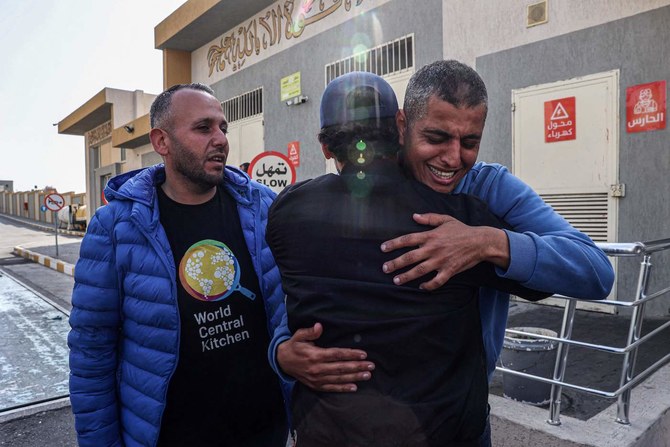

RAFAH, Gaza Strip: The bodies of six foreign aid workers killed in a series of Israeli strikes were transported out of the Gaza Strip and into Egypt on Wednesday ahead of their repatriation, Egypt’s state-run Qahera TV reported.
The deadly strikes have renewed criticism of Israel’s wartime conduct and highlighted the perilous conditions aid workers face in trying to deliver food to the besieged enclave, where experts say nearly a third of the population is on the brink of starvation.
The three British citizens, a Polish citizen, an Australian and a Canadian American dual citizen worked for World Central Kitchen, an international charity founded by celebrity chef José Andrés. Their Palestinian driver was also killed, and his remains were handed over to his family for burial in Gaza.
The other bodies were driven into Egypt through the Rafah crossing.
They were distributing food that had been brought into Gaza through a newly established maritime corridor late Monday when Israeli airstrikes targeted their three vehicles, killing everyone inside.
Israel said it carried out the strikes by mistake and that it has launched an independent investigation into how it happened.
Some of Israel’s closest allies, including the United States, condemned the deaths, which led the World Central Kitchen and other charities to suspend food deliveries to Palestinians on the brink of starvation, citing the dire security situation in Gaza.
Cyprus, which has played a key role in setting up the maritime corridor, said the ships that had arrived Monday were returning to the Mediterranean island nation with some 240 tons of undelivered aid. But it also said the sea deliveries would continue.
Israel faces growing isolation as international criticism of its Gaza assault has mounted. On the same day as the deadly airstrikes, Israel stirred more fears by apparently striking Iran’s consulate in Damascus and killing two Iranian generals. The government also moved to shut down a foreign media outlet — Qatari-owned Al Jazeera television.
The hit on the charity’s convoy also highlighted what critics have called Israel’s indiscriminate bombing and lack of regard for civilian casualties in Gaza.
In an op-ed published by Israel’s mass-circulation Yediot Ahronot newspaper on Wednesday, Andrés wrote that “the Israeli government needs to open land routes to food and medicine today. It needs to stop killing civilians and aid workers today.”
Andrés, whose organization has provided aid in war and disaster zones all over the world, including to Israelis after the Oct. 7 attack that triggered the war, said the strikes “were not just some unfortunate mistake in the fog of war.”
“It was a direct attack on clearly marked vehicles whose movements were known by the (Israeli military). It was also the direct result of (the Israeli) government’s policy to squeeze humanitarian aid to desperate levels,” Andrés wrote.
Israel has severely restricted access to northern Gaza, where experts say famine is imminent.
The deaths of the World Central Kitchen workers threatened to set back efforts by the US and other countries to open a maritime corridor for aid from Cyprus to help ease the desperate conditions in northern Gaza.
US President Joe Biden issued an unusually blunt criticism of Israel by its closest ally, suggesting that the incident demonstrated that Israel was not doing enough to protect civilians.
“Incidents like yesterday’s simply should not happen,” he said. “The United States has repeatedly urged Israel to deconflict their military operations against Hamas with humanitarian operations, in order to avoid civilian casualties.”
Israel’s military chief, Lt. Gen. Herzi Halevi, announced the results of a preliminary investigation early Wednesday.
“It was a mistake that followed a misidentification -– at night during a war in very complex conditions. It shouldn’t have happened,” he said. He gave no further details. He said an independent body would conduct a “thorough investigation” that would be completed in the coming days.
World Central Kitchen said it had coordinated with the Israeli military over the movement of its cars. Three vehicles moving at large distances apart were hit in succession. They were left incinerated and mangled, indicating multiple targeted strikes.
At least one of the vehicles had the charity’s logo printed across its roof to make it identifiable from the air, and the ordnance punched a large hole through the roof. A video showed the bodies at a hospital in the central Gaza town of Deir Al-Balah, several of them wearing protective gear with the charity’s logo.
Nearly 33,000 Palestinians have been killed in the war, around two-thirds of them women and children, according to Gaza’s Health Ministry, which does not distinguish between civilians and combatants in its count.
The war began when Hamas-led militants stormed into southern Israel in a surprise attack on Oct. 7, killing some 1,200 people and taking around 250 hostage. Israel responded with one of the deadliest and most destructive offensives in recent history.

keywords


