

Haramain railway transports over 1.3m visitors so far during Ramadan

1 / 2
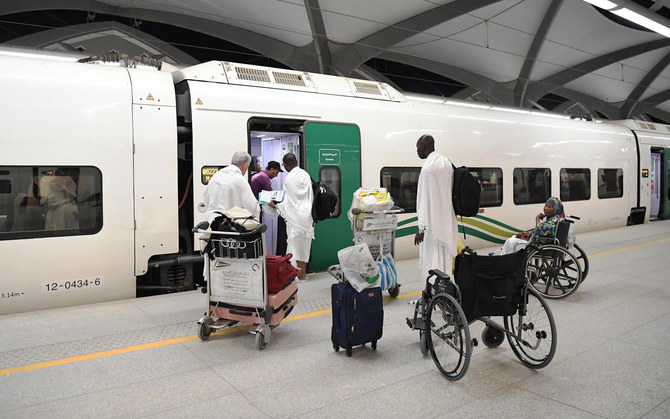
Passenger services are comprehensive, covering gate reception, reservation verification, guidance to waiting areas via escalators, and seamless transition to the train platform. (SPA photos)
2 / 2
Passenger services are comprehensive, covering gate reception, reservation verification, guidance to waiting areas via escalators, and seamless transition to the train platform. (SPA photos)
Short Url
Updated 03 April 2024
Follow

Haramain railway transports over 1.3m visitors so far during Ramadan

RIYADH: The Haramain High-Speed Railway has so far transported over 1.3 million visitors and Umrah performers during Ramadan, providing round-the-clock trips between Madinah and Makkah, the Saudi Press Agency reported.

Its purpose is to facilitate transportation for visitors, citizens and residents to participate in Umrah rituals and prayers at the Grand Mosque and the Prophet’s Mosque.

With strategically located stations in Makkah, Madinah, King Abdulaziz International Airport in Jeddah and King Abdullah Economic City in Rabigh, the Haramain High-Speed Railway is the largest transportation project in the Middle East.

Covering 450 km in approximately two hours at speeds of up to 300 kph, the electrically operated, emission-free train upholds the highest security and safety standards.

The process is managed by young Saudi specialists, from passenger reception and reservation verification to baggage procedures and direct boarding just minutes before departure. These specialists also ensure that the train adheres to its running schedule for punctuality.

Passenger services are comprehensive, covering gate reception, reservation verification, guidance to waiting areas via escalators, and seamless transition to the train platform.

Furthermore, station staff supervise security arrangements, ensure luggage safety, direct passengers to their designated seats, and assist individuals with disabilities by providing wheelchair access to designated seating areas.

To ensure a safe and convenient journey, onboard provisions — including food options and secure electronic payment methods — are provided throughout the trip. 


Hafez Galley’s exhibition pays tribute to two Egyptian artists who shaped a visual era

Both artists emerged in an era when newspapers and magazines played a central role in shaping Egypt’s visual culture. (Supplied)
Updated 6 sec ago
Follow

Hafez Galley’s exhibition pays tribute to two Egyptian artists who shaped a visual era

  • Artworks by Attyat Sayed and El Dessouki Fahmi will be on display until Feb. 28

JEDDAH: Hafez Gallery in Jeddah has opened an exhibition showcasing the works of influential Egyptian artists Attyat Sayed and El Dessouki Fahmi. The exhibition runs until Feb. 28.

Kenza Zouari, international art fairs manager at the gallery, said the exhibition offers important context for Saudi audiences who are becoming increasingly engaged with Arab art histories.

Artworks by Attyat Sayed and El Dessouki Fahmi will be on display at Hafez Gallery until Feb. 28. (Supplied)

“Attyat Sayed and El Dessouki Fahmi’s decades-long practice in Cairo established foundational models for how artists across the region approach archives, press, and ultimately collective memory,” Zouari told Arab News. 

Both artists emerged in an era when newspapers and magazines played a central role in shaping Egypt’s visual culture. Their early work in press illustration “demanded speed, clarity, the ability to distill complex realities into a single, charged image,” the gallery’s website states.

Seeing the works of both artists side-by-side is breathtaking. It’s fascinating to witness how press illustration shaped such profound and lasting artistic voices.

Lina Al-Mutairi, Local art enthusias

Heba El-Moaz, director of artist liaison at Hafez Gallery, said that this is the second time that the exhibition — a posthumous tribute to the artists —has been shown, following its debut in Cairo.

“By placing their works side by side, it highlights how press illustration, often considered ephemeral, became a formative ground for artistic depth, narrative power, and lasting influence, while revealing two distinct yet deeply interconnected artistic paths within modern Egyptian visual culture,” she told Arab News. 

Artworks by Attyat Sayed and El Dessouki Fahmi will be on display at Hafez Gallery until Feb. 28. (Supplied)

Sayed’s work evolved from black-and-white illustration into “layered, dynamic compositions that translate lived emotion into physical gesture, echoing an ongoing negotiation between the inner world and its outward form,” the website states. Viewed together, the works of Sayed and Fahmi “reveal two distinct yet deeply interconnected artistic paths that contributed significantly to modern Egyptian visual culture.”

The exhibition “invites visitors into a compelling dialogue between instinct and intellect, emotion and structure, spontaneity and reflection; highlighting how artistic rigor, cultural memory, and sustained creative exploration were transformed into enduring visual languages that continue to resonate beyond their time,” the gallery states.

Lina Al-Mutairi, a Jeddah-based art enthusiast, said: “Seeing the works of both artists side-by-side is breathtaking. It’s fascinating to witness how press illustration shaped such profound and lasting artistic voices. The exhibition really brings their vision and influence to life.”