


BEIRUT: Tensions continued to rise in southern Lebanon on Tuesday amid ongoing clashes between the Israeli army and Hezbollah. Residents of areas along the border with Israel were bracing themselves for a possible escalation of hostilities following an Israeli attack on the Iranian Consulate in the Syrian capital, Damascus, on Monday that killed seven senior members of the Islamic Revolutionary Guard Corps.
The regime in Tehran responded with threats of retaliation, while Israeli officials, including Defense Minister Yoav Gallant, warned “the price of any operation against us will be high.”
Meanwhile, the activities of the UN’s Interim Force in Lebanon and ceasefire observers have been suspended in southern Lebanon for three days after a military vehicle belonging to the international force was hit by an artillery attack near the town of Rmeish in the central sector. Lebanon blamed Israel for the attack, in which three observers and a Lebanese translator were injured.
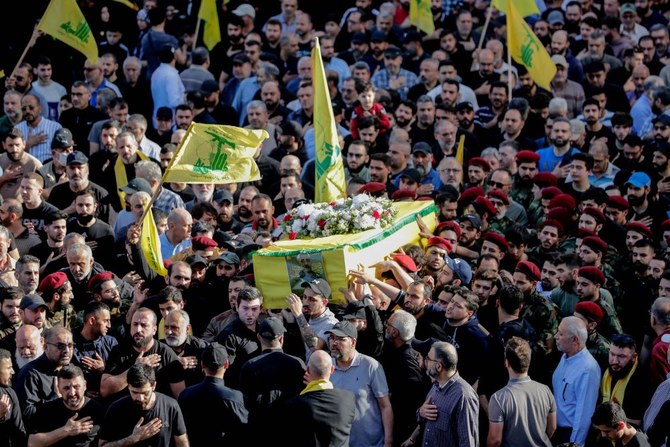
On Tuesday morning, two shells fired by Israeli forces struck the town of Khiam. Hezbollah said that one of its members, Hassan Reda Youssef, a resident of the town who was born in 1986, was killed in the attack.
Israeli forces stationed near the Blue Line, the UN’s line of demarcation between Lebanon and Israel, targeted the main street between the border towns of Ramieh and Marwahin with heavy machine-gun fire to reduce activity on the streets and prevent residents from entering border areas.
The Israeli military also used heavy artillery to attack areas on the outskirts of several towns, including Naqoura, Jabal Al-Labouneh, Alma Al-Shaab, Tayr Harfa, Al-Dhahira and Aita Al-Shaab.
Hezbollah said its forces had “targeted a gathering of enemy soldiers at a site in Al-Malikiyah with missile weapons and successfully hit them.”
In an unprecedented step, Hezbollah also announced that the International Committee to Commemorate Jerusalem Day will hold a public event on Wednesday in Ghobeiry, in Beirut’s southern suburbs.
The group said “leaders of the resistance axis” will give speeches during the event, including Hezbollah Secretary-General Hassan Nasrallah; the head of the Hamas political bureau, Ismail Haniyeh; the leader of the Islamic Jihad movement in Palestine, Ziad Nakhla; Houthi leader Abdul-Malik Al-Houthi; Iranian President Ibrahim Raisi; and, on behalf of the Iraqi resistance, Hadi Al-Amiri.
“The speeches will be broadcast simultaneously in Palestine, Lebanon, Syria, Iraq, Yemen and Iran,” Hezbollah said.
A political analyst told Arab News: “Iran was dealt a severe blow (by the attack on its consulate in Syria) and this event, which will be shown on screens on Wednesday, is meant to help Iran absorb this blow.
“The high level of interest in this event suggests that the military response has been delayed. The current reaction is focused on politics, mobilization and information.”
He noted that there was no indication that a representative of the Syrian regime would speak at the event, which raised doubts about the political stance of officials in Damascus.
Regarding the situation in Lebanon along its border with Israel, the analyst said: “It is true that the southern Lebanese front is witnessing tensions but it has not seen an escalation of hostilities during recent days.
“This is because Israel is carrying out targeted killings, using precise information, to weaken its enemy without giving them a chance to retaliate in the same way. The embarrassment occurring is great; it is hard (for Hezbollah) to respond — but it is also hard not to respond.”
According to Israeli newspaper Yedioth Ahronoth, Gallant, the defense minister, took part in “deliberations with officials in the Israeli army’s Home Front Command to discuss plans for the media campaign that the army is preparing to launch in case the ongoing border confrontations with Hezbollah escalate. There is growing concern about the expansion of the conflict between Israel and Iran as a result of the Damascus attack on Monday.”


