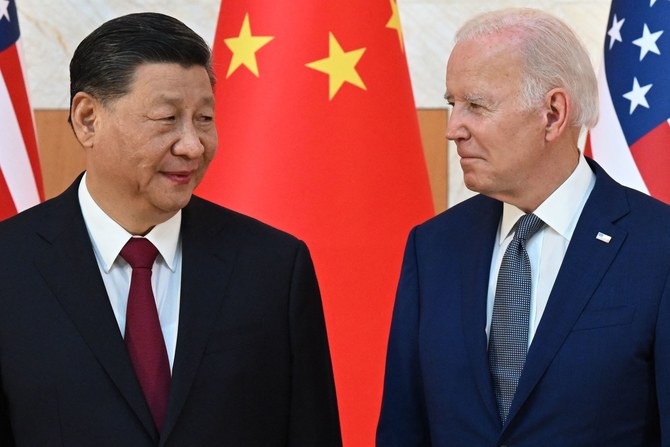
WASHINGTON: President Joe Biden and Chinese President Xi Jinping discussed Taiwan, artificial intelligence and security issues Tuesday in a call meant to demonstrate a return to regular leader-to-leader dialogue between the two powers.
The call, described by the White House as “candid and constructive,” was the leaders’ first conversation since their November summit in California produced renewed ties between the two nations’ militaries and a promise of enhanced cooperation on stemming the flow of deadly fentanyl and its precursors from China.
The call also kicks off several weeks of high-level engagements between the two countries, with Treasury Secretary Janet Yellen set to travel to China on Thursday and Secretary of State Antony Blinken to follow in the weeks ahead.
Biden has pressed for sustained interactions at all levels of government, believing it is key to keeping competition between the two massive economies and nuclear-armed powers from escalating to direct conflict. While in-person summits take place perhaps once a year, officials said, both Washington and Beijing recognize the value of more frequent engagements between the leaders.
Xi told Biden that the two countries should adhere to the bottom line of “no clash, no confrontation” as one of the principles for this year.
“We should prioritize stability, not provoke troubles, not cross lines but maintain the overall stability of China-US relations,” Xi said, according to China Central Television, the state broadcaster.
The two leaders discussed Taiwan ahead of next month’s inauguration of Lai Ching-te, the island’s president-elect, who has vowed to safeguard its de-facto independence from China and further align it with other democracies. Biden reaffirmed the United States’ longstanding “One China” policy and reiterated that the US opposes any coercive means to bring Taiwan under Beijing’s control. China considers Taiwan a domestic matter and has vigorously protested US support for the island.
Taiwan remains the “first red line not to be crossed,” Xi told Biden, and emphasized that Beijing will not tolerate separatist activities by Taiwan’s independence forces as well as “exterior indulgence and support,” which alluded to Washington’s support for the island.
Biden also raised concerns about China’s operations in the South China Sea, including efforts last month to impede the Philippines, which the US is treaty-obligated to defend, from resupplying its forces on the disputed Second Thomas Shoal.
Next week, Biden will host Philippines President Ferdinand Marcos Jr. and Japanese Prime Minister Fumio Kishida at the White House for a joint summit where China’s influence in the region was set to be top of the agenda.
Biden, in the call with Xi, pressed China to do more to meet its commitments to halt the flow of illegal narcotics and to schedule additional precursor chemicals to prevent their export. The pledge was made at the leaders’ summit held in Woodside, California, last year on the margins of the Asia-Pacific Economic Cooperation meeting.
At the November summit, Biden and Xi also agreed that their governments would hold formal talks on the promises and risks of advanced artificial intelligence, which are set to take place in the coming weeks. The pair touched on the issue on Tuesday just two weeks after China and the US joined more than 120 other nations in backing a resolution at the United Nations calling for global safeguards around the emerging technology.
Biden, in the call, reinforced warnings to Xi against interfering in the 2024 elections in the US as well as against continued malicious cyberattacks against critical American infrastructure, according to a senior US administration official who previewed the call on the condition of anonymity.
He also raised concerns about human rights in China, including Hong Kong’s new restrictive national security law and its treatment of minority groups, and he raised the plight of Americans detained in or barred from leaving China.
The Democratic president also pressed China over its defense relationship with Russia, which is seeking to rebuild its industrial base as it presses forward with its invasion of Ukraine. And he called on Beijing to wield its influence over North Korea to rein in the isolated and erratic nuclear power.
As the leaders of the world’s two largest economies, Biden also raised concerns with Xi over China’s “unfair economic practices,” the official said, and reasserted that the US would take steps to preserve its security and economic interests, including by continuing to limit the transfer of some advanced technology to China.
Xi complained that the US has taken more measures to suppress China’s economy, trade and technology in the past several months and that the list of sanctioned Chinese companies has become ever longer, which is “not derisking but creating risks,” according to the broadcaster.
The call came ahead of Yellen’s visit to Guangzhou and Beijing for a week of bilateral meetings on the subject with finance leaders from the world’s second largest economy — including Vice Premier He Lifeng, Chinese Central Bank Gov. Pan Gongsheng, former Vice Premier Liu He, American businesses and local leaders.
An advisory for the upcoming trip states that Yellen “will advocate for American workers and businesses to ensure they are treated fairly, including by pressing Chinese counterparts on unfair trade practices.”
It follows Xi’s meeting in Beijing with US business leaders last week, when he emphasized the mutually beneficial economic ties between the two countries and urged people-to-people exchange to maintain the relationship.
Xi told the Americans that the two countries have stayed communicative and “made progress” on issues such as trade, anti-narcotics and climate change since he met with Biden in November. Last week’s high-profile meeting was seen as Beijing’s effort to stabilize bilateral relations.
Ahead of her trip to China, Yellen last week said that Beijing is flooding the market with green energy that “distorts global prices.” She said she intends to share her beliefs with her counterparts that Beijing’s increased production of solar energy, electric vehicles and lithium-ion batteries poses risks to productivity and growth to the global economy.
US lawmakers’ renewed angst over Chinese ownership of the popular social media app TikTok has generated new legislation that would ban TikTok if its China-based owner ByteDance doesn’t sell its stakes in the platform within six months of the bill’s enactment.
As chair of the Committee on Foreign Investment in the US, which reviews foreign ownership of firms in the US, Yellen has ample leeway to determine how the company could remain operating in the US
Meanwhile, China’s leaders have set a goal of 5 percent economic growth this year despite a slowdown exacerbated by troubles in the property sector and the lingering effects of strict anti-virus measures during the COVID-19 pandemic that disrupted travel, logistics, manufacturing and other industries.
China is the dominant player in batteries for electric vehicles and has a rapidly expanding auto industry that could challenge the world’s established carmakers as it goes global.
The US last year outlined plans to limit EV buyers from claiming tax credits if they purchase cars containing battery materials from China and other countries that are considered hostile to the United States. Separately, the Department of Commerce launched an investigation into the potential national security risks posed by Chinese car exports to the US.


![]()

Biden and Xi discuss Taiwan, AI and fentanyl in a push to return to regular leader talks
Short Url
https://arab.news/np4w7
Biden and Xi discuss Taiwan, AI and fentanyl in a push to return to regular leader talks
- The call, described by the White House as “candid and constructive,” was the leaders’ first conversation since their November summit in California


Latest updates


© 2026 SAUDI RESEARCH & PUBLISHING COMPANY, All Rights Reserved And subject to Terms of Use Agreement.