

Northwestern Pakistani province works on monsoon contingency plan after rains kill 10 people

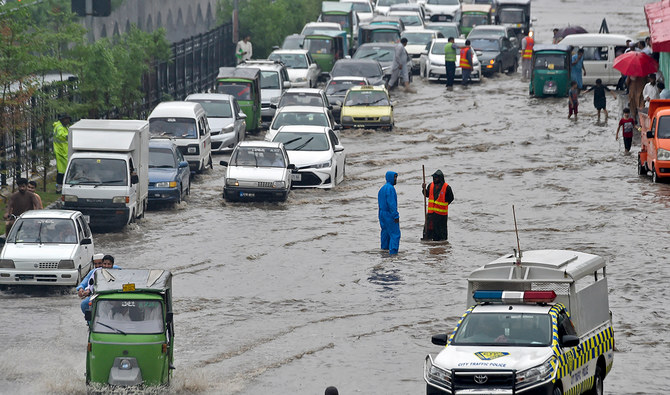
Commuters make their way through a flooded street after a heavy rain shower in Peshawar on August 17, 2022. (AFP/File)
Short Url
Updated 02 April 2024
Follow

Northwestern Pakistani province works on monsoon contingency plan after rains kill 10 people

  • The casualties occurred last week, when heavy rains and hailstorms lashed the Khyber Pakhtunkhwa province for days
  • In 2022, monsoon rains triggered most devastating floods in Pakistan, killing 1,700 people and affecting another 33 million

ISLAMABAD: Authorities in Pakistan’s northwestern Khyber Pakhtunkhwa (KP) province are working on a monsoon contingency plan for this year, the provincial disaster management authority (PDMA) said on Tuesday, days after torrential rains killed at least 10 people in the province. 

The casualties occurred in Shangla, Bannu, Bajaur, Peshawar, Swat and other districts as heavy rains and hailstorms lashed the northwestern province from March 29 till March 31.

Pakistan has been facing a range of climate-related challenges and is considered one of the top 10 places in the world most vulnerable to erratic weather patterns.

To preempt any monsoon-related disasters, the PDMA said it had embarked on a “comprehensive” contingency plan for this year.

“The plan aims to engage all relevant stakeholders in identifying potential hazards, vulnerabilities, and risks associated with the monsoon season,” it said in a statement.

“By mapping available resources, the authorities seek to minimize disaster risks and ensure a well-coordinated response to any emergencies that may arise.”

Pakistan produces less than one percent of the world’s carbon footprint but, according to the Global Climate Risk Index, has lost nearly ten thousand lives and suffered economic losses worth $3.8 billion due to climate change throughout the years 1999 to 2018.

In 2022, torrential monsoon rains triggered the most devastating floods in Pakistan’s history, killing around 1,700 people. Over 33 million people were affected by the floodwaters — a staggering number close to the population of Canada. Millions of homes, tens of thousands of schools as well as thousands of kilometers of roads and railways still need to be rebuilt.


Pakistan PM leaves for Saudi Arabia on brief visit as Middle East crisis rages on

Updated 10 sec ago
Follow

Pakistan PM leaves for Saudi Arabia on brief visit as Middle East crisis rages on

  • The visit comes at a time of increased volatility in the region, following US-Israeli strikes on Iran and Tehran’s counterattacks
  • Sharif and Crown Prince Mohammed will discuss the ongoing tensions, regional security and bilateral relations, Sharif’s office says

ISLAMABAD: Pakistan’s Prime Minister Shehbaz Sharif on Thursday departed for Saudi Arabia on a brief, hours-long visit, his office said, amid an ongoing conflict in the Middle East.

The visit comes at a time of increased volatility in the region, following Unites States-Israeli strikes on Iran and Tehran’s counterattacks on US bases in several Gulf countries as well as commercial and oil infrastructure, raising the spectre of a wider war.

Sharif, expected to discuss regional security and diplomatic coordination with Saudi leaders, is visiting the Kingdom on the invitation of Crown Prince Mohammed bin Salman, according to the prime minister’s office.

“Sharif will meet His Highness Prince Mohammed bin Salman,” the former’s office said.

“The meeting between the two leaders will discuss the ongoing tensions in the region, the regional security situation and the bilateral relations between the two countries.”

The development came a day after Bloomberg, citing comments from Sharif’s spokesperson, reported that Pakistan is ready to support Saudi Arabia “no matter what” as tensions escalate across the Middle East following Iranian strikes on Gulf states.

Mosharraf Zaidi told Bloomberg TV Islamabad would come to Riyadh’s aid whenever required, emphasizing the longstanding security partnership between the two countries, which was further strengthened by a mutual defense pact signed in September last year.

There was “no question we might, we will” come to Saudi Arabia’s aid “no matter what and no matter when,” Zaidi said.

“Both countries, even before the defense agreement, have always operated on the principle of being there for the other,” he added.

Pakistan and Saudi Arabia have historically maintained close military and strategic ties, and the new agreement elevated their security cooperation at a time of heightened regional instability.

Zaidi said Pakistan was also working diplomatically to prevent the conflict from expanding further across the region.