

Amid row over Iran pipeline, Pakistan says has ‘right’ to buy gas from neighbors 

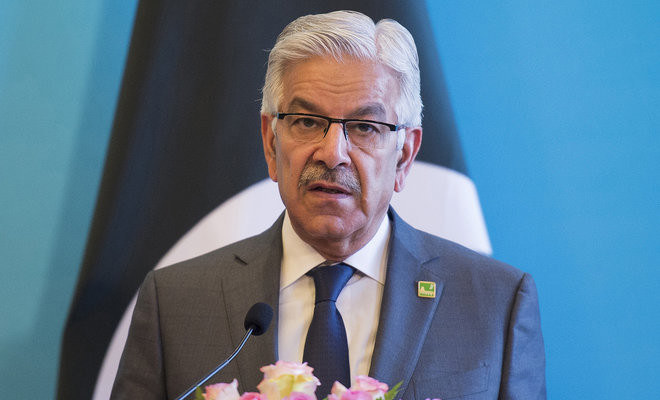
In this file photo, Pakistan's Foreign Minister Khawaja Muhammad Asif speaks during a joint press conference with China's Foreign Minister Wang Yi and Afghanistan's Foreign Minister Salahuddin Rabbani after the first China-Afghanistan-Pakistan Foreign Ministers' Dialogue in Beijing on Dec. 26, 2017. (AFP/File)
Short Url
Updated 02 April 2024
Follow

Amid row over Iran pipeline, Pakistan says has ‘right’ to buy gas from neighbors 

  • Defense Minister says US should give Pakistan alternative for cheaper gas if it opposes pipeline from Iran 
  • Pakistan and Iran pipeline project has for years faced delays, funding challenges and threat of US sanctions 

ISLAMABAD: Defense Minister Khawaja Muhammad Asif this week responded to Washington’s criticism of the Iran-Pakistan gas pipeline project, saying it was the South Asian country’s right to buy gas at competitive rates from neighboring countries considering its economic crisis. 

The Pakistan-Iran gas pipeline, known as the Peace Pipeline, is a long-term project between Tehran and Islamabad that has faced delays and funding challenges for several years. The pipeline would transport natural gas from Iran to neighboring Pakistan.

Last week, the US said it did not support the pipeline project going forward and cautioned about the risk of sanctions in doing business with Tehran. Petroleum Minister Musadik Malik said last month Pakistan was seeking a US sanctions waiver for the project.

“If America tells us not to take gas from Iran and sanctions will be imposed on us, then it should also give us an alternative,” Asif told reporters on Monday. 

“If a neighbor is giving us gas at competitive rates then it is our right [to buy it],” he said. “America should view all these things in the context of our economic situation.”

Pakistan has pursued the pipeline as a way of alleviating severe energy shortages that have crippled its economy but the cash-strapped country also needs billions of dollars in aid from the US. 

On February 23, Pakistan approved the construction of a part of the pipeline amid fears of a potential $18 billion penalty for failing to complete the project on time.

India, unlike Pakistan, quit the project in 2009, citing costs and security issues — a year after it signed a nuclear deal with Washington. 

Pakistan, for its part, has made little progress on its section of the line for lack of funds and warnings it could be in violation of US sanctions on Iran, which sits on the world’s largest reserves of gas. Iran has spent hundreds of millions of dollars and nearly completed the 900-km (560 mile) pipeline to the Pakistan border


Pakistan, global crypto exchange discuss modernizing digital payments, creating job prospects 

Updated 05 December 2025
Follow

Pakistan, global crypto exchange discuss modernizing digital payments, creating job prospects 

  • Pakistani officials, Binance team discuss coordination between Islamabad, local banks and global exchanges
  • Pakistan has attempted to tap into growing crypto market to curb illicit transactions, improve oversight

ISLAMABAD: Pakistan’s finance officials and the team of a global cryptocurrency exchange on Friday held discussions aimed at modernizing the country’s digital payments system and building local talent pipelines to meet rising demand for blockchain and Web3 skills, the finance ministry said.

The development took place during a high-level meeting between Finance Minister Muhammad Aurangzeb, Pakistan Virtual Assets Regulatory Authority (PVARA) Chairman Bilal bin Saqib, domestic bank presidents and a Binance team led by Global CEO Richard Teng. The meeting was held to advance work on Pakistan’s National Digital Asset Framework, a regulatory setup to govern Pakistan’s digital assets.

Pakistan has been moving to regulate its fast-growing crypto and digital assets market by bringing virtual asset service providers (VASPs) under a formal licensing regime. Officials say the push is aimed at curbing illicit transactions, improving oversight, and encouraging innovation in blockchain-based financial services.

“Participants reviewed opportunities to modernize Pakistan’s digital payments landscape, noting that blockchain-based systems could significantly reduce costs from the country’s $38 billion annual remittance flows,” the finance ministry said in a statement. 

“Discussions also emphasized building local talent pipelines to meet rising global demand for blockchain and Web3 skills, creating high-value employment prospects for Pakistani youth.”

Blockchain is a type of digital database that is shared, transparent and tamper-resistant. Instead of being stored on one computer, the data is kept on a distributed network of computers, making it very hard to alter or hack.

Web3 refers to the next generation of the Internet built using blockchain, focusing on giving users more control over their data, identity and digital assets rather than big tech companies controlling it.

Participants of the meeting also discussed sovereign debt tokenization, which is the process of converting a country’s debt such as government bonds, into digital tokens on a blockchain, the ministry said. 

Aurangzeb called for close coordination between the government, domestic banks and global exchanges to modernize Pakistan’s payment landscape.

Participants of the meeting also discussed considering a “time-bound amnesty” to encourage users to move assets onto regulated platforms, stressing the need for stronger verifications and a risk-mitigation system.

Pakistan has attempted in recent months to tap into the country’s growing crypto market, crack down on money laundering and terror financing, and promote responsible innovation — a move analysts say could bring an estimated $25 billion in virtual assets into the tax net.

In September, Islamabad invited international crypto exchanges and other VASPs to apply for licenses to operate in the country, a step aimed at formalizing and regulating its fast-growing digital market.