

Pak-Saudi fast-food chain offers taste of Middle East with shawarma and mandi

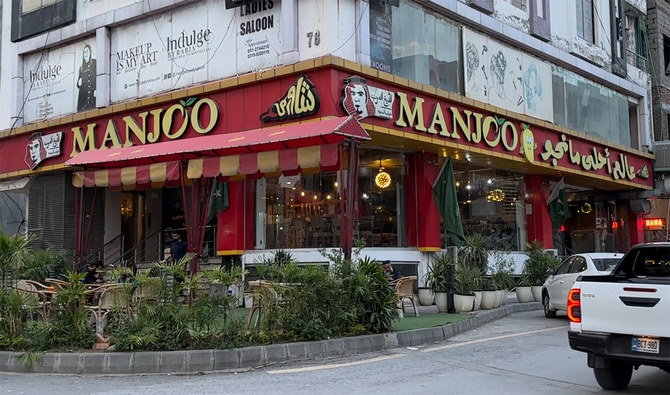
The picture taken on March 28, 2024 shows “Manjoo” Arab restaurant in Rawalpindi, Pakistan. (AN photo)
Short Url
Updated 02 April 2024
Follow

Pak-Saudi fast-food chain offers taste of Middle East with shawarma and mandi

  • First branch of Manjoo set up by Pakistani family in Saudi Arabia in 2009, Rawalpindi branch opened in 2020
  • Owner credits popularity of restaurant to growing taste for Middle Eastern food in Pakistan

RAWALPINDI: Waiters prepared shawarma platters inside the bustling kitchen while eager customers waited to collect their orders in the dining room outside, surrounded by the aroma of skewered meat and spicy rice. 

This is the scene at the “Manjoo” fast food chain, set up four years ago in Rawalpindi by two Pakistani brothers who grew up in Saudi Arabia and opened the restaurant’s first branch in the Kingdom in 2009.

Some of the popular dishes on the menu are shawarmas, seasoned meat and condiments served on pita bread, a meat and spicy rice dish called mandi and fatayer, which are small, triangular-shaped pastries filled with spinach, cheese, meat, or a combination.

Sheikh Tahir, one of the brothers who set up the Rawalpindi branch, said his family moved to Saudi Arabia before he was born and set up various businesses there, including automobile showrooms and mobile phone shops.

“We had other businesses there [in Saudi Arabia] but [younger generation] always wanted to open a restaurant,” Tahir told Arab News. 

That dream materialized in 2009 when the family opened its first Manjoo branch in Madinah. 

One branch grew to five across Saudi Arabia, before the family decided to open a branch and a food truck in Pakistan.

But what does Manjoo mean and why this name specifically?

“Manjoo means mango in Arabic,” Tahir explained, saying Saudi mangoes were cherished fruits available throughout the year.

“In 2009, before we opened the restaurant, we randomly chose this name, and it quickly gained fame.” 

Tahir’s family was skeptical at first whether a restaurant that offered food from the Middle East would be a hit in Pakistan. But the response from customers had been “overwhelming,” the owner said, which he credited to a growing taste for Middle Eastern cuisine in Pakistan.

“Earlier, people in Pakistan were not acquainted to Arab food but now many such restaurants have opened up,” Tahir said.

“And this food is liked by the people because it’s light and has very few spices.”

To ensure the restaurant does not lose its authentic taste, Tahir even brings in chefs from Saudi Arabia. And the customers love it. 

“I come here at least twice a week,” customer Ali Fayaz told Arab News. “Having spent a lot of time in Saudi Arabia and other Arab countries, my taste buds are accustomed to their cuisine.”

Another customer Syed Noman Sarwar praised the restaurant, which his family had been visiting for over three years, for maintaining consistency in taste and quality. 

“I have tried KFC, McDonald’s,” he said, “but nothing compares to the taste of Manjoo.”


Pakistan vaccinates over 44.6 million in final anti-polio drive of 2025

Updated 5 sec ago
Follow

Pakistan vaccinates over 44.6 million in final anti-polio drive of 2025

  • Pakistan has reported 30 polio cases so far this year, underscoring fragile progress against virus
  • Pakistan and Afghanistan are the only two countries in the world where polio remains endemic

ISLAMABAD: Pakistan has vaccinated 44.6 million children against poliovirus in the last nationwide immunization campaign of the year, health authorities said on Monday.

The seven-day anti-polio campaign was launched on Dec. 15, targeting children under the age of five. It was conducted simultaneously in Pakistan and Afghanistan, according to Pakistan’s National Emergency Operations Center (NEOC), which oversees eradication efforts.

Pakistan and neighboring Afghanistan are the only two countries where transmission of the wild poliovirus has never been interrupted, posing a risk to global eradication efforts. The virus, which can cause irreversible paralysis, has no cure and can only be prevented through repeated oral vaccination.

“The final National Polio Eradication Campaign of 2025 has been successfully concluded,” the EOC said in a statement. “During the national polio campaign, vaccination of more than 44.6 million children was successfully completed.”

Giving a breakdown of the numbers, the EOC said approximately 22.9 million children have received polio drops in Pakistan’s eastern Punjab province, around 10.6 million in Sindh, more than 7.1 million in the northwestern Khyber Pakhtunkhwa (KP) province and more than 2.54 million children in Balochistan. 

In Pakistan’s capital Islamabad, over 450,000 children received polio drops while in the northern Gilgit-Baltistan region, approximately 274,000 children have been vaccinated, the NEOC said. 

In Azad Jammu & Kashmir, over 714,000 children received polio drops.

Pakistan has reported 30 polio cases so far in 2025, underscoring the fragility of progress against the virus. The country recorded 74 cases in 2024, a sharp increase from six cases in 2023, reflecting setbacks linked to vaccine hesitancy, misinformation and access challenges in high-risk areas.

Health officials say insecurity remains a major obstacle. Polio workers and their security escorts have repeatedly been targeted in militant attacks, particularly in parts of Khyber Pakhtunkhwa and Balochistan, complicating efforts to reach every child.

A gun attack targeting a polio vaccination team in Pakistan’s northwestern Bajaur district on Dec. 16 left one police constableand a civilian dead. 

Natural disasters, including flooding, have also disrupted vaccination campaigns in recent years.

“Polio workers and security personnel who served during the national campaign are the true heroes of the nation,” the EOC said.